

There is a particular kind of exhaustion that comes from an anxious mind. It is not the tiredness of physical effort, but the fatigue of a mind that will not stop moving — replaying conversations, rehearsing worst-case scenarios, scanning for threats that may never arrive. If you have felt this, you are far from alone. Anxiety has become one of the most searched, most discussed, and most widely experienced mental health struggles in the world today, and for good reason: modern life gives the nervous system very few opportunities to rest.
At our ashram in Rishikesh, we have watched students arrive carrying exactly this kind of tension in their shoulders, their jaw, their breath. And we have watched, over days and weeks of practice, something shift — not overnight, and not as a cure, but as a genuine, teachable process of calming an overactive nervous system.
This article looks closely at that process. Not in vague, feel-good language, but in terms of what is actually happening in your body and mind when you practice yoga — combining what modern science understands about stress with what traditional yoga has taught about the mind for thousands of years.
A brief but important note before we begin: yoga is a powerful support for anxiety, but it is not a replacement for professional mental health care. If anxiety is significantly affecting your daily life, please consider speaking with a doctor or therapist alongside anything you learn here.
Also Read: Life After the 200-Hour Yoga Teacher Training: What's Next?
What Anxiety Actually Does to the Body
Anxiety is often described as if it lives only in the mind, but anyone who has experienced it knows this isn't quite true. Anxiety is deeply physical. A racing heart. Shallow, high breathing. Tight shoulders. A stomach that will not settle. Restlessness that makes it hard to sit still.
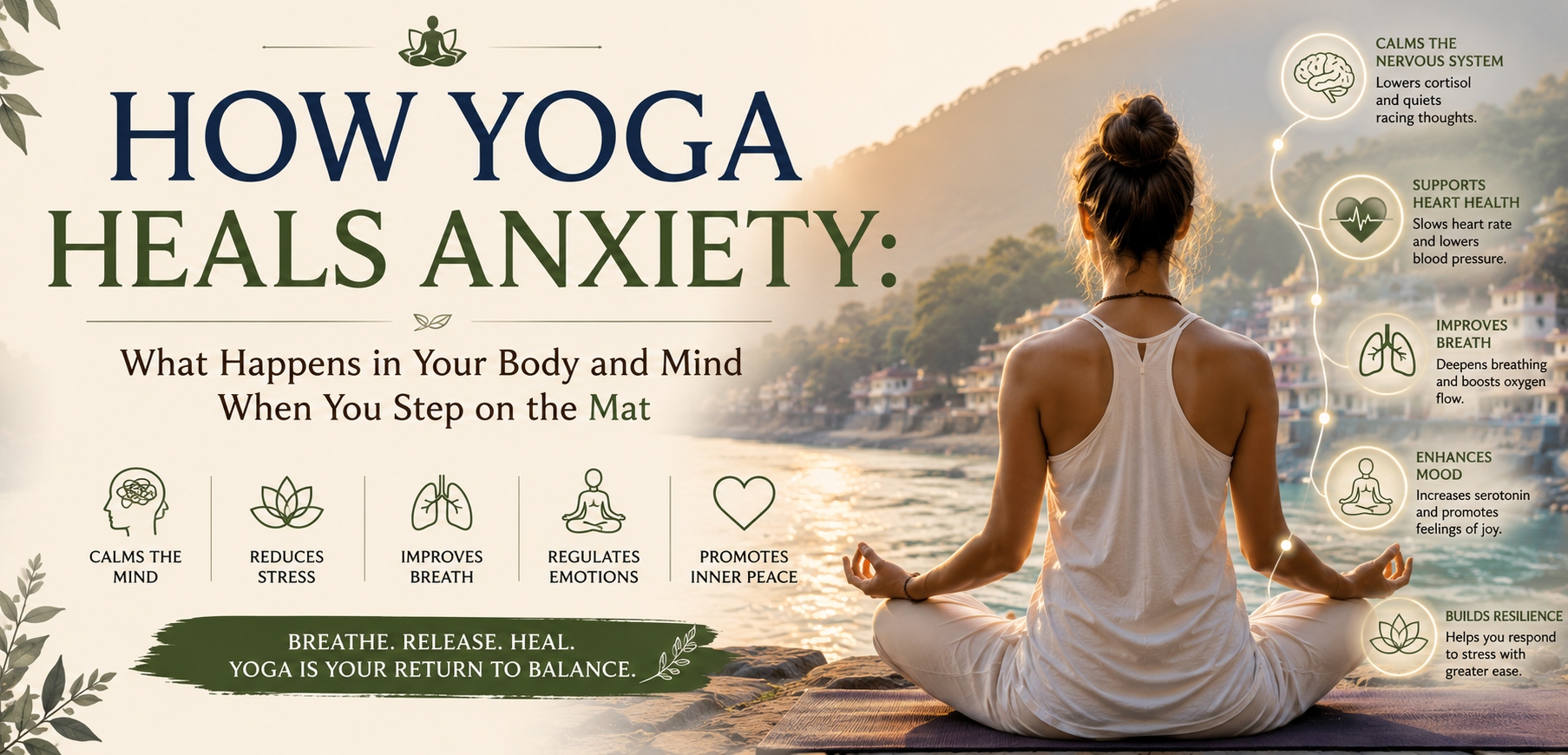
This happens because anxiety activates the body's stress response — sometimes called the "fight or flight" response. When your brain perceives a threat, real or imagined, it signals the sympathetic nervous system to prepare your body for danger. Your heart rate increases to pump more blood to your muscles. Your breathing becomes quick and shallow to take in more oxygen. Stress hormones like cortisol and adrenaline flood your system. Digestion slows. Muscles tense, ready to act.
This response is ancient and, in the right context, useful — it is what allowed our ancestors to react quickly to real physical danger. The problem is that in modern life, this same system activates in response to emails, deadlines, social situations, and racing thoughts, none of which require you to physically run or fight. The body prepares for a danger that never fully resolves, and over time, this creates the chronic, exhausting state we call anxiety.
Understanding this matters because it reframes anxiety not as a personal failing or a purely mental problem, but as a physiological state — one that can be directly and deliberately influenced through the body. This is precisely where yoga becomes relevant.
Also Read: 7 Stages of Kundalini Awakening: Yoga Basis Guide
The Nervous System Shift: How Yoga Counters the Stress Response
Your nervous system has a natural counterbalance to the "fight or flight" sympathetic response: the parasympathetic nervous system, sometimes called the "rest and digest" state. When this system is active, your heart rate slows, your breathing deepens, digestion resumes normally, and your muscles begin to release tension.
Yoga is, in many ways, a direct technology for activating this parasympathetic state. Through slow, deliberate breathing, gentle sustained movement, and stillness, a yoga practice sends clear signals to your nervous system that you are safe — that there is no threat requiring readiness or escape.
One of the key mechanisms behind this shift involves the vagus nerve, a long nerve that runs from the brainstem through the body and plays a central role in regulating the parasympathetic response. Certain yoga practices — particularly slow breathing, humming or chanting, and specific postures — are understood to stimulate the vagus nerve, helping to calm the body more quickly and effectively than most people realize is possible through such simple means.
This is not a mystical claim. It is a fairly well-supported physiological process, and it is one reason why a slow, breath-centered yoga practice tends to be far more effective for anxiety than a fast-paced, high-intensity one. The goal is not to exhaust the body, but to signal safety to the nervous system.
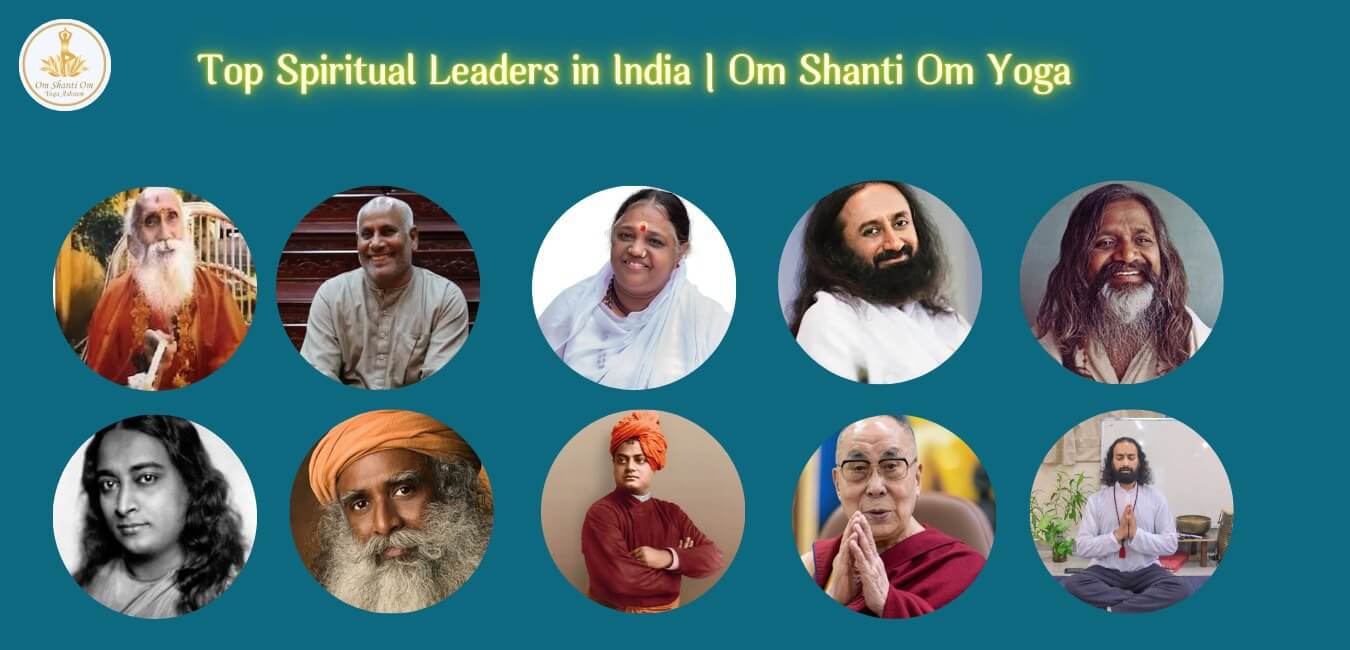
Also Read: Top Spiritual Leaders in India - Guiding Souls Toward Inner Peace
The Breath Connection: Why Pranayama Matters More Than Poses
If there is one single element of yoga most responsible for its calming effect, it is the breath. In traditional teaching, breath — prana — is understood as the direct bridge between body and mind. You cannot easily control your thoughts or emotions by willpower alone, but you can control your breath, and through your breath, you can influence your emotional state.
This is not simply traditional wisdom; it reflects a real physiological loop. Rapid, shallow breathing signals danger to the brain, reinforcing anxiety. Slow, deep breathing signals safety, helping to calm the very system that created the anxious feeling in the first place. This is why breathing techniques are often more immediately effective for anxiety than physical postures alone.
A few beginner-friendly breathing practices, traditionally taught for calming the mind, include:
Slow diaphragmatic breathing. Breathing deeply into the belly rather than shallowly into the chest, with an exhale slightly longer than the inhale. A longer exhale in particular helps activate the parasympathetic response.
Alternate nostril breathing (Nadi Shodhana). A gentle technique of breathing through one nostril at a time, traditionally taught to balance and settle the mind. Many beginners find it surprisingly calming within just a few rounds.
Box breathing. Inhaling for a count of four, holding for four, exhaling for four, and holding again for four — a simple, structured pattern that gives an anxious mind something steady to focus on.
None of these require any physical flexibility or prior experience. They can be practiced sitting in a chair, lying down, or even during a stressful moment at your desk.
Also Read: Hatha Yoga vs. Vinyasa Yoga: Understanding the Differences
What Happens in the Mind: Yoga as Mental Training
Beyond its physiological effects, yoga also works on anxiety at the level of the mind itself, through a quieter but equally important mechanism: attention.
Anxiety, by its nature, pulls attention into the future — toward what might happen, what could go wrong, what needs to be controlled. A regular yoga practice, by contrast, repeatedly draws attention back into the present moment: the sensation of the breath, the feeling of a stretch, the effort of holding a posture, the sound of the room.
This repeated return to the present is a form of mental training. Over time, it strengthens what researchers call interoception — your awareness of internal bodily sensations. Increased interoception has been linked to a greater capacity to notice anxiety as it begins to rise, rather than being swept into it unaware. In simpler terms, yoga can help you catch anxious tension earlier, before it spirals, because you become more attuned to your own body's signals.
Yoga can also interrupt rumination — the repetitive, circular thinking that fuels anxiety. Because postures and breath require a degree of ongoing attention, they naturally compete with the mind's tendency to loop through anxious thoughts. This is part of why yoga is sometimes described as a form of "moving meditation": it trains the same attentional muscles as seated meditation, but through a medium that many beginners find more accessible.
Also Read: A Beginner’s Guide to Hatha Yoga: Everything You Need to Know
The Traditional View: An Old Solution to an Old Problem
It is tempting to think of "yoga for anxiety" as a modern discovery, born from recent scientific studies on stress and the nervous system. But traditional yoga has been addressing this exact challenge for thousands of years, simply using different language.
In the Yoga Sutras, the sage Patanjali describes the fluctuations of the mind — vrittis — as the central obstacle to peace and clarity. An anxious, restless mind, unable to settle, is not a new phenomenon; it is one of the oldest problems yoga was designed to address. The entire structure of traditional practice — ethical grounding, breath control, physical steadiness, withdrawal from overstimulation, concentration, and meditation — can be understood as a systematic method for calming exactly this kind of mental disturbance.
This is part of what makes traditional teaching so valuable for something like anxiety. Rather than offering a single technique in isolation, it offers a complete, tested framework — refined across generations of teachers and students — for working with a restless mind. What is marketed today as "yoga for anxiety" is, in many ways, simply yoga, understood in its fuller and original sense.
Also Read: Qualities of a Good Yoga Teachers
Specific Practices for Anxiety Relief
For beginners looking for a practical starting point, here are a few gentle, accessible practices traditionally used to calm anxiety. None require advanced flexibility or strength.
Child's Pose (Balasana). A resting posture that gently compresses the abdomen, encouraging deeper breathing, while offering a physical sense of safety and containment.
Legs-Up-the-Wall (Viparita Karani). A deeply restorative posture, simply lying with your legs resting up against a wall. This gentle inversion is widely used to calm the nervous system and ease restlessness.
Seated Forward Fold (Paschimottanasana). A gentle forward bend that encourages introspection and a slower breath rate, often felt as calming and grounding.
Cat-Cow (Marjaryasana-Bitilasana). A slow, flowing movement synchronized with breath, useful for releasing tension held in the spine and shoulders — common places where anxiety physically accumulates.
A short seated meditation. Even three to five minutes of quiet, breath-focused sitting after physical practice can meaningfully deepen its calming effect.
A note on approach: consistency matters far more than intensity. A gentle ten-minute practice done daily will generally do more for anxiety than an occasional, longer session. Anxiety responds well to reliability and repetition — the nervous system learns safety through repeated experience, not a single powerful session.
Also Read: The Different Schools of Yoga
Building a Simple Daily Routine
You do not need an elaborate practice to begin experiencing yoga's calming effects. Here is a simple sequence, taking roughly ten to fifteen minutes, suitable for complete beginners:
- Two minutes of slow diaphragmatic breathing, seated comfortably, focusing on a slightly longer exhale than inhale.
- Five to eight rounds of Cat-Cow, moving slowly with the breath.
- One to two minutes in Child's Pose, breathing deeply into the back and sides of the body.
- Three to five minutes in Legs-Up-the-Wall, allowing the body to fully settle.
- Two to three minutes of quiet seated stillness, simply observing the breath without trying to change it.
Practiced regularly — ideally daily, even briefly — this kind of routine can become a genuine anchor for a nervous system that spends much of the day in a heightened state.
A Note on Realistic Expectations
It's worth being honest here: yoga is not a cure for anxiety, and it does not replace the support of a mental health professional when that support is needed. What a consistent yoga practice does offer is a set of real, physiologically grounded tools — breathwork, movement, and attention training — that can meaningfully ease the intensity and frequency of anxious states over time, alongside whatever other support you need.
If you are experiencing anxiety that significantly disrupts your daily life, sleep, relationships, or wellbeing, please consider reaching out to a doctor or licensed therapist. Yoga can be a genuinely valuable companion on that path — but it works best as part of a broader approach to your mental health, not as a stand-alone solution.
Also Read: Is Rishikesh Safe for Solo Female Travelers Doing Yoga Teacher Training?
Conclusion
The connection between yoga and anxiety relief is not simply anecdotal or trendy — it is rooted in real, observable shifts in the nervous system, supported by thousands of years of traditional practice that identified and addressed a restless mind long before modern science had language for cortisol or the vagus nerve.
When you step onto the mat, you are not just stretching your body. You are actively signaling safety to your nervous system, training your attention to stay present, and drawing on a tradition that has helped calm anxious minds for generations, long before "anxiety" was a word anyone searched online.
Start small. Breathe slowly. Return to the mat, even briefly, as often as you can. The calm you are looking for is not somewhere far away — traditional yoga teaches that it is already within you, simply waiting to be uncovered through steady, patient practice.






0 Comments
No comments yet. Be the first to comment!