


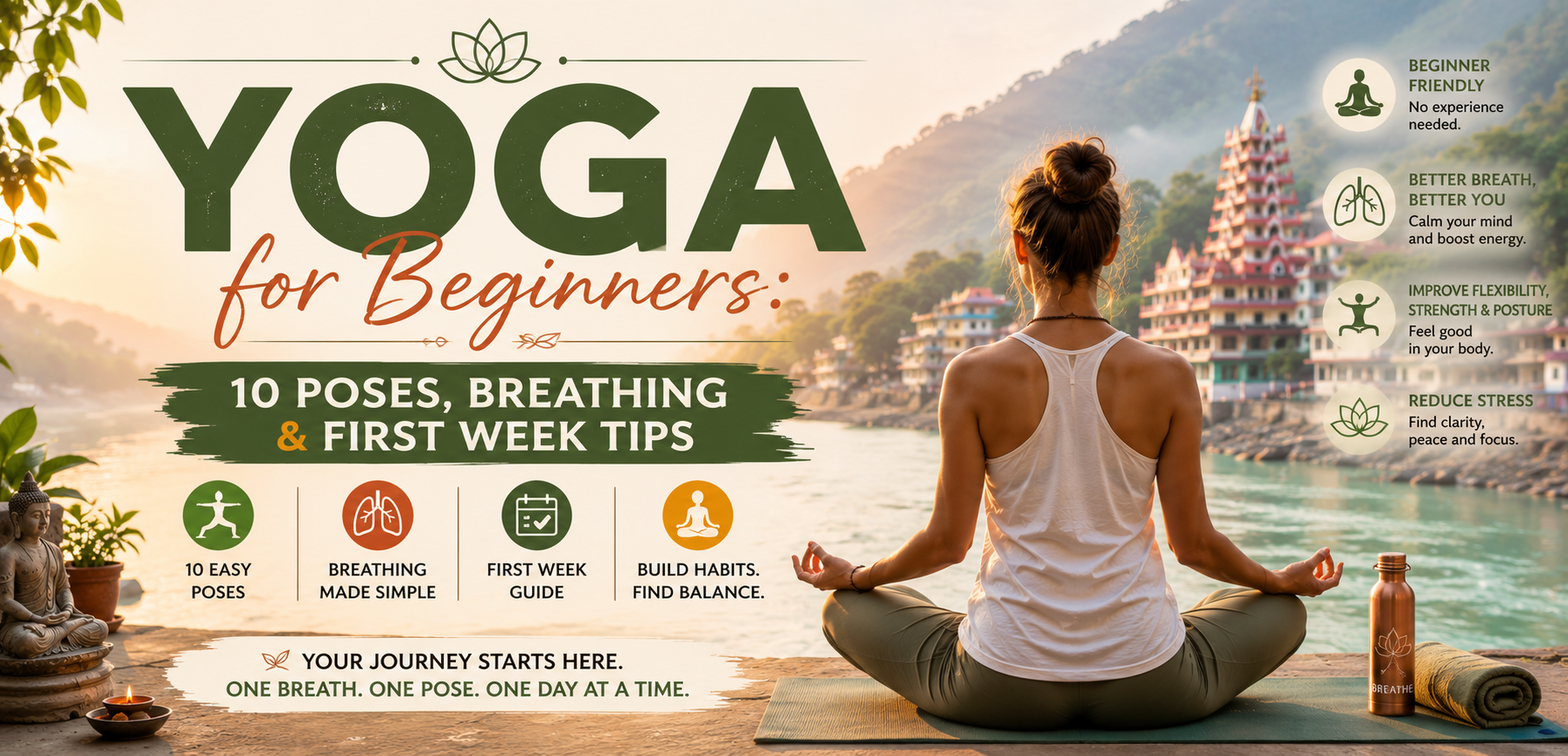
If you have ever stood at the edge of a yoga class, or hovered over the "start" button on a beginner video, wondering whether you are flexible enough, fit enough, or "yoga enough" to begin — take a breath. You are not alone, and more importantly, you are not behind.
Every person who has ever practiced yoga, including the most experienced teachers in Rishikesh ashrams, started exactly where you are right now: as a complete beginner, unsure of what to do with their hands, wondering if they were breathing correctly, and definitely unable to touch their toes.
This guide is designed to remove that uncertainty. You'll learn the breathing basics that everything else builds on, ten essential poses that form a genuine foundation for practice, and a realistic picture of what your first week will actually feel like — soreness, awkwardness, small wins, and all.
Before You Start: What You Actually Need
One of the biggest myths keeping beginners from starting is the idea that yoga requires expensive gear, a studio membership, or a certain body type. None of this is true.
Equipment. At minimum, you need a mat and comfortable clothing that allows you to move freely. That's genuinely it. Traditional yoga was practiced on simple mats or cloths laid on the ground, and that simplicity still works perfectly well today.
Space. You don't need a dedicated yoga room. A quiet corner with enough space to stretch your arms and legs out fully in every direction is enough.
Mindset. This matters more than any equipment. Yoga is not a performance, and it is not a competition with the person next to you, the influencer on your screen, or even your own past self. It is a practice — meaning it is meant to be done imperfectly, repeatedly, and without judgment. Letting go of the need to "get it right" immediately is, in many ways, the first real lesson of yoga.
Timing. Many traditional teachers recommend practicing in the early morning, when the mind is naturally quieter and the body is fresh. That said, the best time to practice is genuinely whatever time you will actually do it consistently. A slightly-less-ideal time that you stick to beats a perfect time you keep postponing.
Breathing Basics Every Beginner Should Know
In traditional yoga, breath comes before posture. This might feel backwards if you've mainly seen yoga presented as a physical workout, but breath is truly the foundation everything else is built on.
Here's why: your breath is directly connected to your nervous system. Fast, shallow breathing signals stress to your brain. Slow, deep breathing signals calm and safety. This means your breath is one of the few bodily functions you can consciously control to directly influence how you feel — which is exactly why it's the starting point of yoga practice, not an afterthought.
Diaphragmatic (belly) breathing is the single most important breathing skill for a beginner to learn. Most people, especially when stressed, breathe shallowly into the chest. Diaphragmatic breathing means breathing deeply into the belly instead.
To practice it: sit or lie down comfortably. Place one hand on your belly. Inhale slowly through your nose, allowing your belly to rise under your hand. Exhale slowly, allowing your belly to fall. Aim for your exhale to be slightly longer than your inhale — this small detail helps activate a calming response in your body.
Practice this for just two or three minutes before you begin any poses. It sounds almost too simple to matter, but this single habit changes the quality of your entire practice, and it's the same principle beginners are taught on their very first day in a traditional ashram setting.
Also Read: How Yoga Heals Anxiety: What Happens in Your Body & Mind
The 10 Essential Poses for Beginners
These ten poses form a genuine foundation for a yoga practice — not because they are the easiest ten poses that exist, but because together, they build strength, flexibility, balance, and body awareness in a well-rounded way. None require prior flexibility or experience.
1. Mountain Pose (Tadasana)
Stand tall with feet hip-width apart, weight evenly distributed, shoulders relaxed away from your ears. What it does: Teaches proper alignment and grounding — the foundation for every standing pose. Common mistake: Locking the knees too tightly. Keep a soft micro-bend instead.
2. Child's Pose (Balasana)
Kneel, then fold your torso forward over your thighs, arms extended or resting alongside your body. What it does: A resting pose that gently stretches the back and hips while calming the nervous system. Common mistake: Forcing the hips toward the heels if that feels tight. Let comfort guide the depth.
3. Cat-Cow (Marjaryasana-Bitilasana)
On hands and knees, alternate between arching your back (Cow) and rounding it (Cat), moving slowly with your breath. What it does: Warms up and mobilizes the spine — a gentle way to begin any practice. Common mistake: Moving too fast. Let each movement match one full inhale or exhale.
4. Downward-Facing Dog (Adho Mukha Svanasana)
From hands and knees, lift your hips up and back, forming an inverted V-shape with your body. What it does: Stretches the hamstrings, calves, and shoulders while building overall strength. Common mistake: Keeping the legs perfectly straight. Bend the knees generously if your hamstrings feel tight — it's still the correct pose.
5. Forward Fold (Uttanasana)
Standing, hinge at the hips and fold forward, letting your head and arms hang, knees softly bent. What it does: Stretches the back body and has a naturally calming, introspective effect. Common mistake: Rounding the lower back aggressively to reach the floor. A bent knee with a longer spine is far more valuable than straight legs with a rounded back.
6. Cobra Pose (Bhujangasana)
Lying face down, place your hands under your shoulders and gently lift your chest, keeping elbows slightly bent. What it does: A gentle backbend that strengthens the spine and opens the chest. Common mistake: Overusing the arms to push up high. The lift should come primarily from the back muscles, with a low, gentle arch.
7. Warrior I or II (Virabhadrasana I/II)
A strong lunge-based standing pose, with arms extended (Warrior II) or raised overhead (Warrior I). What it does: Builds leg strength, stability, and stamina. Common mistake: Letting the front knee collapse inward. Keep it tracking over the ankle.
8. Tree Pose (Vrikshasana)
Standing on one leg, place the sole of the other foot against your inner calf or thigh (never directly on the knee), hands at heart center or overhead. What it does: Builds balance and mental focus. Common mistake: Expecting perfect stillness right away. Wobbling is completely normal and is, in itself, part of the training.
9. Seated Forward Bend (Paschimottanasana)
Sitting with legs extended, hinge forward from the hips, reaching toward your feet. What it does: Stretches the entire back body and encourages a quiet, inward focus. Common mistake: Rounding excessively to reach the toes. It's far better to keep a long spine and fold only as far as that allows.
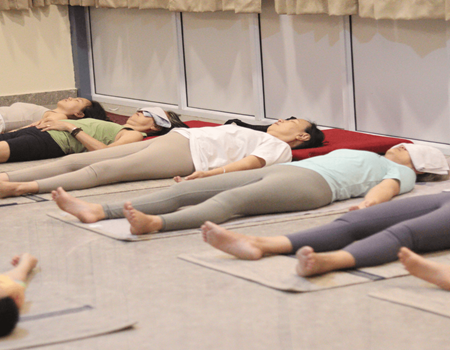
10. Corpse Pose (Savasana)
Lying flat on your back, arms relaxed by your sides, eyes closed, body completely still. What it does: Integrates the effects of your practice and shifts the body into deep relaxation. Common mistake: Skipping it because it "looks easy" or feels unproductive. Traditional teachers often consider this one of the most important poses in the entire sequence — true stillness is a skill.
A simple beginner sequence might move through these poses in the order listed, holding each for five to eight slow breaths, finishing with several minutes in Savasana.
Also Read: What Is Yoga Really? A Beginner's Guide from a Traditional Rishikesh Ashram
What to Expect in Your First Week
Knowing what's normal can make an enormous difference in whether you stick with a new practice. Here's a realistic picture of what your first week of yoga might actually feel like.
Days 1–2: Awkwardness and mild soreness. Your body is learning new movement patterns, and some muscle soreness — particularly in the hips, shoulders, and hamstrings — is completely normal. Your mind may also feel restless or easily distracted during breathing exercises. This is not a sign you're doing it wrong; it's simply what beginning anything new feels like.
Days 3–4: Small improvements become noticeable. Poses that felt impossible on day one often start to feel slightly more familiar, even if not easier. You may notice a small pause of calm during Savasana that wasn't there before.
Days 5–6: Motivation may dip. This is extremely common and worth naming directly. The initial novelty fades, and consistency starts to require more intention than excitement. This is exactly the point where many beginners quit — and exactly the point where sticking with even a short, imperfect practice matters most.
Day 7: A shift in perspective. By the end of the first week, many beginners report not so much physical transformation, but a subtle mental shift — a slightly greater sense of body awareness, a few moments of genuine calm, or simply pride in having shown up consistently.
Common beginner worries are worth normalizing here too: "I can't touch my toes" — very few beginners can, and it is not the goal. "I keep losing my balance in Tree Pose" — wobbling is part of building balance, not a failure of it. "My mind won't stop wandering during breathing exercises" — this happens to experienced practitioners too; noticing the wandering and gently returning your attention is the actual practice, not a distraction from it.
Also Read: How to Choose a Yoga Teacher Training in Rishikesh: 10 Questions to Ask
Common Beginner Mistakes to Avoid
Comparing yourself to others. Whether in a class or on social media, comparing your beginner practice to someone else's years of experience is both unfair to yourself and beside the point. Yoga is not a competitive activity.
Skipping the breath and rushing through poses. It can be tempting to move quickly through a sequence, especially if you're short on time. But rushing bypasses the very thing that makes yoga distinct from ordinary stretching — the conscious connection between breath and movement.
Overstretching or ignoring pain signals. There is a meaningful difference between the sensation of a stretch and actual pain. Discomfort that feels like effort is normal; sharp or pinching pain is a signal to ease back immediately.
Practicing inconsistently, then giving up too early. A short practice done consistently will always outperform an occasional long one. If you can only manage ten minutes some days, ten minutes is enough — showing up matters more than duration.
How Far You Can Take This Practice
What starts as ten poses and a few minutes of breathing can, over time, become something much deeper. Many long-term practitioners — including teachers now living and teaching within traditional lineages — began exactly this way: unsure, a little sore, and simply curious enough to keep coming back.
As your practice deepens, you may find yourself drawn not just to more poses, but to the philosophy, breathwork, and meditation practices that sit behind them — the fuller picture of yoga beyond the physical postures. If that curiosity grows, structured learning under real, experienced teachers, whether through deeper courses or immersive training, is often the natural next step. There's no rush to get there. For now, the only thing that matters is beginning.
Also Read: What Makes a World-Class Yoga Teacher Training? 7 Things to Look for in 2026
Conclusion
Yoga is genuinely accessible to anyone willing to start, regardless of flexibility, fitness level, age, or prior experience. You don't need to master all ten poses in this guide today, and you certainly don't need to have your first week go smoothly to be "doing it right."
All you need to begin is a few minutes, a little floor space, and a willingness to breathe deeply and move slowly. Start with the breath. Try one pose. See how it feels. The rest of the practice — however far you eventually choose to take it — will unfold from there.










0 Comments
No comments yet. Be the first to comment!