

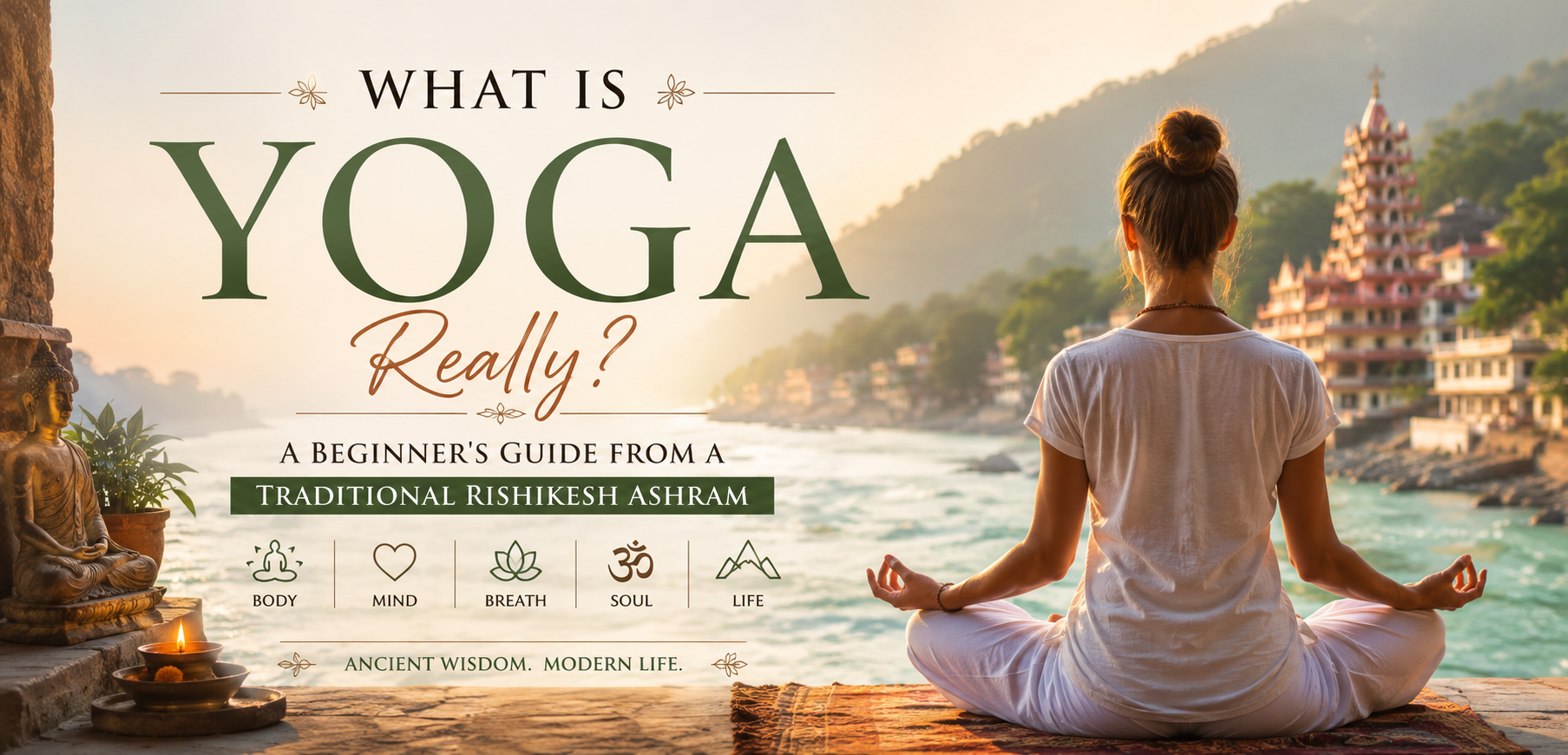
If you ask ten different people what yoga is, you will probably get ten different answers. For some, it is a fitness class squeezed between work meetings. For others, it is an Instagram photo on a beach at sunrise. And for many beginners walking into a studio for the first time, it is simply "that stretching thing."
Here in Rishikesh, on the banks of the Ganges, where yoga has been taught, practiced, and passed down through generations of teachers for centuries, we see it differently. Yoga is not a workout. It is not a trend. It is a complete way of living that touches the body, the breath, the mind, and something deeper still.
This guide is written from that traditional perspective — not to criticize modern yoga studios, but to offer beginners a fuller picture of what yoga actually is, where it comes from, and how you can begin practicing it in a way that is authentic, sustainable, and genuinely transformative.
The Real Meaning of Yoga (Beyond the Mat)
The word "yoga" comes from the Sanskrit root yuj, which means to yoke, join, or unite. At its core, yoga is about union — the union of body and breath, of mind and awareness, and ultimately, of the individual self with something greater than the self.
This is very different from how yoga is often marketed today. Walk into most fitness studios around the world and you will find yoga presented as a physical exercise system: a sequence of poses designed to build strength, flexibility, and calm. That is not wrong, exactly — physical postures are part of yoga. But it is incomplete, in the same way that describing a symphony as "some instruments making noise" is technically true but misses almost everything that matters.
In the traditional teaching we follow at our ashram, yoga is understood as a science of self-discipline and self-realization. The physical postures, known as asanas, are simply one tool among many. The real aim of yoga is to quiet the fluctuations of the mind so that a person can experience their own true nature, clearly and without distortion.
This distinction matters enormously for beginners. If you come to yoga expecting only a workout, you may get some benefit, but you will miss the deeper transformation that generations of practitioners have described — a settling of the mind, a sense of inner steadiness, and a different relationship with your own thoughts and emotions.
Also Read: First Time in Rishikesh? 12 Things Locals Wish You Knew Before Arriving
The Eight Limbs of Yoga: A Roadmap Most Beginners Never See
Around 2,000 years ago, the sage Patanjali compiled the Yoga Sutras, a foundational text that organizes the practice of yoga into eight interconnected limbs, known as Ashtanga Yoga (not to be confused with the modern physical style of the same name). Understanding these eight limbs, even briefly, gives beginners a much richer sense of what they are stepping into.
1. Yama — Ethical Restraints These are guidelines for how we relate to others: non-violence, truthfulness, non-stealing, moderation, and non-possessiveness. Yoga begins not on the mat, but in how we treat the people and world around us.
2. Niyama — Personal Observances These are inward disciplines: cleanliness, contentment, self-discipline, self-study, and surrender. They shape our relationship with ourselves.
3. Asana — Physical Postures This is the limb most people in the West associate with "yoga." Traditionally, asana was practiced to prepare the body to sit comfortably and steadily for meditation — not as an end in itself.
4. Pranayama — Breath Control The regulation of breath to influence and calm the mind. In traditional teaching, breath is considered the bridge between body and mind.
5. Pratyahara — Withdrawal of the Senses The practice of turning attention inward, away from constant external stimulation. In a world of notifications and noise, this limb is arguably more relevant today than ever.
6. Dharana — Concentration Training the mind to hold focus on a single point, object, or thought.
7. Dhyana — Meditation A sustained, effortless flow of attention — what most people simply call meditation.
8. Samadhi — Union or Absorption A state of deep peace and oneness, considered the ultimate goal of the entire practice.
Notice something important here: asana, the physical postures that dominate modern yoga marketing, is only the third of eight limbs. This is not a criticism of physical practice — it is genuinely valuable — but it explains why traditional teachers in Rishikesh often say that most people practicing "yoga" today are experiencing perhaps a quarter of what the tradition actually offers.
Also Read: How to Choose a Yoga Teacher Training in Rishikesh: 10 Questions to Ask
Common Myths About Yoga, Debunked
As a traditional ashram, we hear the same misunderstandings from beginners again and again. Let's address them directly.
"You need to be flexible to start yoga."
This is one of the most persistent myths, and it keeps many people from ever beginning. The truth is the opposite: you do not need flexibility to start yoga — you develop flexibility through yoga. Every experienced practitioner, every teacher, every yogi you admire started exactly where you are now. Flexibility is a result of practice, not a prerequisite for it.
"Yoga is a religion."
Yoga is not a religion in the sense of worship, doctrine, or belief in a specific deity. It is better understood as a philosophy and a practical science of mind and body that developed within the broader landscape of Indian spiritual traditions. People of any faith, or no faith at all, practice yoga without conflict. What yoga does ask of you is honesty, discipline, and openness — qualities that are universal, not religious.
"Yoga is just exercise."
As we explored above, physical postures are one limb among eight. Reducing yoga to exercise is a bit like reducing a university education to "sitting in chairs." The physical practice is real and valuable, but it was never meant to stand alone.
"You need special equipment or expensive gear to practice."
Traditionally, yoga was practiced with almost nothing — a simple mat or cloth on the ground, comfortable clothing, and a willingness to show up. The equipment industry around yoga is a modern development, not a traditional requirement.
Also Read: World-Class Yoga Teacher Training: 7 Things to Look for in 2026
What a Beginner Actually Needs to Know
If you are just starting out, here is what matters most, based on how yoga has traditionally been taught to new students in ashrams for generations.
Start With the Breath
Before worrying about complicated poses, spend time simply observing your breath. Traditional pranayama practices often begin with something as simple as noticing the natural rhythm of inhalation and exhalation, without trying to change it. This single habit — paying attention to your breath for a few minutes a day — is one of the most powerful entry points into yoga, and it costs nothing and requires no flexibility at all.
Also Read: Best Ganga Aarti in Rishikesh - Timings, Places, How to Reach
Learn a Few Foundational Postures Well
Rather than chasing advanced or impressive-looking poses, traditional teaching emphasizes mastering a small number of foundational postures with correct alignment and steady breath. A few examples commonly taught to beginners include:
- Tadasana (Mountain Pose) — the foundation of standing postures, teaching alignment and grounding
- Balasana (Child's Pose) — a resting pose that teaches surrender and stillness
- Bhujangasana (Cobra Pose) — a gentle backbend that opens the chest and strengthens the spine
- Vrikshasana (Tree Pose) — a balance posture that builds focus and stability
- Sukhasana (Easy Pose) — a simple seated position used as a base for breathing and meditation
Quality of attention matters far more than quantity of poses. A beginner who practices five postures mindfully will progress faster than one who rushes through thirty without awareness.
Also Read: Hatha Yoga Teacher Training Programs - Online & In-Person Courses
Understand That Meditation Is Not Separate From Yoga
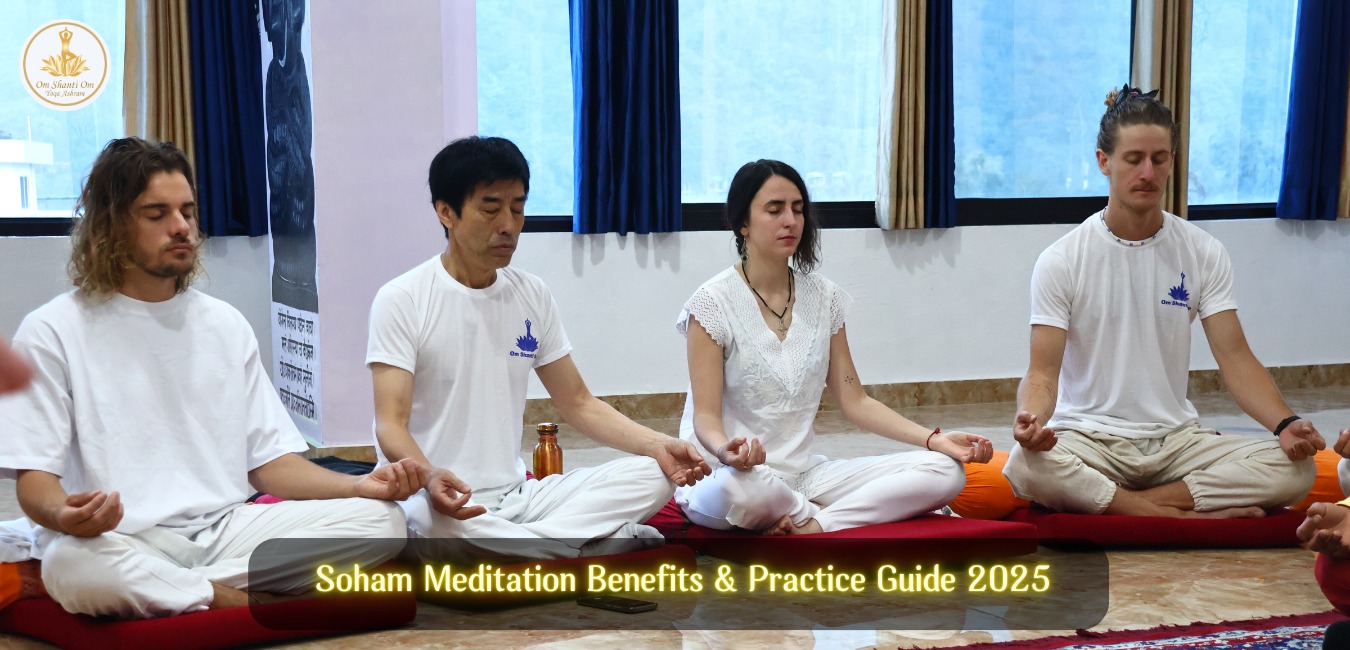
Many beginners think of meditation as something you do after or instead of yoga. In the traditional view, meditation is yoga — it is one of its eight limbs and, in many ways, its ultimate purpose. Even five to ten minutes of quiet sitting after physical practice can begin to reveal what yoga is really pointing toward.
The Value of Learning From a Real Teacher
Videos and apps can be a helpful starting point, but they cannot correct your alignment, sense your breath, or adapt teaching to your specific body and mind the way a real teacher can. In the traditional guru-shishya parampara — the teacher-student lineage — knowledge is passed down through direct relationship and observation, not just information. This is part of why yoga has survived, largely intact, for thousands of years: it has always been taught person to person, not just page to page.
Also Read: Krishnaya Vasudevaya Haraye Paramatmane Shloka Meaning
Why Learning Yoga From a Traditional Source Matters
Rishikesh is often called the "Yoga Capital of the World," and for good reason. This is the place where sages have practiced and taught for centuries along the Ganges, in the foothills of the Himalayas. It is not a marketing title — it reflects an unbroken continuity of teaching that stretches back further than most modern yoga institutions have existed.
When yoga is taught within this lineage, students receive more than a sequence of poses. They receive the context, philosophy, and depth that gives the physical practice its meaning. A posture taught by someone who understands its purpose within the eight limbs is a very different experience from the same posture taught purely as a fitness movement.
This is not to say that studio yoga elsewhere has no value — it absolutely does, and it has brought the practice to millions of people who might otherwise never have encountered it. But there is something distinct about learning from a source where the teaching has been lived, practiced, and refined across generations, rather than assembled from trends and social media.
Many of our own students arrive as complete beginners, often carrying the same misconceptions addressed above. What we consistently observe is that once people understand yoga's full scope — not just as exercise but as a path — their relationship with the practice deepens. They stop asking "did I burn calories today?" and start asking "did I feel more present today?" That shift in questions is, in many ways, the real beginning of yoga.
Also Read: 8 Best Yoga Asanas for Period Pain: Gentle Poses for Natural Relief
How to Start Your Yoga Journey
You do not need to travel to Rishikesh to begin, though many students eventually find their way here to deepen their practice. Here is how to start wherever you are:
- Begin with breath awareness. Sit quietly for five minutes a day and simply observe your breathing.
- Learn a handful of foundational postures correctly, ideally with guidance, rather than a long, complicated sequence.
- Add a few minutes of stillness or meditation after any physical practice, even if it feels awkward at first.
- Read a little of the philosophy, even in small doses. Understanding the "why" behind yoga transforms how you experience the "how."
- Seek out a real teacher when you can, whether locally or through a structured course, to correct your practice and deepen your understanding beyond what self-study alone can offer.
- Be patient. Traditional yoga was never meant to be mastered quickly. It is called a practice for a reason — it unfolds gradually, over years, not weeks.
Conclusion: Yoga as a Path, Not a Trend
Yoga is not a workout you complete and check off your list. It is not a costume, a body type, or a set of impressive poses for social media. At its heart, yoga is a living tradition — a path toward understanding your own mind, calming its restlessness, and connecting with a deeper sense of steadiness and peace.
The physical postures that dominate modern perceptions of yoga are real and valuable, but they are the doorway, not the destination. Behind that doorway lies breath, discipline, ethics, concentration, meditation, and ultimately, a profound sense of union — the very meaning of the word "yoga" itself.
Whether you begin your practice in a local studio, through an online class, or one day here with us in Rishikesh, we hope this guide has offered you a fuller, more authentic picture of what yoga really is. Not just a form of exercise, but a way of returning — again and again, breath by breath — to who you truly are.







0 Comments
No comments yet. Be the first to comment!