


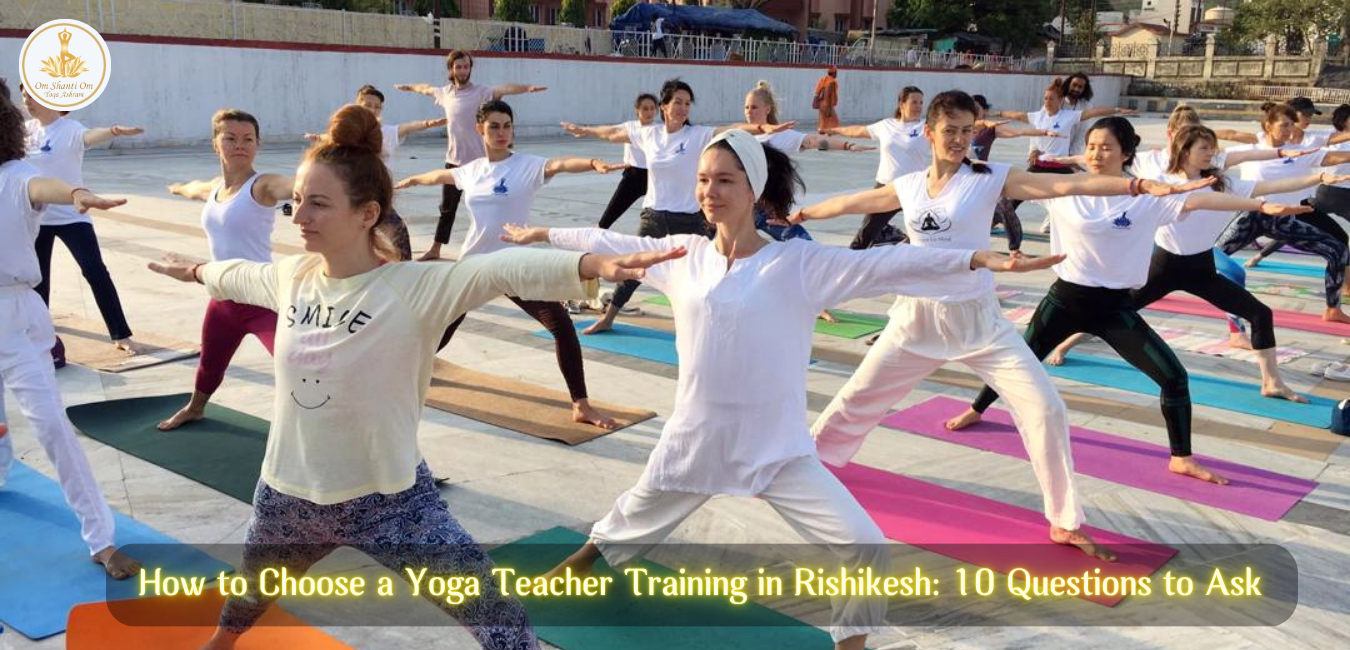
Rishikesh has earned its reputation as a genuine hub for yoga education. The city has a real concentration of experienced teachers, a long lineage of serious practice, and an environment that supports deep immersion in a way that few places on earth can match. But that reputation belongs to the city, not automatically to every school operating within it. Many programs use the Rishikesh name as a marketing asset without delivering on what it implies.
This post won't hand you a ranked list of schools. What it will give you is something more useful: ten specific, honest questions that cut through the marketing language and reveal what a program is actually like before you hand over your deposit. These are the questions most students wish they'd asked before booking — and the ones most schools hope you won't think to send.
Why These Questions Matter More in Rishikesh Than Anywhere Else
Precisely because Rishikesh has such a strong reputation, it also has more noise than anywhere else in the yoga training world. The city's credibility serves as a kind of borrowed authority — a school can benefit simply from being located there, without necessarily earning that benefit through the quality of its teaching.
The stakes are real. A 200 hour YTT in Rishikesh typically represents several weeks of your life, a significant financial investment, and — if you're planning to teach — the foundation that will shape how you stand in front of a class for years. Getting it right matters.
These ten questions are designed to separate the programs that are genuinely excellent from the ones that have simply learned to describe themselves that way.

Also Read: What Makes a World-Class Yoga Teacher Training? 7 Things to Look for in 2026
The 10 Honest Questions to Ask Before You Book
Question 1: Who Is Actually Teaching My Training — and What Is Their Background?
This is the most important question on the list, and it's the one most students forget to ask specifically enough.
A school's marketing will tell you about the institution, its years of operation, its graduate numbers, and its facilities. What it often won't tell you clearly is who will be standing in the room teaching the majority of your hours. Those are different things, and the distinction matters enormously.
Ask by name: who is the lead teacher for this specific intake, and what is their background? Where did they train, under whom, and for how long? Which tradition do they come from? How many years have they been teaching?
A teacher with a genuine lineage and deep personal practice will answer these questions with specific names of their own teachers, the tradition they trained in, and the years they've put into it. A school that deflects to institutional language, "our faculty has decades of combined experience," is telling you something by not telling you something.
Question 2: How Many Students Will Be in My Batch?
Batch size is one of the clearest, most concrete predictors of individual attention — and it's something every school knows exactly but not every school volunteers upfront.
In a room of 50 students, a teacher moving through the space during an asana session can realistically offer a few seconds of individual attention per person. In a room of 12, they can observe your practice, correct your alignment, give you something specific to work on, and come back to check. Those are functionally different educational experiences.
Ask for the confirmed maximum number for your specific intake dates. Not a typical range, not an average, the cap. If a school's answer is vague or keeps shifting, that's useful information. Programs that prioritize individual attention tend to be proud of their small batch sizes and will tell you directly.
Question 3: Can You Send Me the Full Daily Schedule — Not Just the Syllabus?
A syllabus tells you which topics a program covers. A day-by-day schedule tells you how seriously those topics are actually taken.
These are not the same thing. Any school can list anatomy, philosophy, pranayama, and meditation on a syllabus. The schedule reveals whether philosophy gets three weeks of integrated daily sessions or a single afternoon lecture. It shows whether pranayama is treated as a core practice or a ten-minute add-on before asana.
What a strong schedule looks like: an early morning start (around 5 or 6 am), a clear and even distribution of time across subjects throughout the week, teaching methodology woven in from the first days, and a full day that reflects genuine immersion rather than a few sessions with long unstructured gaps in between.
If a school won't send an actual timed schedule before you book — or sends you a vague document that doesn't specify hours per subject — press for more detail. A program with nothing to hide tends to be happy to show you exactly how its days are structured.

Question 4: How Much Teaching Practice Is Built Into the Program — and When Does It Start?
Ask most Yoga Teacher Training graduates what they wish they'd had more of, and the answer is almost always teaching practice. It's the most consistently underdelivered promise in the industry — and the one with the biggest impact on how confident a new teacher feels stepping in front of their first real class.
Teaching is a practical skill. You develop it by actually doing it — cueing poses to real people, managing a room's energy, watching how students respond to your instructions, receiving specific feedback, and then trying again. You do not develop it primarily by watching an experienced teacher demonstrate.
A genuinely strong program starts teaching practice in the first week and returns to it regularly throughout the course. Students teach each other frequently, receive structured written and verbal feedback after each session, and have the chance to apply corrections in subsequent sessions.
Ask specifically: how many hours of teaching practice are included? When in the curriculum does it begin? What does the feedback process look like? If the answer is that teaching practice is concentrated in the final few days as a graduation formality, that's a red flag worth taking seriously.
Question 5: Is the Accommodation Genuinely On-Site, or Will I Be Commuting?
The word "residential" gets used loosely in YTT marketing. Some programs that describe themselves this way mean that students attend sessions at the school and stay in a nearby hotel or guesthouse — which is simply a daytime course with separate accommodation.
Genuine residential immersion means living on-site: waking up in the same building where you practice, eating meals with your fellow students, sharing a schedule from early morning through the evening. That texture — the conversations over dinner, the quiet before a 5 am meditation, the experience of being in sustained community — is a significant part of what a residential training actually produces. It's not reproducible in a commuter format.
Confirm clearly: is accommodation on the school's premises? Do all students eat together at set mealtimes? Is there a structured schedule that runs from early morning through the evening, seven days a week? The specificity of the answers will tell you whether "residential" is being used accurately.
Question 6: What Styles of Yoga Are Taught — and Does That Match What I Want to Learn?
This question matters more than most students realize at the booking stage, and it can make a substantial difference to how useful the training actually is for your specific goals.
Rishikesh schools tend to specialize. Some are rooted in traditional Hatha yoga — slower, more technique-focused, with significant emphasis on classical postures and their energetic effects. Others emphasize Ashtanga Vinyasa, with its structured series and Mysore-style self-practice methodology. Some teach Vinyasa flow as their primary style; others blend several traditions into a hybrid curriculum.
None of these is inherently better than the others. But if you're hoping to teach Ashtanga specifically, a primarily Hatha-focused program — however excellent — may not give you what you're looking for. And a program that claims to cover all styles comprehensively is worth pressing on: "all styles" can sometimes mean a superficial introduction to several rather than genuine depth in any.
Be clear with yourself about the style you practice most, the students you hope to teach, and the niche you want to develop — then ask whether a specific school's curriculum actually matches that.
Question 7: What Does the Feedback and Assessment Process Look Like?
How a program assesses its students reveals more about its teaching philosophy than almost any other single factor.
Surface-level assessment looks like this: a written test in the final week covering terminology and philosophy, and a practical exam where students teach a short sequence. The feedback is minimal, and it arrives too late to be useful for anything other than passing.
Genuine assessment looks different. Feedback is given regularly throughout the training — not just at the end. It covers multiple dimensions: alignment knowledge, cueing clarity, ability to observe and correct students, understanding of anatomy as applied to actual practice, and teaching presence. It's specific enough to be actionable, not just "good job, keep working on your assists."
Ask: How often are students formally assessed during the training? What form does feedback take? Is it written? Who delivers it? When does assessment begin? A strong answer will describe a continuous process. A weak one will describe a single final exam.

Question 8: Are There Hidden Costs Beyond the Course Fee?
The headline price displayed on a school's website is rarely the full financial picture — and the gap between advertised cost and actual cost can be surprisingly significant.
Common additions that aren't always included in course fees: Yoga Alliance registration (which can add $100–$200 or more), course materials and textbooks, excursion or cultural activity fees, airport transfers, laundry, personal supplies, and any optional therapies or wellness sessions that are mentioned in marketing but not actually included in the base price.
Before committing a deposit, ask for a written breakdown of exactly what the course fee covers and what will cost extra during your stay. This isn't a minor administrative detail — it's a question of whether the school is being honest with you from the first interaction. A school that gives you a complete, transparent cost breakdown before you book is giving you early evidence of how it operates in general.
Question 9: What Support Exists After I Graduate?
Graduation day tends to be emotional and energizing. The weeks that follow are often when the reality sets in: you have a certificate, you've completed an intense training, and now you need to actually build a teaching practice from scratch. For most new teachers, that transition is harder than the training itself.
The programs that take their graduates' outcomes seriously build for this. What genuine post-training support looks like varies: an active alumni community where graduates can ask questions and stay connected, mentorship pathways for new teachers, job placement assistance or referral networks, and discounted access to advanced training for their own graduates.
What it doesn't look like is a graduation photo on the school's Instagram feed and an email two weeks later offering the 300-hour course at full price.
Ask specifically: what does your alumni community look like in practice? Do you offer mentorship for graduates? Have any of your graduates gone on to teach professionally, and can I speak with one of them? The quality of the answer will tell you a great deal about whether the school sees its relationship with you as ending at graduation or continuing beyond it.
Question 10: Can I Speak to a Recent Graduate Before I Book?
This is the most valuable step on the entire list — and the one most students skip.
A school-selected testimonial on a website is marketing copy, however genuine it may sound. What you want is an independent conversation with someone who attended the specific program you're considering, within the past year or two, ideally during a similar time of year. Someone who can tell you what the daily schedule actually felt like, whether the lead teacher was genuinely present throughout the training or largely delegated to assistants, what surprised them (positively or negatively), and whether they'd do it again at the same school.
You can often find independent alumni through Facebook groups dedicated to YTT students and graduates, yoga forums, or simply by asking the school to connect you with someone you can speak to directly — not a pre-written testimonial, but a real conversation.
Pay attention to how a school responds to this request. One that's confident in its reputation will facilitate it willingly. One that's hesitant, offers only written testimonials, or makes the connection difficult is worth questioning.
Also Read: 8 Best Yoga Asanas for Period Pain: Gentle Poses for Natural Relief
How to Use These Questions as a Decision-Making Framework
The most effective way to use these ten questions is to send them in writing — by email — to any school you're seriously considering. Phone calls are easier to deflect; written responses create a record and tend to produce more considered, accountable answers.
Look for specificity. A school that answers each question with concrete detail — names, numbers, times, specific processes — is demonstrating the kind of transparency that tends to characterize genuinely strong programs. A school that answers in generalities, redirects to marketing language, or avoids committing to specifics is also telling you something.
A few of these questions are deal-breakers if answered poorly: who is teaching, batch size, the schedule, and whether you can speak to an alumnus. The others are important context. Together, they give you a far more accurate picture than any ranking list or star rating system can.

Green Flags vs. Red Flags — Quick Reference
Green flags:
- Lead teacher named specifically with clear, verifiable lineage
- Batch size capped under 20, confirmed in writing
- Full day-by-day schedule provided without being asked twice
- Teaching practice begins in week one and runs throughout
- Accommodation confirmed as on-site with shared meals
- Transparent, itemized cost breakdown provided upfront
- Willingness to connect you directly with a recent graduate
Red flags:
- "Expert faculty" language without named individuals
- Vague or shifting answers about batch size
- Only a topic syllabus is provided, not a timed schedule
- Teaching practice concentrated at the end of the program
- "Residential" means a nearby hotel, not on-site accommodation
- Headline price missing high additional costs
- Reluctance or inability to facilitate an independent alumni conversation
Also Read: How to Become a Certified Yoga Teacher in India: Complete Guide 2026
Conclusion
The right training in Rishikesh genuinely exists. The city has real programs run by real teachers with deep lineages and genuine commitment to their students' development — programs that will shape how you teach and practice for years after you leave.
Finding one isn't about luck or picking the highest-rated result on a search page. It's about asking the right questions, reading the answers carefully, and being willing to take a little extra time before committing. The ten questions above are a place to start. The pattern of a school's responses — specific or vague, transparent or evasive, student-focused or sales-focused — will tell you most of what you need to know.
Take the time. It pays off in the training room and in every class you teach afterward.












0 Comments
No comments yet. Be the first to comment!