


Most advice about meditation starts the same way: sit down, close your eyes, breathe slowly, try not to move. For a lot of people, that instruction alone is where things fall apart. If your mind is already running at full speed, being told to sit still and empty it out can feel less like relaxation and more like a losing argument with yourself.
Osho Dynamic Meditation takes a different route entirely. For the first forty minutes, it asks you to do almost the opposite of what you'd expect from meditation — breathe hard, move your body, make noise, let go of whatever's been building up. Only after that does it ask for stillness. The idea underneath it is fairly simple once you hear it explained: silence is easier to find once the noise inside you has somewhere to go first.
This is one of the meditation styles taught in many yoga teacher training programs in Rishikesh, including our own 200-Hour YTTC, and it tends to surprise people the first time they try it. Here's what it actually is, where it came from, and how the five stages work.

Quick Answer
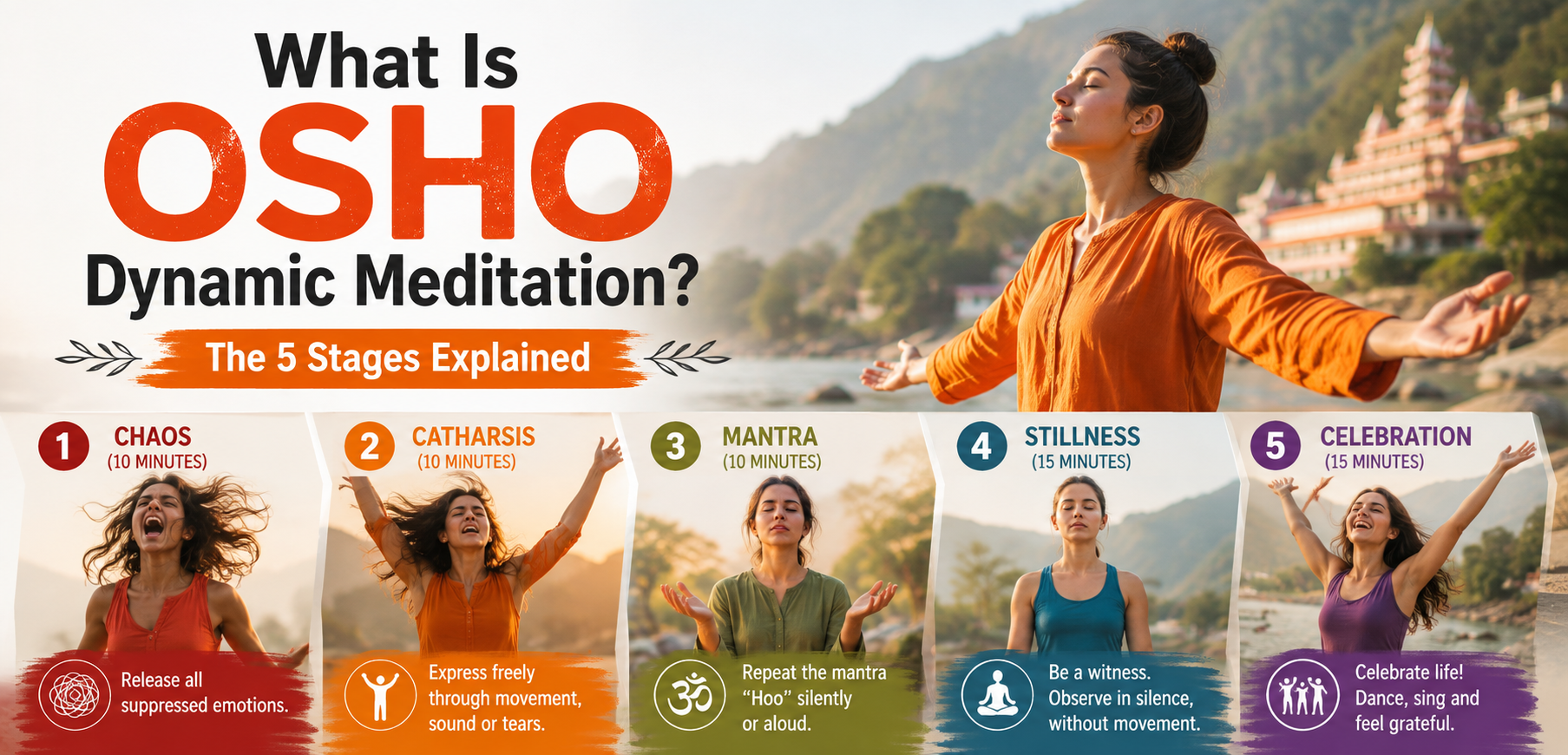
Osho Dynamic Meditation is a one-hour active meditation technique created by the spiritual teacher Osho in 1970. It moves through five distinct stages — chaotic breathing, physical catharsis, jumping while chanting a sound, sudden stillness, and free celebration — designed to release built-up tension before settling into a quieter, more aware state of mind. It's typically practiced in the early morning, with eyes closed, to a specific accompanying soundtrack that signals each stage.
Where It Came From
Osho Dynamic Meditation was developed in 1970 by Osho (born Chandra Mohan Jain, also known by the name Bhagwan Shree Rajneesh at the time), an Indian spiritual teacher who spent much of his life questioning conventional approaches to meditation. His observation was straightforward: most classical meditation techniques were designed centuries ago for people who lived slower, quieter lives — farmers, monks, villagers whose days weren't filled with constant noise and mental stimulation. Asking a modern, overstimulated mind to simply sit and go still, he argued, was often asking it to do something it wasn't prepared for.
Also Read: Ganesha Mantra: Hidden Symbolism & Deeper Meaning
His response was what he called a "dialectical" style of meditation — one built on contrast rather than a single steady state. Instead of asking the mind to be calm from the first minute, the technique deliberately stirs things up first: fast breathing, physical release, sound, movement. Only once that energy has been allowed to move does the practice ask for stillness. The theory is that forcing calm onto a restless system rarely works, but calm that arrives naturally, after genuine release, tends to hold.
It draws loosely on a mix of influences — breathing techniques found in classical pranayama, elements of catharsis borrowed from Western psychotherapy, and the kind of physical, ecstatic movement found in some devotional and Sufi traditions. The result isn't quite like any single one of those on its own; it's very much its own structured sequence.

The Five Stages, Explained One by One
The full practice runs for exactly one hour, broken into five stages of specific, timed lengths. It's traditionally done with eyes closed (sometimes with a blindfold), on an empty stomach, in loose and comfortable clothing, and accompanied by a specific piece of music that shifts to mark each new stage. Here's what happens during each one.
Stage One: Chaotic Breathing (10 minutes)
The session opens with fast, deep, and deliberately irregular breathing through the nose. There's no set rhythm to follow — the instruction is simply to breathe as intensely as possible, with the focus placed on forceful exhalation rather than inhalation, letting the body take care of the inhale on its own. The aim here isn't relaxation; it's disruption. Rapid, chaotic breathing of this kind shakes up habitual breathing patterns, many of which are tied to stress and tension held in the body, and starts to build an internal charge of energy that the following stages will use.
Stage Two: Catharsis (10 minutes)
Once that energy has built up, stage two asks you to let it out however it wants to come out. This might look like shouting, crying, laughing, shaking, jumping, or simply moving in whatever way feels necessary. Nothing here is choreographed or "correct" — the whole point is to stop managing or editing your own reaction and let whatever's been suppressed find its way to the surface. For people used to controlling how they present themselves, this stage is often the most unfamiliar, and sometimes the most confronting.
Stage Three: Jumping With Sound (10 minutes)
In the third stage, arms are raised overhead, and the body jumps rhythmically while chanting a single sound aloud — traditionally "Hoo!" — landing on the heels with each repetition. The sound is meant to be pushed from deep in the body rather than the throat, and the repeated physical impact is thought to stimulate energy along the spine. It's demanding, and by this point most people are fairly tired, which is part of what makes the next stage land the way it's meant to.
Stage Four: Stillness (15 minutes)
This is the pivot point of the entire practice. On a signal (usually a shift in the music or an instruction to "stop"), you freeze completely — exactly wherever you are, in whatever position your body happens to be in. No adjusting, no getting comfortable, no repositioning. You simply stay still and observe whatever is happening internally: sensations, thoughts, the aftermath of the previous three stages. After forty minutes of intense physical activity, this sudden stillness tends to feel very different from the kind of stillness you'd reach by trying to sit quietly from the start. Many practitioners describe this stage as where the actual "meditation" part becomes noticeable — a kind of clarity that shows up once the body has nothing left to perform.
Stage Five: Celebration (15 minutes)
The final stage shifts into free, expressive movement — dancing, singing, or simply moving to music in whatever way feels natural. This isn't a cooldown so much as an intentional close: a way of carrying the lightness or clarity from stage four back out into ordinary movement, and into the rest of the day. Osho placed a lot of emphasis on this stage specifically, treating celebration as a genuine part of the meditative process rather than an afterthought tacked onto the end.

How It's Actually Meant to Work
The logic connecting all five stages comes down to one idea: release before rest. Most of us carry a fair amount of tension, and it's not always tension we can fully identify. Trying to meditate calmly on top of that tension, without addressing it first, often just means sitting quietly while your mind keeps circling the same static. Osho Dynamic Meditation deals with that static directly — the first three stages exist specifically to surface and discharge it, so that the fourth stage of stillness isn't a battle against a noisy mind but something closer to genuine rest.
There's also a specific instruction that runs through the whole practice, regardless of which stage you're in: stay a witness. Even during the most physically intense stages, the idea is to remain aware of what you're doing rather than getting completely swept up and losing yourself in the activity. That thread of awareness — moving fast, shouting, jumping, all while still quietly watching yourself do it — is arguably the actual meditation, more than any single stage on its own.
Also Read: Guru Mantra Meaning & the Living Guru-Shishya Tradition
The practice is traditionally done early in the morning, on the reasoning that the mind tends to carry the least "buildup" at that point in the day, and that starting the day with this kind of release changes how the rest of it unfolds. There's also a practical element to the timing: doing something this physically expressive is generally easier before the day has filled up with obligations, conversations, and the accumulated self-consciousness that tends to build as hours pass.
It's worth noting that the specific sequence — the exact order, the exact durations, the accompanying music — isn't arbitrary. Each stage is built to set up the one that follows. The chaotic breathing in stage one wouldn't have much to release if it weren't followed by catharsis. The catharsis wouldn't build toward anything if stage three's jumping and chanting didn't add another layer of physical exertion on top of it. And the stillness of stage four wouldn't feel nearly as distinct if it arrived without three stages of intensity building up to it by contrast. Removing or shortening any single stage tends to change how the whole practice lands, which is part of why the technique is generally taught and practiced as a complete sequence rather than picked apart into pieces.

Common Questions About Osho Dynamic Meditation
Do I need any meditation experience to try it?
No. If anything, people with little to no meditation background sometimes take to it more naturally than those who've spent years training themselves toward stillness through seated practice, simply because there's less of a mental script to unlearn.
Is it safe to do every day?
Many practitioners do use it as a daily morning practice, and it's designed to be sustainable at that frequency. That said, anyone with a heart condition, high blood pressure, a recent injury, or who is pregnant should check with a doctor first, given the physical intensity of the early stages.
Can it be done alone, or does it need a group?
It can be done solo, but most people find a group setting easier, particularly for the catharsis and celebration stages, where shared energy tends to lower self-consciousness. This is part of why it's more commonly taught in a class or retreat setting than picked up entirely solo from instructions online.
What if I don't feel anything during the catharsis stage?
That's normal too, especially in early sessions. Not everyone has an obvious emotional release the first few times, and forcing one rarely helps. The instruction is to follow whatever's genuinely there rather than to manufacture a reaction, so a quieter first session doesn't mean it isn't working.
How is it different from ordinary exercise with a meditation label?
The distinction lies in the instruction to remain a witness throughout — staying aware of what you're doing even during the most physically intense stages, rather than simply working out. Exercise alone typically doesn't ask for that continuous internal awareness threaded through movement, sound, and eventual stillness.
Also Read: Gayatri Mantra Meaning, Sound Science & How to Chant It
Who Tends to Benefit Most From It
This style of meditation is often recommended specifically for people who find traditional, seated, silent meditation genuinely difficult — not because they're doing it wrong, but because a very active or overstimulated mind sometimes needs to move before it can sit still. If you've ever tried to meditate quietly and found your thoughts louder than ever, this is often the kind of practice that clicks in a way seated meditation hasn't.
It also tends to suit people carrying a lot of unexpressed tension, stress, or pent-up energy — the kind that builds up from busy schedules, suppressed emotion, or simply not having many outlets for physical release in day-to-day life.
Who Might Find It Challenging
To be fair to anyone considering it: the physical intensity of the first three stages isn't for everyone. The shouting, jumping, and uninhibited movement can feel deeply uncomfortable for people who are self-conscious about being watched, or who have physical limitations that make sustained jumping difficult. It's also generally not recommended without modification for people with certain heart conditions, pregnancy, or joint issues, given the physical demands of stages one through three.
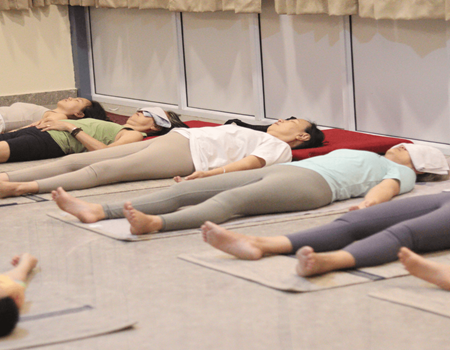
If that describes you, it doesn't mean meditation itself is off the table — it just means a gentler, more traditional practice like Yoga Nidra or a seated breath-based meditation might be a better starting point. Different nervous systems respond to different approaches, and there's no single "correct" way into stillness.
What to Expect the First Time
Walking into a first session, a few things are worth knowing in advance. Loose, comfortable clothing helps, since you'll be moving a lot in the early stages. It's usually best attempted on an empty stomach, given how physically active the first half is. Sessions are typically done with eyes closed throughout — sometimes with a blindfold — partly to remove self-consciousness about being watched, and partly to keep the focus inward rather than on your surroundings.
It's completely normal to feel a bit awkward or self-conscious the first time, particularly during the catharsis stage. Most people find that feeling fades within the first few sessions, once the initial strangeness of shouting or moving freely in front of others wears off. If a session is done in a group setting, that shared energy — everyone breathing hard, moving, releasing at the same time — often makes the whole experience easier than doing it alone, since there's no one paying particular attention to what anyone else is doing.

Where This Fits Into a Yoga Teacher Training Course
Osho Dynamic Meditation isn't the only meditation style worth knowing as a yoga practitioner or future teacher, but it's a genuinely useful one to have experienced firsthand both for your own practice and for understanding the range of tools available to offer future students. It sits at one end of a spectrum that includes much gentler, more traditional practices like mantra chanting, Yoga Nidra, and seated breath meditation, and having direct experience with more than one style tends to make for a more well-rounded, adaptable teacher.
At Om Shanti Om Yoga Ashram, Osho Dynamic Meditation is one of the meditation practices included in our 200-Hour Yoga Teacher Training, alongside more traditional seated techniques, so students get a genuine feel for both ends of that spectrum rather than just reading about the difference in a manual.
The Bottom Line
Osho Dynamic Meditation isn't a gentle, quiet introduction to meditation — it's built for people whose minds need to move before they can rest. The five stages take you through chaotic breathing, physical release, rhythmic jumping, sudden stillness, and free celebration, each one building toward the next. Whether or not it becomes a regular part of your own practice, understanding how and why it works is genuinely useful — both as a practitioner curious about different paths into stillness, and as a future teacher building a toolkit broad enough to meet different students where they actually are.







0 Comments
No comments yet. Be the first to comment!