


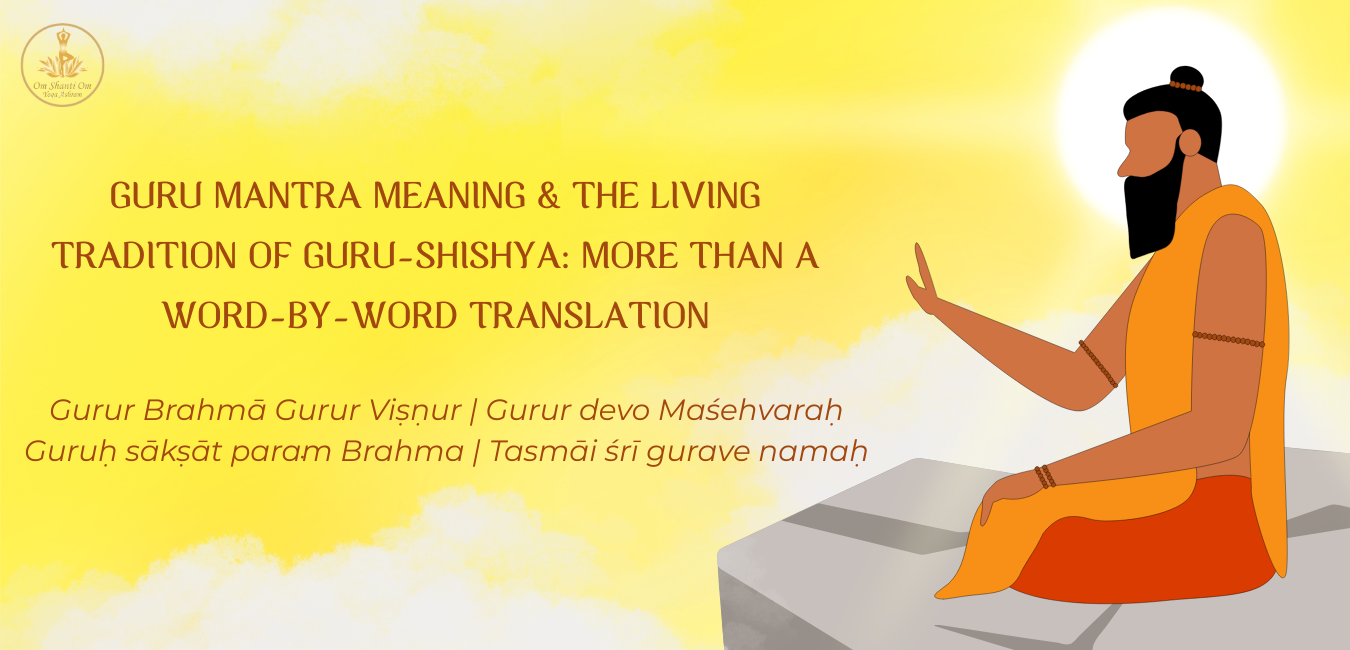
There is a particular kind of stillness that settles over a room when the Guru Mantra is chanted properly, not performed, but genuinely offered. If you've spent time in an ashram, you've likely witnessed it: a teacher or a senior student begins the familiar verse, and something in the atmosphere shifts. People who were fidgeting a moment ago go quiet. Heads bow slightly, almost involuntarily. It's not the words alone that do this. It's everything the words are connected to — centuries of teachers passing something invisible and irreplaceable down to students, one generation after another.
Most explanations of the Guru Mantra stop at translation. They'll tell you what each Sanskrit word means, maybe throw in a line about "the guru being like God," and move on. That's not wrong, exactly, but it's incomplete in a way that does the mantra a disservice. To actually understand this verse, you have to grasp the relationship it describes — the guru-shishya parampara, the living tradition of teacher and student that has shaped how wisdom has moved from one person to another in India for thousands of years. The mantra isn't really about the words. It's about what the words are pointing toward.
What Is the Guru Mantra?
The verse most commonly known as the Guru Mantra — sometimes called the Guru Stotram — appears in slightly different forms across various texts, but its most widely recited version comes from the Guru Gita, a section of the Skanda Purana. It reads:
Gurur Brahma, Gurur Vishnu, Gurur Devo Maheshwara, Guru Sakshat, Param Brahma, Tasmai Shri Gurave Namah.
If you've ever attended a yoga class, a satsang, or any kind of traditional teaching session in India, there's a strong chance you've heard this exact verse, often chanted right at the beginning as a way of honoring the teacher before instruction begins.
What's notable about this mantra, compared to something like the Gayatri Mantra or the Mahamrityunjaya Mantra, is that it isn't primarily addressed to a deity in the conventional sense. It's addressed to the Guru — and in doing so, it makes one of the boldest claims in the entire Vedic tradition: that the guru is not merely a respected teacher, but is, in a very real sense, equivalent to the divine itself.
Word-by-Word Meaning
Let's slow down and actually sit with each part of this verse, because the structure itself carries meaning.
Gurur — A form of "Guru," meaning teacher, but carrying a depth the English word doesn't fully capture. The Sanskrit root is often broken down as "gu," meaning darkness or ignorance, and "ru," meaning the one who removes or dispels. A Guru, in this sense, is not simply someone who transmits information — a Guru is specifically the one who removes the darkness of ignorance.
Brahma — Refers to Brahma, the creator deity in the Hindu trinity (Trimurti), responsible for bringing the universe into being. By invoking Brahma first, the mantra credits the Guru with a creative function — the Guru "creates" within the student a new way of seeing, a new capacity for understanding that didn't exist before.
Vishnu — Refers to Vishnu, the preserver deity, responsible for sustaining and protecting creation. Here, the Guru is credited with sustaining the student's growth — nurturing and protecting the understanding that has been planted, rather than letting it wither or be lost.
Devo Maheshwara — Refers to Maheshwara, another name for Shiva, the destroyer deity responsible for dissolution and transformation. This line credits the Guru with the power to destroy — specifically, to destroy ignorance, ego, illusion, and the mental patterns that obstruct clarity.
Together, these first two lines map the Guru onto the entire Trimurti — creation, preservation, and destruction. It's an extraordinary claim once you really look at it: the Guru is being described as performing, within the inner world of the student, the same three fundamental functions that these three great deities perform for the entire cosmos. The Guru creates new understanding, sustains its growth, and destroys the ignorance that would otherwise smother it.
Guru Sakshat — Means "the Guru, directly perceived" or "the Guru, visibly present." This phrase makes an important distinction — it's not describing some distant, abstract concept of "guru-ness." It's pointing at an actual, present, physically real human being standing in front of the student.
Param Brahma — Means "the Supreme Absolute" or "the highest reality." This is the same "Brahman" referenced throughout the Upanishads — the ultimate, formless ground of all existence that Vedantic philosophy describes as the true nature of everything.
This is the line that tends to stop people in their tracks the first time they really absorb it. The mantra is saying that the Guru standing physically in front of you — flawed, human, visible, ordinary in appearance — is also, somehow, identical to the highest, most ultimate reality there is. Not a representative of that reality. Not a messenger. The thing itself, made approachable.
Tasmai — Means "to that one" or "to him."
Shri Gurave — "Shri" is an honorific of respect and auspiciousness, similar to how it's used before names as a sign of reverence. "Gurave" is the dative form of Guru — "to the Guru."
Namah — Means "I bow" or "I offer salutation." This single word carries the entire emotional posture of the mantra: surrender, humility, and reverence, all compressed into one syllable.
Put together, a natural English rendering reads something like: "The Guru is Brahma, the Guru is Vishnu, the Guru is the great god Maheshwara. The Guru, truly present before me, is the Supreme Absolute itself. I bow to that revered Guru."
Why This Claim Isn't as Strange as It First Sounds
For someone encountering this mantra for the first time, especially from outside the tradition, that central claim — your teacher is the same as ultimate reality — can sound like an uncomfortable amount of reverence to place on a single human being. It's worth sitting with why this idea exists, rather than dismissing it too quickly or accepting it uncritically.
The Vedantic worldview underlying this mantra holds that the same Brahman — the same ultimate, undivided consciousness — exists within every single being, without exception. In that sense, the claim "the Guru is Brahman" isn't actually a special privilege granted only to teachers. It's simply a more direct acknowledgment of something the tradition believes is universally true. Every person, in their deepest essence, is Brahman. The difference with the Guru is one of realization, not of essence — the Guru is someone who has actually recognized this truth directly, rather than merely believing it intellectually or having forgotten it entirely beneath layers of ego and conditioning.
This reframes the mantra considerably. It's not asking the student to worship a particular human personality, with all of that person's individual quirks, opinions, and imperfections. It's asking the student to recognize and honor what is being transmitted through that person — the living demonstration of a truth that, in theory, exists equally within the student themselves. The Guru becomes something like a mirror, or a doorway: a visible, accessible point of contact with a reality that would otherwise remain abstract and theoretical.
This is also why the tradition places such enormous weight on finding a genuinely qualified Guru, and why it warns just as strongly against blind devotion to unqualified or exploitative teachers. The reverence described in this mantra is meant for someone who has done the work — who has walked the path themselves and can therefore actually illuminate it for someone else. It is not meant to be handed out automatically to anyone holding a teaching position.
The Living Tradition of Guru-Shishya
To really understand the Guru Mantra, you have to step back from the verse itself and look at the relationship it's emerging from — what's known as the guru-shishya parampara, or the teacher-student lineage tradition.
This isn't simply a teaching method, in the way a university lecture or an online course is a teaching method. The guru-shishya relationship, in its classical form, is built on sustained, personal, often lifelong contact between teacher and student. Historically, a shishya (student) would live with their guru, sometimes for years, observing not just formal instruction but the guru's entire way of being — how they ate, how they treated others, how they responded to difficulty, how they handled silence. Knowledge in this tradition was never considered separable from the character of the one transmitting it. You couldn't simply extract the "information" and discard the relationship; the relationship was the curriculum.
This is part of why so many of the most significant yogic and philosophical lineages in India trace themselves back through an unbroken chain of named teachers and students — guru to shishya, shishya eventually becoming guru to the next shishya, stretching back centuries. Adi Shankaracharya's lineage, the various branches of Hatha Yoga that trace back through named teachers, the Vedanta sampradayas — all of them function this way, not because tradition demands sentimentality about the past, but because something about the depth of realization being transmitted seems to require direct, person-to-person contact rather than purely textual study.
In a culture that increasingly favors self-directed learning — YouTube tutorials, apps, solo practice — this model can feel almost foreign. And to be fair, the tradition itself acknowledges that not everyone needs, or will find, a guru in this classical, intensive sense. But it's worth understanding what the relationship was actually designed to address. Some forms of knowledge are genuinely transferable through books and videos — anatomy, sequencing, the names of postures. But the tradition holds that subtler transformations — the dissolution of ego, the direct recognition of one's true nature, the kind of inner shift the Guru Mantra is actually describing — tend to require the catalytic presence of someone who has already undergone that shift themselves. There's a transmission that happens in presence, not just in information, and the parampara exists specifically to protect and preserve that.
What This Looks Like in Practice Today
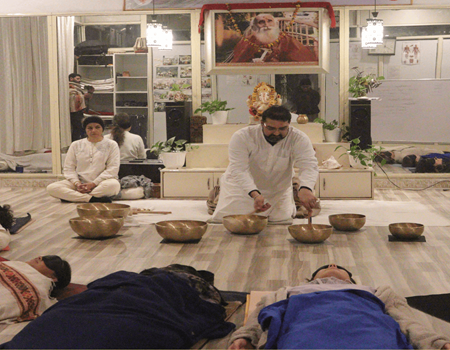
At a contemporary yoga ashram, the guru-shishya relationship rarely takes its most classical, intensive historical form — and that's an honest thing to acknowledge rather than romanticize away. Most students arrive for a defined period: a teacher training, a retreat, a few weeks or months of immersive study, rather than the decades-long residential apprenticeships of an earlier era.
But the essential spirit of the relationship can still be genuinely present, even in a shorter timeframe. It shows up in a teacher who corrects a student's alignment not mechanically, but with real attention to that particular student's body and history. It shows up in a teacher's willingness to sit with a student's doubts and frustrations rather than offer only polished, rehearsed answers. It shows up in small moments — a teacher noticing when a student is pushing too hard out of ego, or holding back out of fear, and responding to the person rather than just the posture.
Chanting the Guru Mantra at the start of a class or a teacher training, then, isn't simply ritual for ritual's sake. It's a moment of conscious acknowledgment — a recognition that what's about to happen in the room is more than information transfer. It's an invitation to approach the teaching and the teacher with the kind of openness and humility that actually allow transformation to occur. A student who walks into a class purely to extract technique, while remaining closed off and skeptical of everything else being offered, tends to leave with technique and very little else. A student who chants this mantra and genuinely means it — who arrives willing to be taught, not just instructed — tends to leave changed in ways that are harder to put into words, but unmistakably real.
Chanting the Guru Mantra
In practical terms, the Guru Mantra is most often chanted at the very beginning of a class, a satsang, or a period of formal study, before any teaching begins. It can be chanted once, or repeated multiple times, often in a simple, steady melodic pattern rather than the more elaborate musical settings used for some other mantras.
There's no requirement for elaborate ritual to chant it correctly. What matters most is genuine intention — pausing, even briefly, to actually call to mind what's being said, rather than letting the words become an automatic formality. Some practitioners chant it silently before beginning their personal practice, as a way of acknowledging not a specific physical teacher in the room, but the entire unbroken lineage of wisdom that has made their own practice possible — every teacher, going back through time, who preserved and passed on what they themselves now have access to.
Pronunciation, as with all Sanskrit chanting, benefits from listening to an experienced chanter before attempting it solo, particularly around the aspirated sounds in words like "Brahma" and "Maheshwara." But unlike some of the longer Vedic mantras, the Guru Mantra is short enough that most students memorize it within a single hearing or two, which is part of why it has remained so universally chanted across so many different schools and lineages of practice.
A Mantra That Asks Something of You
What makes the Guru Mantra genuinely different from a simple prayer is the posture it asks the practitioner to take. It doesn't ask you to request anything — no protection, no blessing, no specific outcome. It asks you to recognize something, and then to bow to that recognition. It asks you to consider, even briefly, that the person teaching you might be carrying something far more significant than technique or information, and that approaching them — and by extension, approaching your own capacity for growth — with humility rather than skepticism might open a door that arrogance keeps permanently closed.
You don't have to fully resolve, on an intellectual level, whether your teacher is "truly" equivalent to ultimate reality to get something real out of chanting this mantra. What the verse actually asks of you is simpler and more immediate: a moment of genuine respect, a willingness to be taught, and an acknowledgment that wisdom, in this tradition, has always traveled from one open heart to another. The guru-shishya relationship, at its best, isn't about hierarchy or blind obedience — it's about two people, separated by experience but united by the same essential nature, walking together toward the same clarity the Guru Mantra describes as already, quietly, present in both of them.









0 Comments
No comments yet. Be the first to comment!