


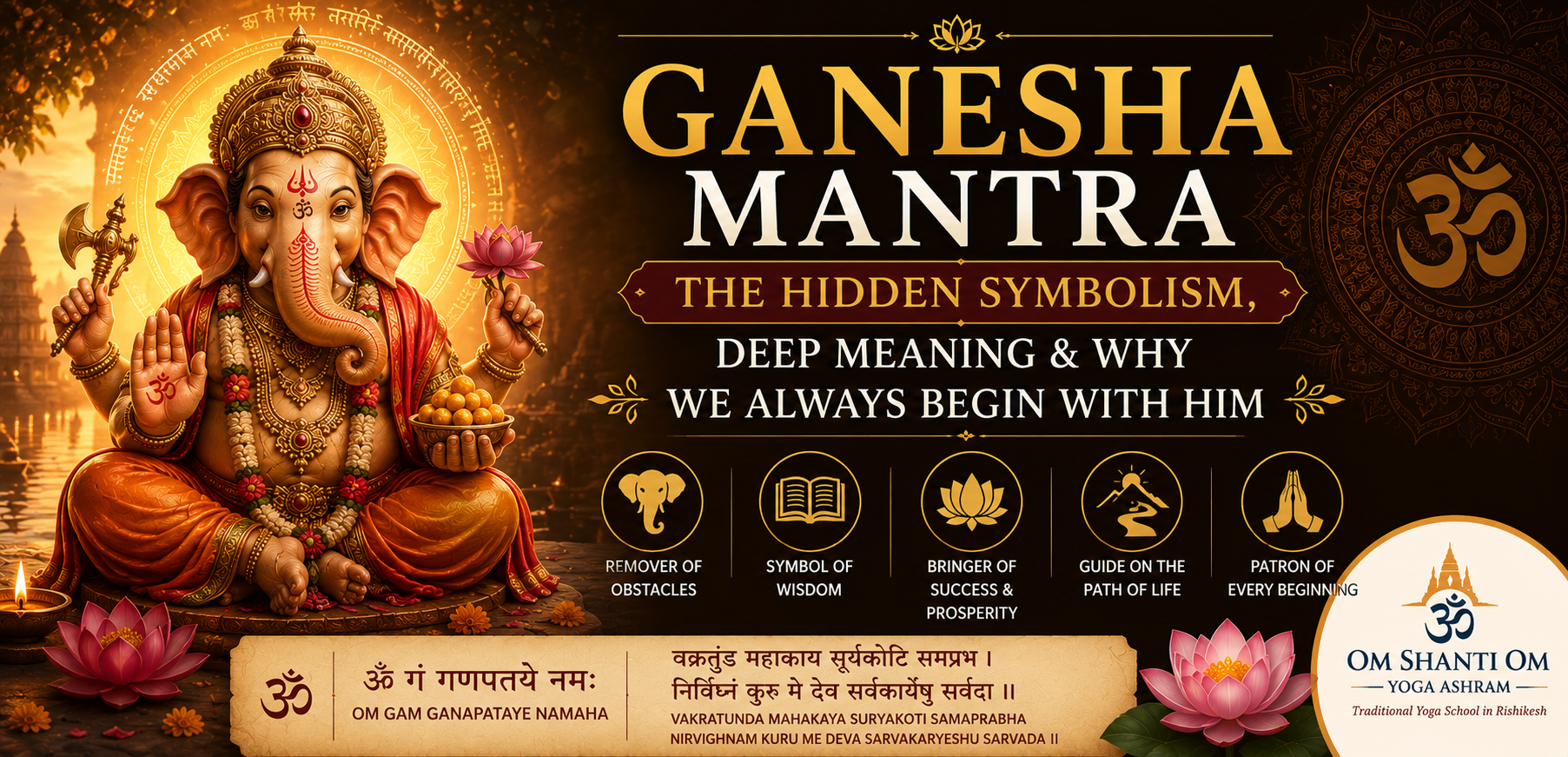
Walk into almost any Hindu wedding, housewarming business launch or yoga studio and there is a good chance the very first thing that happens before the actual event before the vows, before the first pose is a short invocation to Ganesha. It's so consistent across contexts that most people stop questioning it. He just goes first. Always.
But that consistency isn't arbitrary. There's a clear, fairly practical logic behind why this particular deity gets first billing, and it's tied up in both the mantra chanted in his name and the unusual, almost cartoonish form he's depicted in. Once you actually look at the symbolism — the elephant head, the oversized belly, the impossibly small mouse he rides — it stops looking decorative and starts looking like a fairly deliberate set of instructions about how to begin anything difficult.
This post breaks down the mantra itself, the meaning packed into his iconography, and why "start with Ganesha" isn't just a religious habit — it's a mindset that holds up whether or not you have any religious framework at all.
Who Is Ganesha, Briefly?
In Hindu tradition, Ganesha is the son of Shiva and Parvati, instantly recognisable by his elephant head set on a human body. He carries a long list of titles, but two matter most here: Vighnaharta (remover of obstacles) and Vighnesha (lord of obstacles) — both pointing to the same core idea, that Ganesha governs the barriers between an intention and its outcome.
He's also widely regarded as the patron of wisdom, intellect, and the arts and sciences, which is why students, writers, and anyone starting a new creative or scholarly project will often invoke him specifically. The combination of "clears obstacles" and "governs wisdom" is exactly why he's the one called on first, before any other deity, ritual, or undertaking begins.
The Ganesha Mantra(s): Text & Translation
There isn't just one Ganesha mantra — there are several, used in different contexts. Two are by far the most common.
The Short Mantra: Om Gam Ganapataye Namah
ॐ गं गणपतये नमः Oṁ Gaṁ Gaṇapataye Namaḥ
Breaking it into parts:
- Om — the primordial sound, used to open most Sanskrit mantras.
- Gam — a bija (seed) mantra specifically associated with Ganesha. Seed mantras are short, often single-syllable sounds believed to carry the concentrated vibrational essence of a deity, rather than literal meaning.
- Ganapataye — a form of "Ganapati," another name for Ganesha. Gana refers to a group or host (specifically Shiva's attendants), and pati means lord or master — so Ganapati translates loosely to "lord of the hosts" or "lord of the multitudes."
- Namah — "I bow" or "salutations to."
Put together: Om, salutations to Ganapati, the lord of the hosts.
This is the version most commonly chanted quickly, repeatedly, often on mala beads, as a short intention-setting practice before something important.
Also Read: Asato Ma Sadgamaya: The Three Prayers Every Yogi Is Actually Living — Whether They Know It or Not
The Longer Invocation: Vakratunda Mahakaya
वक्रतुण्ड महाकाय सूर्यकोटि समप्रभ निर्विघ्नं कुरु मे देव सर्वकार्येषु सर्वदा
Vakratunda Mahākāya Sūryakoṭi Samaprabha Nirvighnaṁ Kuru Me Deva Sarva-Kāryeṣu Sarvadā
Word-by-word:
- Vakratunda — "curved trunk," a direct reference to Ganesha's physical form.
- Mahakaya — "great body" or "massive form."
- Suryakoti samaprabha — "with the radiance of a million suns" (literally "koti," meaning ten million, used here more poetically than literally).
- Nirvighnam kuru — "make [it] free of obstacles."
- Me deva — "my Lord" or "O God."
- Sarva-karyeshu sarvada — "in all endeavours, always."
Full translation: O Lord with the curved trunk, of massive form, radiant as a million suns — please make all my endeavours free of obstacles, always.
This longer version functions almost like a formal request — it's the one most commonly used before starting something specific and significant: a new project, an exam, a journey, a wedding ceremony.
Pronunciation Guide
Om Gam Ganapataye Namah:
- Om — let it resonate, rolling from "ah" into a closed-lip hum, not a flat "ohm."
- Gam — a short, clipped sound, GUM rather than a drawn-out "gaaam."
- Ganapataye — ga-na-PA-ta-ye. Even, unhurried syllables.
- Namah — NA-mah, with a soft final "h," almost a breath rather than a hard stop.
Vakratunda Mahakaya:
- Vakratunda — vak-ra-TUN-da.
- Mahakaya — ma-ha-KAH-ya.
- Suryakoti samaprabha — soor-ya-KO-ti sa-ma-PRA-bha. Take this phrase slowly; it's the longest unbroken stretch in the verse.
- Nirvighnam kuru me deva — nir-VIGH-nam ku-ru me DAY-va.
- Sarvakaryeshu sarvada — sar-va-KAR-ye-shu sar-va-da.
A common mistake is rushing the bija sound "Gam" or swallowing it entirely — it's meant to be a distinct, deliberate syllable, not a passing sound on the way to "Ganapataye." It's also traditional to chant the short mantra in repetitions of 108 (a full cycle on a mala), though there's no requirement to hit that number for the practice to be meaningful.
The Hidden Symbolism Behind Ganesha's Form
This is where things get genuinely interesting, because Ganesha's appearance isn't just stylistic — nearly every feature carries a specific, intentional meaning.
The elephant head represents wisdom and discernment. Elephants are known for sharp memory and intelligence, and the oversized head is read as a symbol of expansive thinking — the capacity to perceive the bigger picture rather than getting lost in small details.
The large ears suggest a simple but easy-to-forget principle: listen more than you speak. In a tradition that places enormous value on the guru-student relationship and oral transmission of knowledge, large ears are a visual reminder that absorbing knowledge requires attentive listening.
The small eyes, by contrast, symbolise focus — the ability to concentrate on what matters despite a world full of distraction. Small, sharp eyes set in a large head suggest precision of attention rather than a wide, unfocused gaze.
The broken tusk has a specific story attached to it. According to one popular account, Ganesha broke off part of his own tusk to use as a writing instrument so he could continue transcribing the Mahabharata without pausing once the sage Vyasa began dictating it. Symbolically, it represents sacrifice in service of a larger purpose, and the idea that imperfection — a broken, incomplete tusk — isn't a flaw to hide. It's part of the whole.
The large belly is often interpreted as the capacity to digest all of life's experiences — the good and the difficult — without being destabilised by either. Nothing that happens is too much to absorb and process.
The trunk is famously dexterous: capable of uprooting a tree and just as capable of picking up a single grain of rice. It's a symbol of adaptability — the ability to apply the right amount of force or delicacy depending on the task in front of you.
The mouse (Mushika), Ganesha's vehicle, might be the most counterintuitive detail of all. Why would a deity of such massive size ride something so small? The traditional reading is that the mouse represents desire — small, persistent, easily overlooked, and capable of nibbling away at anything given enough time. Ganesha riding the mouse, rather than being chased by it, symbolises mastery over desire rather than being controlled by it.
The multiple arms and objects he's often depicted holding — an axe (to cut through attachment), a lotus (purity), a modak or sweet (the reward of disciplined effort) — round out the image. Each item reinforces a different piece of the same overall philosophy: clarity, discipline, sacrifice, and reward, all bundled into a single figure.
Why We Always Begin With Ganesha
Once you see the symbolism laid out, the "always start with Ganesha" tradition stops looking like simple religious sequencing and starts looking like a deliberate design choice. Before a wedding, a new business, a journey, or a yoga practice, the obstacles haven't shown up yet — but they will. Starting with an invocation to the remover of obstacles is essentially a way of acknowledging, upfront, that difficulty is coming, and asking for the discernment and stability to handle it rather than be derailed by it.
This isn't unique to Hindu ritual, either. Plenty of traditions and cultures have some version of a "threshold ritual" — a deliberate pause before beginning serious work, meant to clear the mind and set the right conditions before momentum takes over. Invoking Ganesha first serves a similar function: it's less about appeasing a deity and more about consciously starting from a place of humility and clarity, rather than blind momentum.
Also Read: Ashtanga Opening & Closing Mantras: Full Translation, Correct Pronunciation & Why We Chant Them
How This Shows Up in Yoga & Meditation Practice Today
Some yoga teachers open class with the short Ganesha mantra, especially in more traditional or meditation-focused lineages. Others simply acknowledge the spirit of it — a brief moment of stillness meant to clear mental clutter — without any chanting at all.
For practitioners who aren't religious or aren't from a Hindu background, the symbolism still tends to land on a practical level. "Removing obstacles before starting" translates easily into a secular framing: set your phone aside, let go of whatever distraction followed you onto the mat, and actually arrive before you begin moving. Whether that's done through a Sanskrit chant or a few seconds of silence, the function is the same.
There's no strict rule here. Chanting aloud, chanting silently, or simply holding the intention conceptually are all reasonable ways to engage with this — what matters more is the underlying gesture of consciously starting rather than just sliding into practice on autopilot.
Bringing the Mantra Into Your Own Practice
A few practical ways to actually use this, beyond just reading about it:
Use the short mantra as a pre-practice ritual. A few quiet repetitions of "Om Gam Ganapataye Namah" before practice, work, or anything requiring focus can function as a clean mental reset.
Borrow the visualisation, not just the words. Before starting something significant, take a moment to mentally picture the obstacles you're likely to face — and acknowledge them, rather than pretending they won't show up. That's effectively what the mantra is doing on a symbolic level.
Journal on a specific question. What's the obstacle — internal or external — currently standing between you and whatever you're trying to start? Naming it specifically tends to be more useful than vague optimism.
Sit with one symbol at a time. Rather than trying to absorb all of Ganesha's iconography at once, spend a week reflecting on just the broken tusk (sacrifice and imperfection), then the mouse (mastery over distraction), and so on. Each piece holds up as a standalone idea worth sitting with.
Final Thoughts
The Ganesha mantra and the imagery behind it aren't really two separate things — together, they form a fairly complete philosophy about how to begin anything worth doing. Clear-headed listening over noise. Focus on distraction. A willingness to absorb difficulty without being destabilised by it. Mastery over the small, persistent pulls of desire and distraction.
You don't need a religious framework to find this useful. The next time you're about to start something that matters — a hard project, a new practice, a difficult conversation — it's worth pausing first, the way tradition has insisted on for centuries, and asking what obstacle you're walking toward before you walk into it blind.









0 Comments
No comments yet. Be the first to comment!