


If you've spent any real time around yoga classes, kirtan circles, or meditation groups, there's a good chance you've heard this chant before. It usually shows up near the end of a session — a slow, repetitive melody, three short lines, often followed by a long "shanti, shanti, shanti."
Most people pick up the tune long before they understand the words. And that's a shame, honestly, because once you actually sit with what this mantra is asking for, it stops sounding like a pretty piece of Sanskrit poetry and starts sounding like a fairly accurate description of what you're already doing every time you show up to practice.
This isn't a mantra about asking some external force for a favor. It's closer to a roadmap — three requests, in a specific order, that mirror the actual arc most yoga practitioners go through, whether they ever chant a word of Sanskrit or not.
What Is the Asato Ma Sadgamaya Mantra?
This chant comes from the Brihadaranyaka Upanishad, one of the oldest and most foundational texts in the Upanishadic tradition, dated to roughly the 7th or 6th century BCE. It's part of what's often called the Pavamana Mantra, a passage traditionally used in purification rituals — the word "pavamana" itself relates to purifying or cleansing.
Here's the full text:
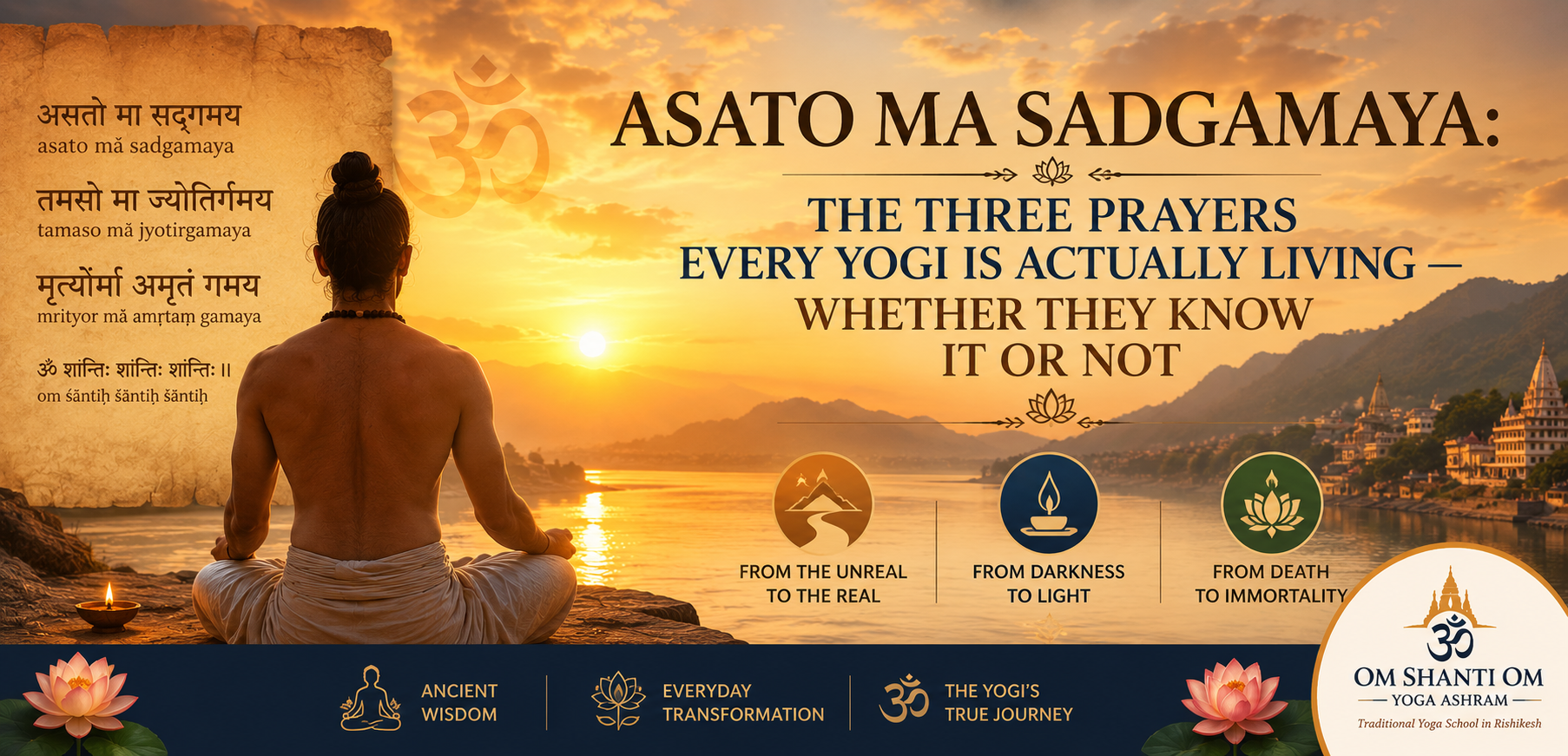
Oṁ asato mā sadgamaya Tamaso mā jyotirgamaya Mṛtyormā amṛtaṁ gamaya Oṁ śāntiḥ śāntiḥ śāntiḥ
A direct, line-by-line translation reads:
Om, lead me from the unreal to the real. Lead me from darkness to light. Lead me from death to immortality. Om, peace, peace, peace.
People sometimes lump this in with the closing chants used in Ashtanga-style classes, but it's a separate tradition entirely — older, broader, and not tied to any specific style of asana practice. You'll hear it in satsang gatherings, meditation retreats, and plenty of yoga studios that have nothing to do with Ashtanga lineage. It's become something of a universal closing prayer across many corners of the yoga and Vedanta world.
What makes it interesting structurally is that it isn't one request — it's three, stacked in a clear progression: truth, then light, then immortality. Each line builds on the one before it. And once you slow down and translate each line on its own, you start to notice that this progression isn't abstract spiritual theory. It's basically what happens, in miniature, every single time you commit to a consistent practice.
Also Read: Ashtanga Opening & Closing Mantras: Full Translation, Correct Pronunciation & Why We Chant Them
Prayer One: Asato Ma Sadgamaya — "Lead Me From Untruth to Truth"
Breaking Down the Words
Asat refers to non-being, falsehood, or the unreal. Sat is its opposite — truth, being, what's actually real. Gamaya means "lead me" or "take me toward." So the line is a direct request: take me from what's false toward what's true.
What This Is Actually Asking For
This isn't really about abstract metaphysical truth — capital-T Truth about the universe. On a practical level, it's about honesty. Specifically, honesty with yourself, which is a much harder thing to maintain than people assume.
Most of us carry around a fairly distorted self-image. We tell ourselves stories about our limits, our capabilities, our patience, our discipline — and a lot of those stories are built more on ego or fear than on anything observably true.
How Yogis Are Already Living This
On the mat, this shows up almost immediately for anyone who practices seriously. You can't fake a posture your body genuinely isn't ready for — not for long, anyway. Eventually, gravity, fatigue, or your own nervous system forces an honest accounting of where you actually are, not where your ego insists you should be.
Anyone who's tried to muscle their way into a deep backbend before their spine was ready, or forced a bind that their shoulders weren't open enough for, knows this lesson in a very physical, often painful way. Practice has an uncomfortable habit of stripping away self-deception. You either work with your actual body, or you get injured trying to perform for an imaginary one.
Off the mat, this plays out the same way. Long-term practitioners often talk about how yoga eventually forces a kind of reckoning — with how stressed they actually are, how disconnected from their body they've become, or how much of their self-image was built on stories rather than facts. That slow erosion of self-deception is, functionally, exactly what this first line is asking for.
Prayer Two: Tamaso Ma Jyotirgamaya — "Lead Me From Darkness to Light"
Breaking Down the Words
Tamas refers to darkness, but in the yogic and Vedantic context, it carries a heavier meaning than just "absence of light." It's associated with inertia, dullness, confusion, and stagnation — one of the three gunas (qualities) described in Samkhya philosophy. Jyoti means light, specifically the kind associated with illumination or insight, not just brightness.
What This Is Actually Asking For
This line is asking for clarity to replace confusion — not necessarily intellectual understanding, but the kind of insight that comes from direct experience. It's the difference between reading about something and actually getting it.
How Yogis Are Already Living This
Every practitioner has had the moment where something just clicks. Maybe it's a posture you've attempted for months without success, and then one day — for no obvious reason — your body understands what your mind had been instructing it to do all along. That's not really a flexibility breakthrough. It's an awareness breakthrough. The "darkness" of confusion lifts, and something becomes obvious that wasn't obvious before.
This happens off the mat, too, often more significantly. People frequently describe starting yoga purely for physical reasons — flexibility, strength, stress relief — and then, somewhere down the line, noticing it's quietly become a tool for emotional regulation or mental clarity they didn't expect. The shift from "I'm here to stretch" to "I'm here because this is the only hour of my day where my mind actually settles" is, in its own ordinary way, a movement from tamas to jyoti. From dullness and noise to a kind of clear-headedness.
Prayer Three: Mrityor Ma Amritam Gamaya — "Lead Me From Death to Immortality"
Breaking Down the Words
Mrityu means death. Amrita literally means "deathless" or "without death" — it's also the word used for the nectar of immortality in various mythological stories. Gamaya, again, means "lead me."
Literal vs. Symbolic Reading
Taken at face value, this sounds like a request to escape physical death, which can feel a bit out of place in a modern yoga context. But most teachers and scholars read this line symbolically rather than literally. The "death" being referenced isn't necessarily bodily death — it's the death of a limited, fixed sense of self. The small, anxious, ego-bound identity most people operate from day to day.
"Immortality" in this reading isn't about living forever. It's about touching something more stable and less fragile than your current self-concept — a sense of identity that isn't entirely dependent on your job title, your physical ability, your reputation, or whatever story you've been telling yourself about who you are.
How Yogis Are Already Living This
This is probably the slowest of the three to notice, because it happens gradually, almost without you registering it. Long-term practitioners often describe a quiet erosion of an old identity — "I'm not flexible," "I'm not athletic," "I'm too old for this," "I'm not the kind of person who meditates." Practice doesn't argue with these stories. It just slowly makes them factually untrue, one consistent session at a time, until the old identity simply can't be maintained anymore.
That's a small death, in a sense — the death of a self-image that no longer fits the evidence. And what replaces it isn't some grand spiritual immortality. It's usually something quieter: a more durable sense of self that isn't as easily shaken by a bad day, an injury, or a plateau in progress. Less attached, less fragile, more able to absorb change without falling apart.
Also Read: Guru Mantra Meaning & the Living Tradition of Guru-Shishya: More Than a Word-by-Word Translation
Why Call These "Prayers Every Yogi Is Already Living"?
Lined up together, the progression looks almost deliberate: truth, then light, then immortality. Honesty about where you actually are. Clarity that replaces confusion. A more stable sense of self that survives change.
The argument here isn't that chanting this mantra magically produces these outcomes. It's closer to the reverse: showing up to a disciplined practice over months and years tends to push people through this exact sequence, whether they ever read a single word of Sanskrit. A beginner's first honest moment on the mat — admitting their hamstrings are not, in fact, fine — is the first prayer in action. The moment a posture finally clicks after months of repetition is the second. The slow replacement of an old, limiting self-story with a steadier one is the third.
In other words, the mantra isn't handing practitioners a goal they need to go chase. It's describing a process a lot of them are already partway through, often without ever naming it.
How and When This Mantra Is Traditionally Chanted
This chant most commonly appears in satsang gatherings, meditation groups, and the closing minutes of certain yoga classes — typically slower-paced or more meditation-oriented styles rather than fast vinyasa flows. It's often set to a simple, repetitive melody, which makes it easier to pick up by ear than to read cold off a page.
A short pronunciation guide:
- "Asato" — ah-SAH-toh. Short, even syllables.
- "Mā sadgamaya" — mah sad-GA-ma-ya. The "d" and "g" are close together but distinct; don't blend them into one sound.
- "Tamaso" — TA-ma-soh.
- "Jyotirgamaya" — jyo-tir-GA-ma-ya. The "jy" cluster at the start is a single blended sound, similar to "j" in "jewel," moving quickly into "yo."
- "Mṛtyormā" — mrit-YOR-mah. The "ṛ" is a short vocalic "r" sound, tricky for English speakers — closer to "ri" than a rolled "r."
- "Amṛtaṁ gamaya" — am-RI-tam ga-ma-ya.
- "Śāntiḥ" — SHAHN-tih, repeated three times, usually said slower and softer with each repetition.
As with the Ashtanga mantras, chanting this respectfully doesn't require any particular religious background. It's widely taught in yoga and meditation communities worldwide, and most teachers welcome students learning and reciting it, regardless of where they're coming from, as long as it's approached with genuine interest rather than as an aesthetic accessory.
Bringing the Mantra Into Your Own Practice
A few ways to actually work with this mantra, rather than just listening to it:
Chant it as a closing ritual. Even just the final lines, repeated quietly to yourself at the end of practice, can create a clear sense of closure.
Journal on one line at a time. Spend a week sitting with "lead me from untruth to truth," specifically, where in your life are you currently avoiding an honest look at something? Move to the next line the following week.
Pair each line with a phase of practice. Some practitioners use the first line during intention-setting at the start of class, the second during the most physically or mentally challenging part of practice, and the third during Savasana, as a way of consciously letting go of who they were before they stepped onto the mat.
Use it as a meditation anchor. Rather than chanting it aloud, some people simply repeat the three lines silently during seated meditation, using each as a brief point of focus rather than a goal to achieve.
Also Read: Gayatri Mantra: Word-by-Word Meaning, the Science of Its Sound, and How to Chant It Correctly
Final Thoughts
The Asato Ma Sadgamaya mantra has survived for roughly 2,500 years not because it's catchy, but because the progression it describes — honesty, clarity, a steadier sense of self — is genuinely one of the more accurate descriptions of what sustained practice actually does to a person.
You don't need to chant a word of it to be moving through these stages. Most consistent practitioners already are. But it's worth asking yourself, now and then: which of these three prayers are you currently living through? Are you still working on the first one — getting honest about where you actually are? Already somewhere in the second, watching old confusion clear? Or quietly in the middle of the third, letting an old identity die so a steadier one can take its place?
There's no wrong answer. The mantra isn't a test. It's just a fairly old, fairly accurate map of a process that doesn't really end.









0 Comments
No comments yet. Be the first to comment!