


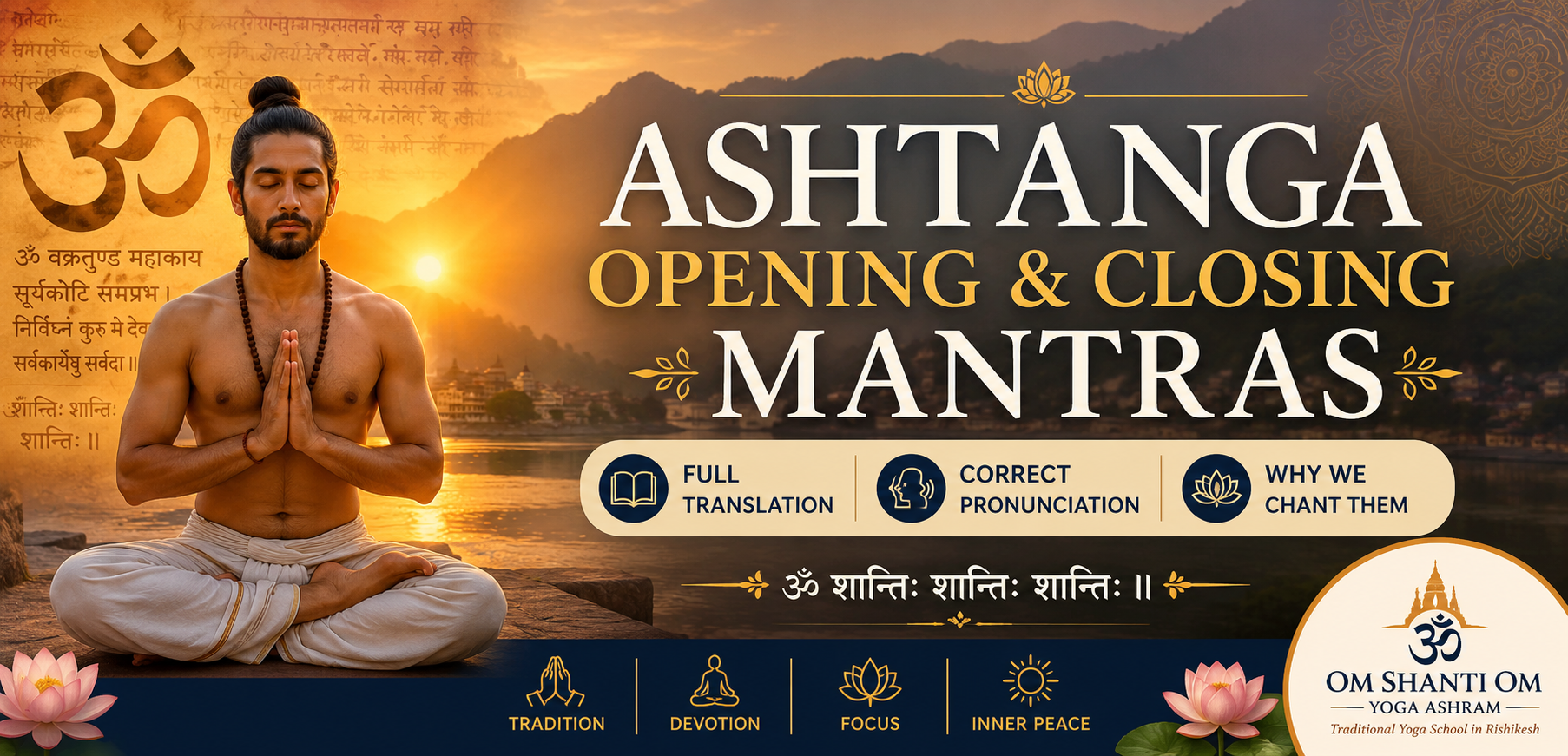
If you've ever walked into a Mysore-style Ashtanga room early in the morning, you've probably noticed something before you even unroll your mat: the chanting. A teacher, or sometimes the whole room together, opens practice with a string of Sanskrit syllables that sound ancient, slightly mysterious, and — if you're new to it — a little intimidating to repeat out loud.
That's the opening mantra. And at the end of practice, after the last breath of Savasana, there's another one, shorter and gentler, that closes things out.
Most students learn these mantras by ear, repeating sounds without necessarily knowing what they mean or why they're there. Which is fine — chanting doesn't require an advanced Sanskrit degree. But understanding the words tends to change the experience. It stops being a ritual you go along with and becomes something you're actually participating in.
This post breaks down both mantras line by line: the original Sanskrit, an honest translation, how to actually pronounce the syllables, and the reasoning behind why this practice has stuck around for generations of Ashtanga students.
What Are the Ashtanga Mantras, Exactly?
In the Ashtanga Vinyasa system as taught by Sri K. Pattabhi Jois in Mysore, India, practice is traditionally bookended by two short chants:
- The Opening Mantra — recited before practice begins, as an invocation to the sage Patanjali, who is credited with compiling the Yoga Sutras.
- The Closing Mantra — recited at the very end, after final relaxation, as a kind of universal blessing or peace prayer.
Neither mantra is exclusive to Ashtanga. The closing mantra in particular shows up across many yogic and Vedic traditions. But within Ashtanga, both have become so consistently paired with practice that for many students, they're inseparable from it — the verbal "bookends" that mark where practice starts and stops.
It's worth saying upfront: chanting is not a religious requirement, and you don't need to subscribe to any particular belief system to take part. Many teachers describe it less as worship and more as a way of consciously shifting gears — closing the laptop of daily life, so to speak, before stepping onto the mat, and then closing the practice itself before stepping back into the day.
Also Read: Guru Mantra Meaning & the Living Tradition of Guru-Shishya: More Than a Word-by-Word Translation
The Opening Mantra: Invocation to Patanjali
The Sanskrit
Oṁ Vande gurūṇāṁ caraṇāravinde sandarśita svātma sukhāva bodhe niḥśreyase jāṅgalikāyamāne saṁsāra hālāhala mohaśāntyai
Ābāhu puruṣākāraṁ śaṅkhacakrāsi dhāriṇam sahasra śirasaṁ śvetaṁ praṇamāmi patañjalim
Oṁ
The Translation
Broken into its two halves, the mantra reads roughly like this:
First half: I bow to the lotus feet of the gurus, which awaken the insight of one's own happiness — the supreme good, acting like a healer in the jungle, pacifying the poisonous delusion of worldly existence (samsara).
Second half: I bow to Patanjali, who has the form of a man down to his arms, holding a conch shell, a discus, and a sword, with a thousand radiant white heads.
That second half sounds strange out of context, and it deserves a quick explanation, because it's not random imagery — it's a specific reference.
Also Read: Gayatri Mantra: Word-by-Word Meaning, the Science of Its Sound, and How to Chant It Correctly
What It Actually Means
The first stanza is a tribute to the lineage of teachers (gurus) who pass down this practice. The metaphor of the "jungle healer" is a nice one: in traditional medicine systems, a jangali was someone who knew how to treat snakebites and poisonings in the wilderness, often using nothing but local plants and direct experience. The mantra compares a good teacher to this kind of healer — someone who can cut through the "poison" of confusion and suffering using practical, hands-on wisdom rather than abstract theory.
The second stanza honors Patanjali specifically. According to tradition, Patanjali is considered an incarnation of Adishesha, the great serpent on which the god Vishnu reclines, which explains the otherwise puzzling image of "a thousand white heads." The conch, discus, and sword he holds are symbolic tools: the conch represents the sound of creation (and by extension, the spoken word and sacred knowledge), the discus represents the wheel of time, and the sword represents the discernment needed to cut through ignorance.
So functionally, the opening mantra does two things at once: it's a gesture of respect toward the chain of teachers who kept this practice alive, and a direct nod to Patanjali as the figure who systematized yoga's philosophical framework in the Yoga Sutras.
How to Pronounce It
Sanskrit pronunciation trips people up mostly because of long vowels, retroflex consonants, and a few sounds that don't map cleanly onto English. A few pointers:
- "Oṁ" isn't a flat "ohm." It's closer to "AUM," with the sound rolling from an open "ah," through "oo," and closing with the lips on "m." Let it resonate rather than cutting it short.
- "Vande" — the "a" is short, like in "vandal." Stress falls on the first syllable: VAHN-deh.
- "Gurūṇāṁ" — note the long "ū" (goo-ROO-nahm), not "guru-nam" rushed together.
- "Caraṇāravinde" — broken down: cha-ra-NAH-ra-vin-deh. The "c" is pronounced like "ch" in "chair," not like an English "k" or "s."
- "Jāṅgalikāyamāne" — the trickiest line for most beginners. Take it slow: jahn-ga-li-KAH-ya-MAH-neh.
- "Saṁsāra hālāhala" — saṅ-SAH-ra HAH-lah-ha-la. Both "ā" sounds are long and held, not clipped.
- "Śaṅkhacakrāsi" — the "ś" is a softer "sh" sound (like "shoe"), distinct from the harder "s." Shahn-kha-cha-KRAH-si.
- "Sahasra śirasaṁ śvetaṁ" — sa-HA-sra SHI-ra-sam SHVE-tam. Notice the repeated "sh" sounds give this line a kind of hiss that's actually meant to be there.
A few common mistakes to watch for: rushing through compound words instead of breaking them into syllables, flattening long vowels into short ones, and pronouncing "c" as "k" (it should always sound like "ch"). If you're learning this for the first time, it genuinely helps to listen to a recording from a teacher trained in traditional chanting and repeat phrase by phrase rather than trying to read the whole thing cold.
Why We Chant It
Beyond the literal translation, the opening mantra serves a few practical purposes in the context of practice:
It marks a transition. Chanting out loud (or even silently) creates a clear before-and-after. You're no longer checking your phone or thinking about your to-do list — you're now in practice mode.
It situates you in a lineage. Yoga as it's taught today didn't appear out of nowhere. The mantra is a small acknowledgment that you're stepping into something that's been refined and passed down by real people, across real time, long before you arrived.
It sets an intention. Bowing to "the happiness of one's own true self" before a physically demanding practice is a reminder that the point isn't to perform poses for their own sake — it's to use the practice as a tool for something deeper.
The Closing Mantra: A Universal Prayer for Wellbeing
The Sanskrit
Svastiprajābhyaḥ paripālayantāṁ nyāyena mārgeṇa mahīṁ mahīśāḥ gobrāhmaṇebhyaḥ śubhamastu nityaṁ lokāḥ samastā sukhino bhavantu
The Translation
May the rulers of the earth keep to the path of virtue, governing the world by good and just means. May there be perpetual goodness for those who safeguard knowledge and the sacred (traditionally interpreted as the cows and Brahmins, symbolic of nourishment and wisdom). May all beings everywhere be happy and free.
What It Actually Means
Unlike the opening mantra, which is specific to yoga and Patanjali, the closing mantra is a "Mangala" — a generic peace and welfare prayer found across various Sanskrit texts. It's less about yoga specifically and more about wishing well for the world at large: good governance, the protection of knowledge and resources, and basic happiness for all living beings, full stop.
There's no hidden complexity here, the way there is with the imagery of Patanjali. It's a closing benediction — a way of saying, "Let whatever I gained in this practice extend outward, instead of staying locked up inside my own experience."
That's actually a meaningful structural choice. The opening mantra is inward and reverent, directed at teachers and tradition. The closing mantra flips outward, directed at the world. You start by acknowledging where the practice came from, and you end by sending something back out into it.
How to Pronounce It
This mantra is shorter and a bit more rhythmic, which makes it slightly easier to pick up:
- "Svastiprajābhyaḥ" — SVAS-ti-pra-JAH-bhyah. The "sv" cluster at the start can feel awkward; say it more like "svuh" with a quick transition into "asti."
- "Paripālayantāṁ" — pa-ri-PAH-la-yan-tahm. Even, steady syllables, no sound dropped.
- "Nyāyena mārgeṇa" — NYAH-ye-na MAR-ge-na. The "ny" at the start of "nyāyena" is a single blended sound, similar to the "ny" in "canyon."
- "Mahīṁ mahīśāḥ" — ma-HEEM ma-HEE-shah. Notice the rhyme-like repetition; it's meant to flow.
- "Gobrāhmaṇebhyaḥ" — go-BRAH-ma-ne-bhyah. Take this one in two clean chunks: "go" then "brahmanebhyah."
- "Śubhamastu nityaṁ" — SHU-bha-mas-tu NIT-yam. Soft "sh," and the final "m" gets a light nasal hum, not a hard stop.
- "Lokāḥ samastā sukhino bhavantu" — lo-KAH sa-mas-TAH su-KHI-no bha-VAN-tu. This final line is often chanted slightly slower and louder, since it's effectively the "main point" of the whole prayer.
A helpful trick: this entire mantra has a kind of singsong cadence once you know it, similar to a nursery rhyme. Once you stop trying to read it like prose and start letting the natural rhythm guide you, it gets much easier to remember.
Why We Chant It
Coming after Savasana, the closing mantra works almost like emotional punctuation. A few reasons it's worth keeping in the routine:
It closes the loop. If the opening mantra marks the start of practice, this one marks a clear, intentional end — rather than just standing up and walking out.
It redirects focus outward. After an hour or two of intense, often inward-focused physical work, this mantra is a gentle nudge to remember that practice isn't only self-improvement for its own sake — it's also meant to make you a slightly better participant in the world around you.
It's an act of humility. Wishing well for "all beings" — not just yourself, your studio, or your country — keeps practice from becoming self-centered, which is an easy trap in a practice as physically demanding as Ashtanga.
Tips for Actually Learning to Chant These
If you want to get comfortable with both mantras rather than just mumbling along, a few practical suggestions:
- Learn it in phrases, not as one long block. Both mantras are made of natural line breaks. Master one line completely before moving to the next.
- Use a recording from a trained chanter, ideally someone who learned in the traditional oral lineage, rather than relying purely on a transliterated text. Sanskrit has tonal and rhythmic qualities that are hard to capture in writing alone.
- Say it slowly first, then build speed. Most teachers chant at a clip that sounds effortless because they've repeated it hundreds of times — not because it's meant to be rushed when you're learning.
- It's okay to chant silently or under your breath at first. No rule says you have to belt it out from day one. Many students mouth along quietly for months before chanting confidently out loud.
- Don't worry about "perfect" pronunciation immediately. Intention and consistency matter more than flawless Sanskrit, especially at the start. Refinement comes with repetition.
The Deeper Layer: Why Chanting Matters at All
If you strip away the specific words, chanting itself has a function in yoga that goes beyond translation. In yogic philosophy, sound (and specifically the vibration created by chanting) is considered a way of focusing and settling the mind — sometimes called nada yoga, or the yoga of sound.
There's a practical version of this, too, no mysticism required: chanting forces you to slow your breath, focus your attention on something specific, and physically transition out of whatever mental noise you were carrying in from the rest of your day. By the time you finish the opening mantra, you've usually taken several long, controlled breaths and quieted your inner monologue, even if just slightly. That's not nothing — it's a genuinely useful warm-up for the breath-focused work that the rest of Ashtanga practice demands.
In that sense, the mantras aren't separate from the physical practice. They're an extension of it — the same emphasis on breath, focus, and presence, just expressed through voice instead of movement.
Final Thoughts
You don't need to be fluent in Sanskrit, religious, or even particularly spiritual to get something out of these mantras. At a basic level, they're bookends: one that asks for clarity and humility before you begin, and one that sends goodwill back out into the world once you're done.
Learning what the words actually mean tends to deepen that experience — not because the meaning is required, but because most people find it more satisfying to recite something with understanding rather than by rote. The next time you're in a Mysore room and the chanting starts, you'll at least know exactly what you're saying, and why generations of practitioners before you decided it was worth saying in the first place.
FAQ
Do I have to chant to practice Ashtanga?
No. Many students practice without chanting, especially outside of traditional Mysore-style settings. It's a long-standing convention, not a strict requirement.
Is it disrespectful to chant if I'm not Hindu or from an Indian background?
Generally, no — these mantras are widely taught and chanted by practitioners from all backgrounds worldwide, and most teachers in the Ashtanga lineage actively encourage students to learn them. As with any tradition you didn't grow up in, approaching it with curiosity and respect (rather than treating it as a quirky add-on) goes a long way.
Where can I hear the correct pronunciation?
Look for recordings or classes led by teachers trained directly in the Ashtanga lineage, ideally with experience in traditional Sanskrit chanting. Listening repeatedly and chanting along, rather than reading silently, is the fastest way to internalize the correct rhythm and sound.








0 Comments
No comments yet. Be the first to comment!