


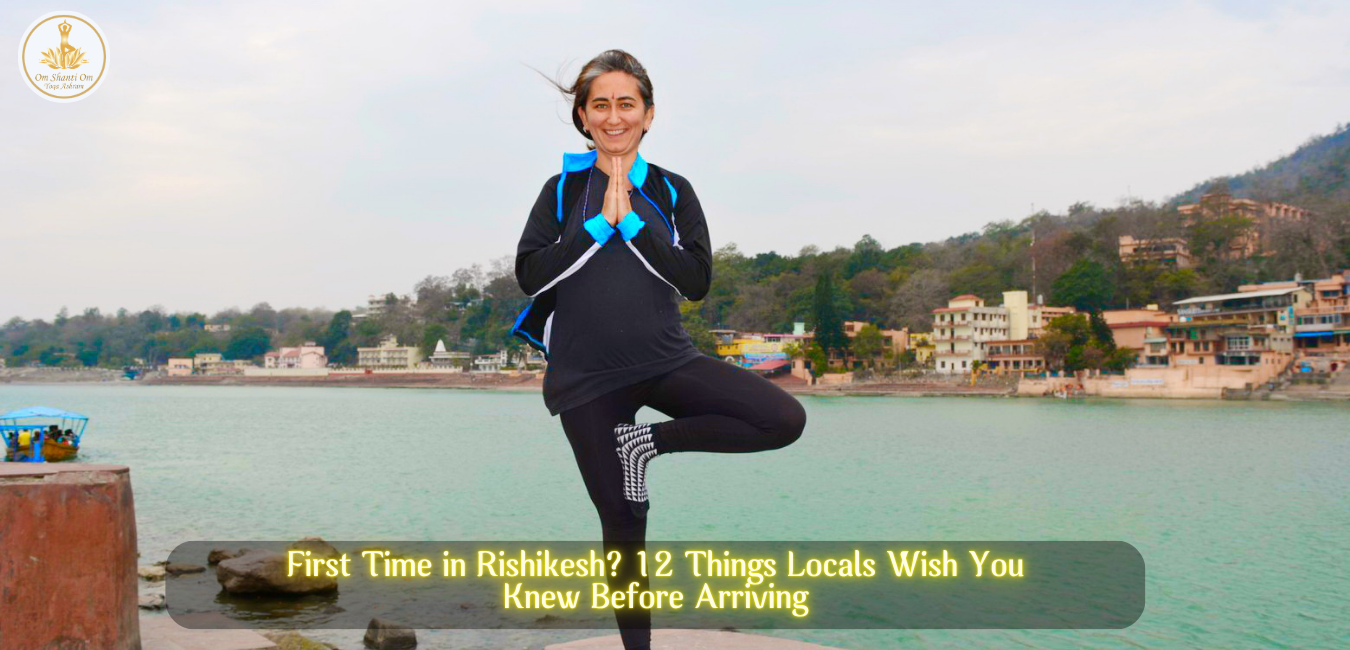
Every first-time visitor to Rishikesh arrives with some version of the same picture. Misty mountains. A glassy Ganges at sunrise. Saffron-robed sadhus on stone ghats. Yoga on rooftops. Peace.
And the real place delivers all of that — just mixed in with a few things the pictures leave out. Motorbikes threading through narrow lanes. Monkeys with opinions about your breakfast. Power cuts that arrive without warning and leave just as quietly. A daily rhythm that starts at 5 am and doesn't apologize for it.
We've watched hundreds of first-time students arrive at this ashram over the years. The ones who settle in quickly, who find their footing fast and get the most out of their time here, are almost always the ones who arrived knowing what to expect. Not the Instagram version — the real one.
This post is that briefing. Twelve things the people who live and teach here year-round wish every first-timer knew before they landed.
A Quick Orientation — What Rishikesh Actually Is
Rishikesh sits in the Himalayan foothills of Uttarakhand, at the point where the Ganges descends from the mountains onto the plains. It is not a beach town, a resort city, or a party destination. It is a pilgrimage town — one of the holiest cities in Hindu tradition — that has, over the past several decades, also become one of the most important centers for yoga education in the world.
Most visitors spend their time in the Laxman Jhula and Ram Jhula areas, where ashrams, yoga schools, cafes, and guesthouses are clustered along the river. The main city, a short distance away, is where locals shop, work, and live — noticeably less curated than the yoga district but equally worth knowing about.
What surprises most first-timers is how layered it is. Quieter than expected in some ways. Louder and more chaotic in others. Deeper and more interesting than any single photo can capture.
Also Read: How to Choose a Yoga Teacher Training in Rishikesh: 10 Honest Questions to Ask Before You Book
The 12 Things Locals Wish You Knew
1. The Ganges Is Sacred — Not a Swimming Spot
This is the first thing, and it's important enough to say clearly: the Ganga is not a recreational river. For the people who live here — and for millions of pilgrims who travel to its banks — it is sacred in a way that goes beyond what most visitors from outside India have encountered before.
Behavior near the river should reflect that. Swimming for leisure in the main flow is strongly discouraged, and not only for spiritual reasons: the current is significantly stronger than it looks, and every year people are injured or killed because they underestimate it. Wade in shallow areas only, and pay attention to locals' cues about where and how it's appropriate to enter the water.
Near the ghats, dress and behave as you would at a temple. The Ganga isn't a backdrop — it's the point.
2. Dress Modestly — Especially Near Temples and the River
Rishikesh is a conservative religious city, and the clothing norms reflect that. Covered shoulders and knees are the baseline expectation near temples, ghats, and ashrams. Beachwear, crop tops, and shorts that end above the knee are jarring in this context — not just to locals, but to the overall atmosphere of the place.
The practical solution is simple: carry a light cotton scarf or shawl. It weighs almost nothing in a bag, works in every situation, and you'll reach for it more than you expect. A good rule of thumb: if you're going anywhere near the river or a temple, the scarf comes out.
This isn't about judgment. It's about arriving as a guest in someone else's sacred space and dressing accordingly.
Also Read: What Makes a World-Class Yoga Teacher Training? 7 Things to Look for in 2026
3. The Power Cuts Are Real — Pack Accordingly
Load shedding — scheduled or unscheduled interruptions to electricity — is a genuine feature of daily life in Rishikesh. Even well-run ashrams with backup systems experience it. A generator kicks in for the essentials; everything else waits.
What this means practically: bring a small headlamp or torch for navigating dimly lit corridors and stairwells during outages. Bring a power bank with enough capacity to keep your phone charged through a day or two of reduced charging access. And bring the expectation that this is normal — not a sign that something has gone wrong.
Most people adjust within a day or two. The power cuts that felt disruptive on day one become background events by day five. Some students find, by the end of their training, that they barely notice them anymore.
4. The Food Is Predominantly Vegetarian — and That's the Point
Rishikesh is, in practice, almost entirely vegetarian. The city's deeply religious character, combined with its status as a center for yogic practice, means that meat is rare — and in the core ashram areas, essentially absent. Alcohol is officially prohibited in many parts of the city, not merely frowned upon.
If your home diet runs heavily on meat, this adjustment takes a few days. After that, most visitors discover that the vegetarian food here — genuinely varied, well-spiced, often freshly prepared — is far more satisfying than they expected.
At an ashram specifically, expect sattvic meals: simple, nourishing food prepared with the intention of supporting clear, steady energy rather than stimulation. This means less oil, less spice, and more whole ingredients than you'd find at a restaurant. It's not exciting food. It's deeply sustaining food, and there's a difference.
5. The Weather Is Nothing Like You Probably Imagined
Rishikesh doesn't have one climate — it has several, depending entirely on when you arrive.
October through February brings cool to cold weather, particularly in the mornings and evenings. This is peak season, and the climate is genuinely ideal for intensive practice — fresh air, clear skies, and temperatures that make an early morning session feel bracing rather than punishing. March and April are warm and pleasant. May and June bring significant heat and humidity before the monsoon breaks. July through September is monsoon season: heavy rain, lush greenery, and a quieter, slower pace around the ashram.
The one thing that surprises visitors across every season is how cold early mornings can be. Even in May, sitting still in meditation or pranayama at 5 am requires a warm layer. Pack at least one thermal or fleece specifically for morning practice, regardless of when you're arriving.
Also Read: Also Read: Hatha Yoga Teacher Training Programs - Online & In-Person Courses
6. Connectivity Is Inconsistent — Use That
WiFi at ashrams and cafes is available but unreliable. Mobile data speeds vary considerably depending on your carrier and location. Streaming, video calls, and even basic browsing can be frustratingly slow at certain times of day.
Before arriving: download offline maps (Google Maps offline works well for Rishikesh), save any documents or schedules you'll need, and download anything you were planning to read or watch during downtime. Don't count on reliable access to anything cloud-based during your first week.
Here's the other thing, though: the patchy connectivity is not just an inconvenience. For most students arriving from high-stimulus, always-connected environments, a week of unreliable WiFi quietly becomes one of the best things about the experience. The disconnection creates space. Use it.
7. Mornings Here Start Earlier Than You're Used To
A 5 am wake-up is not an ambitious choice in Rishikesh — it's simply how the day begins. Ashram life is structured around the early hours, when the air is clear, the river is relatively quiet, and the mind is at its most receptive before the day's noise begins.
Most students struggle with this for the first three to five days. The body fights it. The impulse to negotiate — just this once, just ten more minutes — is strong. And then, somewhere around day four or five, something shifts. The early morning stops feeling like a demand and starts feeling like the best part of the day.
If you want to make that transition faster, start shifting your sleep schedule two weeks before you arrive. Move your bedtime earlier by fifteen to thirty minutes every few days. Arrive already partially adjusted, and the first week becomes significantly easier.
8. Monkeys Are Everywhere — and They Are Not Pets
Rishikesh has a large and remarkably bold monkey population. They are on the suspension bridges, the ghats, the rooftops, and occasionally inside rooms if windows are left open. They are not afraid of people. They are particularly interested in food.
Do not feed them — it reinforces aggressive behavior and creates problems for everyone who comes after you. Do not make direct eye contact while you're holding something they might want. Keep bags closed and zipped when you're outdoors, especially near the Laxman Jhula bridge, where the monkey density is highest, and opportunistic theft of snacks, sunglasses, and anything shiny is a genuine daily occurrence.
If a monkey approaches you, stay calm, don't run, and back away slowly without looking threatening. They generally lose interest quickly once it's clear you have nothing to offer.
9. Bargaining Is Normal in Markets — But Not Everywhere
In local markets, street stalls, and with auto-rickshaw drivers, gentle negotiation over price is a normal part of the transaction. Starting at roughly half the quoted price and settling somewhere in the middle is a common rhythm. This isn't adversarial — it's simply how business works in many contexts here.
At fixed-price shops (usually indicated as such), restaurants, and ashrams, bargaining is not appropriate. And even in contexts where negotiation is normal, there's a meaningful difference between respectful back-and-forth and aggressive haggling over amounts that, in the context of local livelihoods, are genuinely small.
A useful internal check: if the amount you're trying to save is the equivalent of a few rupees, it may not be worth the energy — or the relationship.
Also Read: How to Become a Certified Yoga Teacher in India: Complete Guide 2026
10. Aarti Is Worth Waking Up For — or Staying Up For
Ganga Aarti — the fire ritual offered at the river's edge at dusk — is one of the most genuinely moving things you can witness in Rishikesh. Parmarth Niketan ashram holds a well-known evening aarti at sunset, involving priests, fire, bells, and chanting on the steps leading down to the river. It draws both pilgrims and visitors, and on most evenings it is beautiful in a way that is hard to describe in advance.
There is also a morning aarti for those who are already up at the right hour, which tends to be more intimate and significantly less crowded.
Attend as an observer, not a tourist attraction. Arrive before it begins. Keep your phone away unless you've been there long enough to absorb it first. Move toward the edges of the gathering if you need to leave early. And if you're invited to participate — to offer flowers or fire — accept with both hands and genuine attention.
11. Your Practice Will Feel Different Here — That's Normal
Almost every student who arrives for a YTT or intensive practice notices the same thing in the first few days: their body is behaving differently. Poses that felt accessible at home suddenly feel harder. Fatigue arrives earlier. Emotions surface unexpectedly.
Some of this is altitude adjustment, some is the change in climate and diet, some is the shift in daily schedule, and some is simply what happens when a practice that was previously done in a comfortable, controlled environment is suddenly being done at 5 am in a new place after an international journey.
This adjustment period is part of the training, not an obstacle to it. The body is recalibrating. Within a week — sometimes less — most students find their footing again, often practicing at a depth they hadn't reached before. Trust the process. Don't judge your first three days as representative of the full experience.
12. Slow Down — The City Rewards Patience Over Agenda
Rishikesh operates on a different rhythm from most cities visitors come from. Things take longer here. An auto-rickshaw that was supposed to arrive at a certain time may arrive fifteen minutes later. A meal at a restaurant may take considerably longer than expected. Administrative processes, paperwork, and logistics move at their own pace.
Trying to impose a tight Western schedule on this environment produces frustration. Arriving with a loosely held itinerary — a list of things you'd like to do, without a fixed order or timeline — produces a much better experience.
Some of the most significant moments people carry home from Rishikesh were not planned. A conversation with a sadhu at the river. An unexpected invitation to join an evening puja. A solo walk that turned into two hours on a quiet ghat. These things happen in the spaces between the schedule. They require a little patience and a willingness to let go of the plan.
Also Read: 7 Stages of Kundalini Awakening: Yoga Basis Guide
Practical Packing List for Rishikesh
Clothing: Light, modest layers; practice wear (non-restrictive, breathable); at least one warm layer for early mornings; a cotton scarf or shawl; comfortable walking shoes and flip-flops for the ashram.
Gear: Headlamp or small torch; power bank (10,000mAh or above); universal power adapter; reusable water bottle with filter if possible.
Health: Any personal medications in original packaging; insect repellent; electrolyte sachets for hot months; basic stomach remedies (probiotic, rehydration salts); a small first-aid kit.
Documents: Printed copies of your visa, booking confirmations, and passport photo pages — power cuts and poor connectivity mean digital-only access isn't always reliable.
Mindset: Flexibility, genuine curiosity, a schedule held loosely, and significantly reduced expectations around WiFi speed.
A Note on Arriving at an Ashram Specifically
Stepping from travel mode into ashram mode is a real transition, and it happens fast. Within an hour of arriving, you're likely to be on a set schedule, eating at set times, and sleeping in simple accommodation shared with people you've just met.
A few things that make this easier: arrive with your phone already on silent as a default. Learn the meal times and be on time for them — shared schedules work because everyone shows up. Observe the quiet hours, particularly early mornings and late evenings. Ask before you photograph anything or anyone.
The single thing that most consistently shapes whether someone has a good ashram experience or a difficult one is whether they surrender to the structure or spend the first week negotiating with it. The structure exists for a reason. Let it work.
Conclusion
Rishikesh is genuinely unlike anywhere else — a place where ancient pilgrimage routes, serious yogic education, and a very particular quality of mountain-river air combine into something that changes most people who spend time here in ways they don't fully understand until they're home.
It rewards people who arrive prepared, curious, and willing to be surprised. It can frustrate people who arrive with a fixed picture of what it should be and a tight agenda for making that happen.
You now know more than most people do before their first visit. What remains is simply to show up — on time, modestly dressed, with a scarf in your bag and a power bank in your kit — and let the place do what it does.












0 Comments
No comments yet. Be the first to comment!