

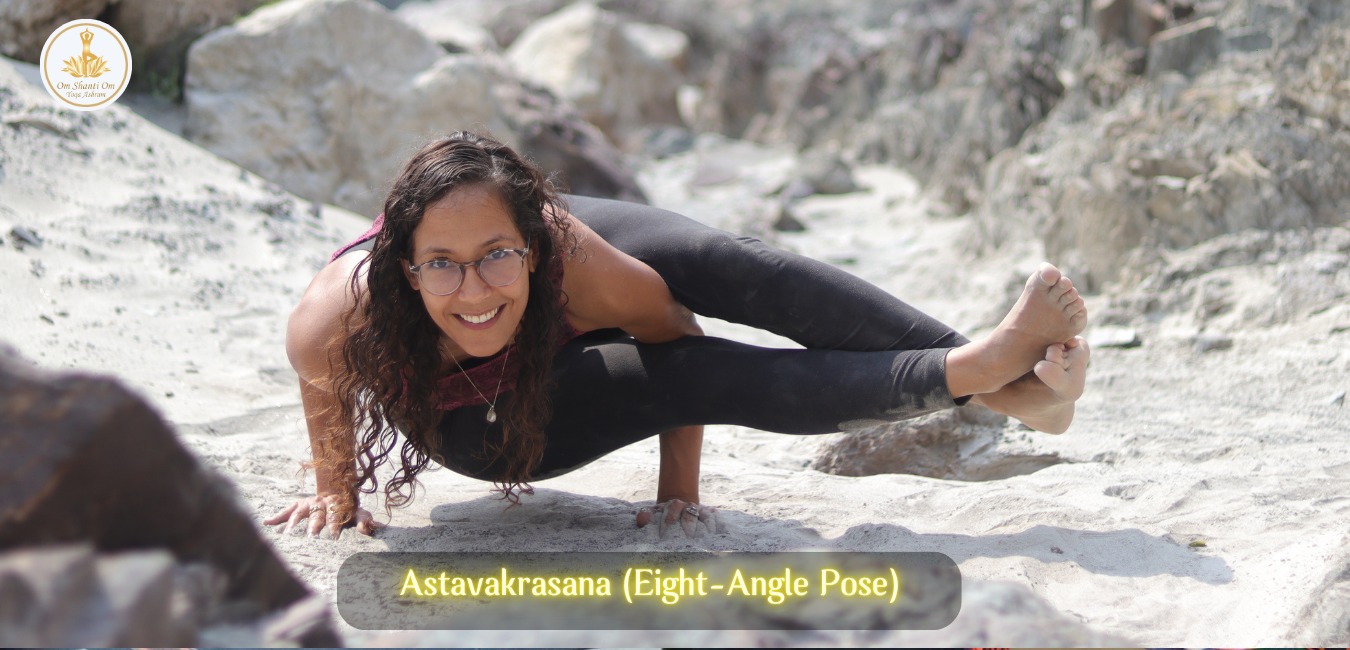
The Eight-Angle Pose (Astavakrasana) is a contemporary arm-balancing yoga pose. This is a very powerful pose, which demands extreme power in the core, back and arms to hold the body. It is not a pose that everybody can perform because it requires high levels of arm and core muscles.
In the eight-angle pose, your arms are in the Chaturanga posture, and you are in balance on either side, lying on one arm at a time. This position is ideal for developing mind-to-muscle interaction. Simultaneously, you get to tighten your entire body with this pose. Astavakrasana (eight-angle pose) improves core strength and balance.
History Behind the Pose
Astavakra is named in the Sanskrit words, such as Astavakra, who was a handicapped sage as well as the guru of King Janaka, spiritually. Beginners should practice 8-limb poses under guidance. The name of the sage was Astavakra, which means eight curvatures that were connected to the eight bends of his handicap. The second word is Asana, which means pose or posture. In this yoga, the practitioner twists gently into a figure of eight position to open the hips.
Eight-angle pose is not discussed in any ancient Hatha yoga books. The book Vyayama Dipika (a book about gymnastics), which was first written in the 19th century, first mentions this. This was later taken up by Krishnamacharya in Mysore and acquired by his disciples, one of whom gave the pose officially as a modern yoga pose in his book Light on Yoga in the 20th century, bearing his name, B.K.S. Iyengar.
_1764243264.jpg)
Step-by-Step Guide to Astavakrasana
Eight-angle pose can be practised in the following steps:
- Begin with the Staff pose. Keep your legs straight in front and your hands straight on your side. The Eight angle pose enhances flexibility and arm strength.
- Bend the right leg and grab the right foot with both hands. Draw your foot near your chest, hold your right leg perpendicular and find out whether the muscle is tightening or not.
- Breathe a couple of times deeply and bend your right knee on your right arm. Ensure that you flex the right leg high, and at right angles with the ground.
- Over your right shoulder, bend your right leg and leave your left leg straight in front of you. Place both hands at your side on the mat, and you are ready to pose like an Elephant's trunk.
- Breathe a few times, and feel relaxed here. Now, draw it in deep, squeeze it inside and swing your left leg to place your left foot around your right leg.
- Focus and take a long breath. You press your fingers into your mat and take your lower body up the mat.
- Bend with 90 degrees (as in Chaturanga Dandasana) and hinge forward with the upper part, and make your legs parallel to the floor at a right angle.
- Find body balance by being focused on your senses, muscles and breath. Take this position here for a little duration of time and breathe slowly.
- Lie flat on the yoga mat with your pelvis and go back to the Staff pose and take a few breaths.
Read Also:- 200 Hour Yoga Teacher Training in Rishikesh
Breath Awareness
- Breath: Before leaving the mat, make sure to activate your core, pelvis, and fingers.
- Exhale: As you lift your pelvis off the mat and into the Chaturanga arms.
- Performance Duration for Beginners: This episode provides insight into the duration of a typical performance and its key characteristics, including the performer's posture and the audience's closeness.
_(1)_1764243406.jpg)
Precautions to follow
Sit on Astavakrasana between 10 and 30 seconds on both sides.
- Performance Time Advanced: Sit on Astavakrasana between 30 to 90 seconds on each side.
- Things to Keep in Mind: All the balances in arm holds are dependent on the awareness of the alignment, and therefore, here are the posture reminders to you on how to perform the eight-angle pose.
- Maintain your core: When there is a weak core, it means that you have to work on your abs, thighs, and back muscles before attempting Astavakrasana. You will not be able to lift your lower body out of the mat without an involved core.
- Watch the position of your hands: As the palms of your hands, place them directly below your shoulders. Do not put them too close to your glutes because in this way you can bend your elbows to make Chaturanga arms without difficulties.
Benefits of Eight-Angle Pose
Eight-Angle Pose or Astavakrasana is a pose with numerous physical and mental effects. This difficult yoga pose can be very effective by incorporating strength, flexibility, and balance into your general well-being.
Physical Benefits
- Makes you strong in the arms and core: Even as you are using your upper body to raise and stabilize yourself in Eight-Angle Pose, you will develop strength in your arms, shoulders, and core muscles. Warm up with wheel pose before advanced backbends. You can prepare your body with hip-openers like full pigeon pose and grounding practices such as lotus position yoga to build the stability.
- Strengthens back muscles: It also strengthens back muscles that work towards improving the back posture and avoiding back pain.
- Strengthens the hamstrings: When you stretch your legs in Eight-Angle Pose and twist them, you also get a deep hamstring pull, which will make you flexible and eliminate tightness.
- Improves balance: The balance needed to support the Eight-Angle Pose is a challenge to your stability and proprioception, which improves your overall balance and coordination.
Mental Benefits
- Improves body awareness: The Eight-Angle Pose is an uninterrupted practice that demands attention and mindfulness, which brings the mind and the body closer to each other.
- Increases focus: The focus required to hold the pose can help to improve your concentration on and off the mat.
- Develops confidence: Once you develop the ability to do the Eight-Angle Pose and become comfortable with it, you will develop confidence and belief in your capabilities.
Also Go Through:- 7 Days Ayurveda Yoga Retreat in Rishikesh

Wind Up
The Eight-Angle Pose (also known as Astavakrasana) is a difficult and gratifying yoga posture that can provide many physical and mental advantages. Strengthen your core with the boat pose every morning. With these steps, tips and variations, you would be able to build the strength, flexibility and balance required to master this pose.
Be patient, mindful, and enjoy the exploration of the Eight-Angle Pose. Flow smoothly from mermaid yoga into hip-opening stretches. Stretch your spine gently in half, lord of the fish pose. If you want to get a successful career as a yoga teacher, our yoga teacher training course will help you the best.






0 Comments
No comments yet. Be the first to comment!