


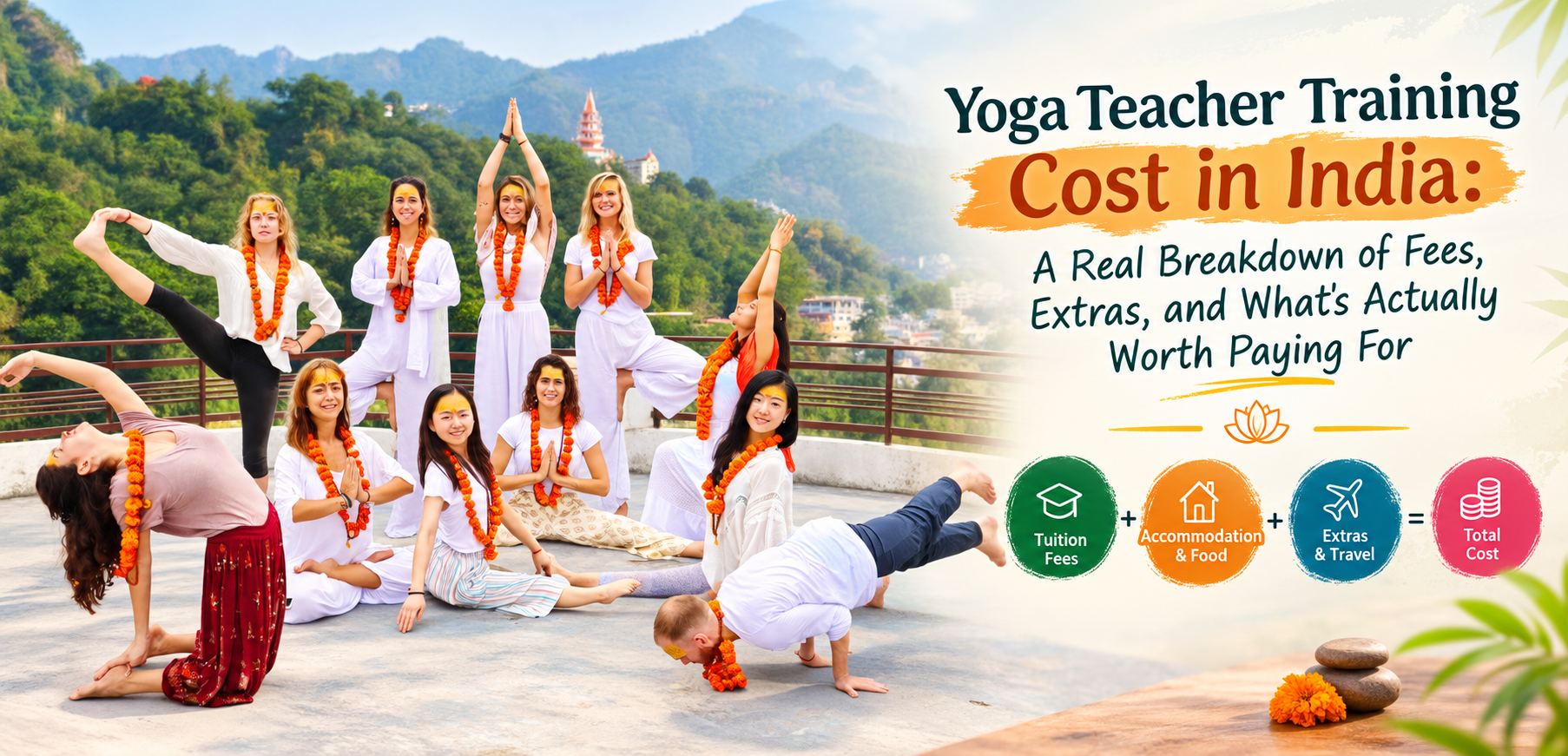
If you have spent any time researching yoga teacher training in India, you have probably noticed something odd: two schools sitting a few streets apart in the same town can charge wildly different prices for what looks, on paper, like the same 200 hour Yoga Teacher Training Course. One quotes $650. Another quotes $2,200. Both promise Yoga Alliance certification, "authentic" teaching, and life-changing transformation.
So which one is actually worth your money?
This guide answers that question. Not with vague reassurances, but with real numbers, what drives prices up or down, and a few honest warnings about the corners some schools cut to hit that headline-grabbing low price. Whether you're saving up for your first 200-hour course or weighing a 500-hour program to go pro, here's what you actually need to know before you book.

Why India Is Still the Cheapest Place to Train — And Why That's Not the Whole Story
Yoga was born in India, and that history still shapes the economics of teacher training here. Local costs for accommodation, food, and staffing are lower than in the US, Europe, or Australia, which is why a comprehensive 200 hour Yoga Teacher Training Course with room and board included can cost less in Rishikesh than a single month's rent in a mid-sized Western city.
That said, "cheap" and "good value" aren't the same thing. India's yoga industry has grown fast — new schools open every year, especially in hotspots like Rishikesh, Goa, Dharamshala, and parts of Kerala — and not all of them have earned their reputation the hard way. Some genuinely offer excellent training at a fair price. Others cut every possible corner: overcrowded batches, underqualified instructors, and certificates that look impressive but carry little actual credibility with employers or studios back home.
The goal here isn't to scare you away from budget options. It's to help you understand what you're paying for, so a low number on a website doesn't end up being the most expensive mistake of your trip.
Average Yoga Teacher Training Costs by Course Length
Prices shift depending on the school, the season, and the region, but here's a realistic range based on what's currently being charged across reputable Indian yoga schools.
50 hour Yoga TTC: Typically a short, focused add-on course (Yin yoga, meditation, or a specific style) rather than a standalone certification. Expect roughly $250 to $500, often without accommodation included.
100 Hour Yoga TTC: A compact introductory program, usually 12–15 days. Costs generally fall between $400 and $900, with basic shared accommodation and meals bundled in at most schools.
200 Hour Yoga TTC: The most common entry point for anyone wanting a full, internationally recognized certification. This is where the price range widens the most — anywhere from $650 to over $2,000 for a 21–26 day program, depending on room type, school reputation, and location.
300 Hour Yoga TTC: Aimed at those who've already completed a 200-hour course and want to go deeper or move toward a 500-hour RYT status. Expect $900 to $2,000+, usually over 25–33 days.
500 Hour Yoga TTC: Either taken as a single intensive program or completed as 200 + 300 hours combined. Standalone 500-hour courses typically run $1,800 to $3,500, spanning 45–55 days.
| Course | Typical Duration | Average Price Range | Certification |
|---|---|---|---|
| 50-Hour Yoga TTC | 7–10 days | $250–$500 | School certificate |
| 100-Hour Yoga TTC | 12–15 days | $400–$900 | School certificate |
| 200-Hour Yoga TTC | 21–26 days | $650–$2,000+ | RYS 200 (Yoga Alliance) |
| 300-Hour Yoga TTC | 25–33 days | $900–$2,000+ | RYS 300 (Yoga Alliance) |
| 500-Hour Yoga TTC | 45–55 days | $1,800–$3,500 | RYS 500 (Yoga Alliance) |
Keep in mind these are ballpark figures. A school's exact pricing can shift by season, promotional offers, or last-minute seat availability, so always check current rates directly with the school rather than relying on numbers you find in old blog posts (including this one, a year or two from now).
What Actually Drives the Price Up or Down
If you're trying to figure out why one 200-hour course costs three times as much as another, it usually comes down to a handful of factors.
Location matters more than people expect.
Rishikesh tends to be more affordable than Goa or Kerala, partly because it's long been the epicenter of yoga training in India and has more schools competing for students. Beach-town locations like Goa often charge a premium simply for the setting, even when the curriculum is comparable.
Room type is one of the biggest swing factors.
A 4-person shared dorm room can cost less than half of what a private room with an attached bathroom runs. If budget is tight, sharing is by far the easiest way to bring the total down without sacrificing the actual teaching quality.
Season plays a bigger role than most people realize.
October through March is peak season in most of India — pleasant weather, more tourists, higher demand, and correspondingly higher prices. Booking during the monsoon months (July–September) or the height of summer can sometimes shave a meaningful amount off the fee, though you'll want to weigh that against less comfortable weather for practicing outdoors.
School reputation and accreditation history carry real weight.
A school that's been Yoga Alliance registered for two decades, with thousands of alumni and a director who's personally studied under a well-known lineage, is going to price itself differently than a school that opened eighteen months ago. That's not automatically a red flag for the newer school — but it's a reason to dig into reviews more carefully before committing.
Added specializations bump up the price too.
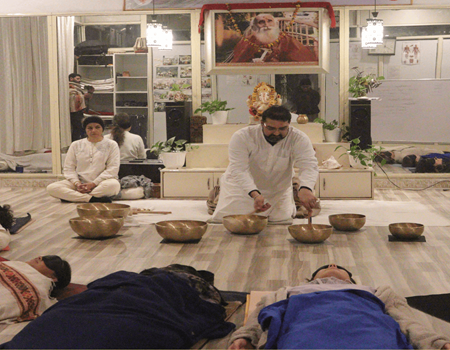
Courses bundled with sound healing, Ayurveda modules, or Yin yoga tend to sit at the higher end of their category, since they typically bring in guest teachers or additional equipment.

What's Usually Included in the Course Fee
Most reputable schools bundle far more into the price than just "classes." Here's what a typical fee generally covers:
- Shared or private accommodation for the full course duration
- Three vegetarian (often satvic) meals a day, plus herbal tea
- All study materials — manuals, guidebooks, sometimes a yoga mat and props
- Yoga Alliance registration and certification upon completion
- Airport or railway station pickup (usually from the nearest major hub)
- Opening and closing ceremonies
- Some cultural extras — evening kirtan, a guided excursion or two, sometimes a puja or fire ceremony
This bundling is actually one of the strongest arguments for training in India rather than closer to home. In many Western countries, a 200-hour course alone (with no accommodation or meals) can cost $2,500–$4,000, and you'd still need to pay separately for somewhere to live and eat for a month.
The Hidden Costs Nobody Puts on the Homepage
This is the part most schools gloss over, and it's exactly where your actual trip budget can quietly balloon.
International flights. Obvious, but easy to underestimate — especially if you're flying from outside Asia during peak season.
Visa fees. Most travelers will need an e-Visa or tourist visa for India, which comes with its own processing fee depending on your nationality and visa length.
Individual Yoga Alliance registration. Some schools' course fees include the school's accreditation costs but not your personal RYT (Registered Yoga Teacher) registration fee with Yoga Alliance, which you may need to pay separately once you're certified and want to register as an instructor.
Local transport beyond the included pickup. If you want to explore beyond the ashram — day trips, side excursions, extra sightseeing — that's usually on you.
Laundry, toiletries, and personal spending. Small, but it adds up over three to eight weeks.
Travel insurance. Not always required, but strongly recommended for any extended stay abroad, particularly one involving physically demanding daily practice.
A rough rule of thumb: budget an extra $300 to $700 on top of your course fee to cover flights (which vary enormously by origin), visa costs, incidentals, and a bit of cushion for exploring once the course wraps up.
Is the Cheapest Option Ever a Bad Idea?
Not necessarily — but it pays to ask a few pointed questions before booking a bargain course.
How many students are in a batch?
A school running 40+ students through a single 200-hour course, taught by two teachers, is going to give you a fundamentally different experience than one capping batches at 15–20. Personalized correction and alignment feedback is a huge part of what makes teacher training actually useful once you're standing in front of your own students.
How long has the school held its accreditation?
Yoga Alliance registration status and length of standing are public information. A school that's been RYS-certified for fifteen years with a large body of reviews has a track record you can actually verify. A school registered eight months ago doesn't necessarily mean lower quality, but it does mean you're relying more heavily on recent reviews than history.
What do recent reviews actually say — not just the star rating?
Look specifically for comments about teaching quality, whether the schedule matched what was advertised, and how the school handled any issues that came up. A 4.9-star average built on 350+ reviews tells a different story than a 5.0 average built on 12.
Are the included meals and accommodation described in detail, or vaguely?
Vague listings ("meals included") are a soft signal to ask more questions. Specific ones (three vegetarian meals daily, herbal tea, filtered drinking water) suggest a school that's actually thought through the daily experience.
None of this means the cheapest school on your shortlist is automatically a bad choice. Plenty of long-established, well-reviewed ashrams still price their 200-hour courses under $1,000 because their overhead is genuinely lower, not because they're skimping. The point is simply to check rather than assume.
Sample Price Comparison: What a 200-Hour Course Actually Looks Like
To make this less abstract, here's how a typical 200-hour, 25-night program breaks down in practice, using standard room-type pricing you'll see echoed across most established Rishikesh-based schools.
| Room Type | Typical Price Range |
|---|---|
| 4-Sharing Room | $650–$850 |
| 3-Sharing Room | $750–$950 |
| 2-Sharing Room | $900–$1,100 |
| Private Room | $1,100–$1,400 |
Many schools also run seasonal or early-bird discounts, particularly for bookings made a few months ahead of the course start date, or for slower months like November and December. It's always worth asking directly whether a current promotion applies — schools rarely advertise every discount on the main pricing page.
Budgeting for the Whole Trip, Not Just the Course
Course fee aside, here's a realistic total-cost picture for a 200-hour program in Rishikesh, assuming a 2-sharing room and a mid-range flight cost:
- Course fee (2-sharing): ~$1,000
- Round-trip international flight: $500–$1,200 (highly dependent on origin)
- Visa fee: $25–$100
- Personal spending, laundry, extra excursions: $100–$250
- Optional individual Yoga Alliance registration: $0–$85 (varies by membership tier)
Realistic total: roughly $1,700 to $2,600, depending largely on where you're flying from. That's still a fraction of what an equivalent training program plus a month's accommodation would cost in most Western countries.
A Few Honest Questions to Ask Before You Pay a Deposit
- Is the certificate Yoga Alliance registered, and at what level (RYS 200, 300, or 500)?
- What's the maximum batch size for the course dates you're considering?
- Exactly which meals, and how many per day, are included?
- Is airport or station pickup included, or is there an extra charge?
- What happens if you need to miss a class due to illness — is there a makeup policy?
- Are there any additional fees not listed on the main course page?
A school that answers these clearly and specifically, without hedging, is usually one worth trusting with your deposit.

The Bottom Line
Yoga teacher training in India remains remarkably good value compared to almost anywhere else in the world — even at the higher end of the pricing spectrum, you're typically getting a month of accommodation, meals, structured curriculum, and internationally recognized certification for less than the cost of a short training-only program elsewhere.
But "affordable" shouldn't mean going in blind. The real cost of a course isn't just the number on the homepage — it's that number plus flights, visas, incidentals, and the value of what you actually walk away with: a certification that opens doors, and training that genuinely prepares you to teach.
Take the time to compare a few schools side by side, ask the specific questions above, and read recent reviews closely rather than skimming the star rating. Do that, and the number you eventually pay will feel less like a gamble and more like an investment you understood going in.











0 Comments
No comments yet. Be the first to comment!