


You don't have to sit still, stay awake, or clear your mind. Here's why Yoga Nidra might be the practice you've been waiting for.
Most people who come to meditation come because something in their life is too loud. The thoughts won't quiet down. The body won't unclench. Sleep comes slowly or not at all. Someone — a friend, a therapist, an article — tells them to try meditating. They sit down, close their eyes, and within thirty seconds they're replanning their grocery list.
Sound familiar?
Here's something that doesn't get talked about enough: traditional meditation, for all its genuine benefits, is hard. It requires a kind of active mental effort that can feel impossible when your nervous system is already stretched thin. And that's exactly where Yoga Nidra enters the picture.
Yoga Nidra is often called "yogic sleep," and the name is both accurate and a little misleading. It's not sleep. It's not quite wakefulness either. It's the extraordinary territory in between — a guided practice that leads you to the threshold of unconsciousness while keeping a thread of awareness intact. And for many people, especially those who have struggled to maintain a traditional meditation practice, it turns out to be a transformative alternative.
But what exactly is Yoga Nidra? How does it actually differ from regular meditation? And how do you know which one is right for you? Let's go through it honestly and practically.

What Is Yoga Nidra?
The name comes from Sanskrit: nidra means sleep, and yoga here refers to union or integration. Together, Yoga Nidra translates roughly as "yogic sleep" — a state of conscious deep rest that sits at the boundary between being awake and being asleep.
References to Yoga Nidra appear in ancient texts, including the Mahabharata, where the god Vishnu is described resting in a state of yoga nidra between cosmic cycles. As a structured, teachable practice, it was systematized in the 20th century by Swami Satyananda Saraswati of the Bihar School of Yoga, who adapted classical tantric techniques into a form accessible to modern practitioners.
The practice works by guiding you through specific stages that progressively withdraw your attention from the external world and lead you into deeper and deeper states of relaxation — without fully crossing into sleep.
Here's what a typical Yoga Nidra session looks like:
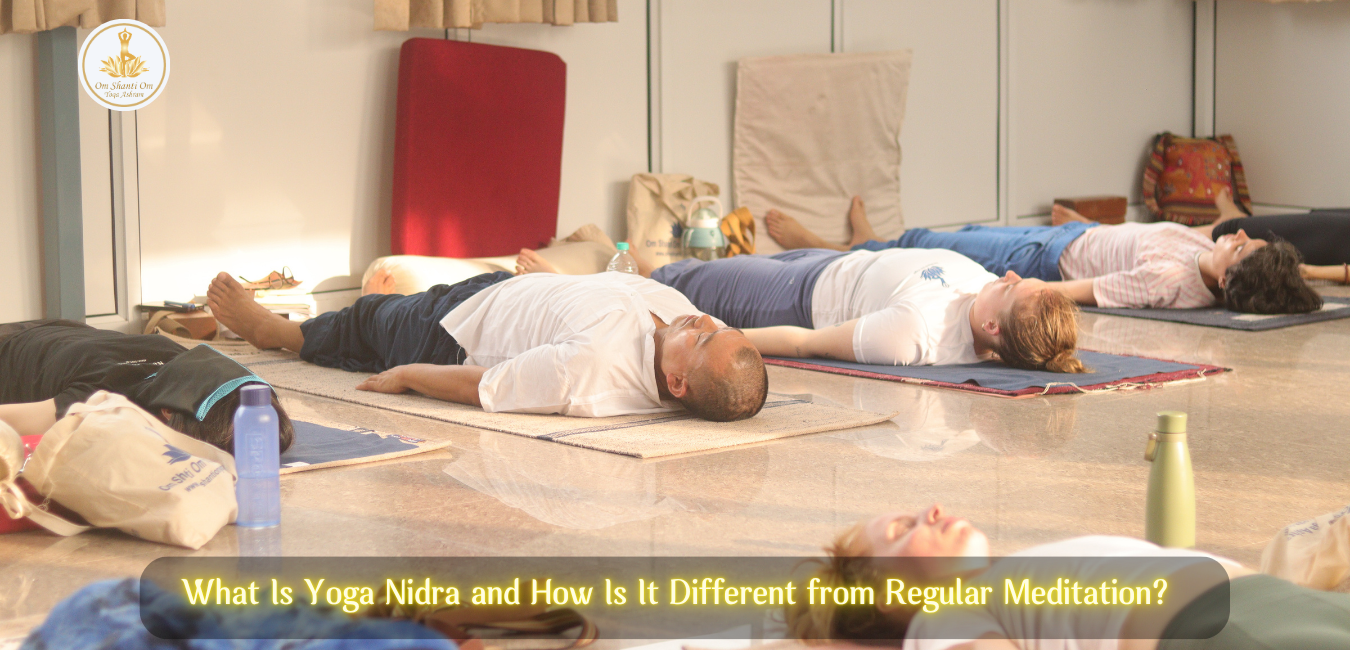
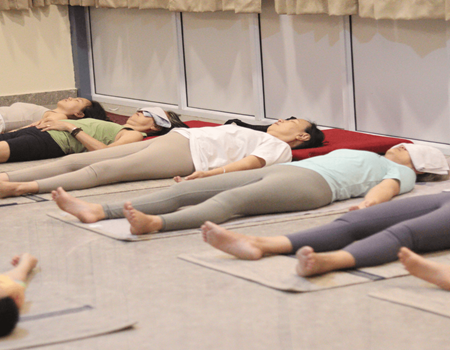
You lie down in Shavasana — flat on your back, arms slightly away from your body, eyes closed, completely still. A teacher or recorded guide leads you through the practice verbally. You follow the voice. That's essentially your only job.
The session usually begins with a Sankalpa — a short, positive intention or resolve that you silently repeat to yourself. Something simple and personally meaningful: "I am at peace." "I am healthy and whole." "I trust myself." This intention is planted at the beginning and again near the end of the session, when the mind is in its most receptive state.
From there, the guide leads you through a rotation of consciousness — a systematic movement of awareness through different parts of the body, sometimes called the "61 points" practice. Right thumb. Index finger. Middle finger. Ring finger. Little finger. Back of the hand. Wrist. Forearm. Elbow. Moving through the body in a specific sequence, quickly enough that the analytical mind can't fully keep up, but slowly enough that awareness can follow. This process begins to dissolve the usual mental chatter.
Following the body scan, many sessions move into breath awareness, then into pairs of opposite sensations (heaviness and lightness, warmth and cold, pain and pleasure), and then into visualization — imagery that bypasses the thinking mind and speaks directly to deeper layers of consciousness.
A session typically lasts between 20 and 45 minutes. Many people report feeling as though they've had several hours of deep rest by the end of it. Some emerge unable to say for certain whether they were awake or asleep throughout. That ambiguity is entirely intentional — and it's the key to understanding what makes Yoga Nidra unique.

What Is Meditation? A Quick Primer
Meditation is a broad term that covers a wide range of practices, all of which share a common intention: training the mind toward greater clarity, stability, and awareness. There is no single "type" of meditation any more than there is a single type of exercise.
Mindfulness meditation — probably the most widely practiced form in the West — involves directing attention to present-moment experience: the breath, bodily sensations, sounds, or thoughts as they arise. When the mind wanders (and it will), you simply notice that it has wandered and return attention to the chosen object. Over and over again.
Focused attention practices use a specific anchor — the breath, a mantra, a candle flame, or a visual object — to hold the mind's focus and build concentration.
Open monitoring practices take a wider lens, observing the stream of thoughts, feelings, and sensations without attaching to or following any of them. The meditator becomes a neutral witness to mental activity rather than a participant in it.
Loving-kindness meditation (Metta) involves actively cultivating feelings of warmth, compassion, and goodwill — first toward oneself, then toward others in expanding circles.
Transcendental Meditation uses silently repeated mantras to help the mind settle into a state of restful alertness — distinct from mindfulness but similarly widely researched.
What most of these practices have in common: they are done sitting upright, with the spine relatively tall, in a state of alert wakefulness. The posture itself is a cue to the nervous system — stay present, stay awake. Falling asleep during meditation is generally considered a sign that the practice hasn't fully landed; the goal is conscious awareness, not unconsciousness.
The Key Differences Between Yoga Nidra and Meditation
Now that we have a clear picture of both, let's look at how they actually differ — because the differences are more significant than most people realize.
1. Body Position
Meditation is practiced sitting up. The upright spine is not incidental — it's functional. It signals alertness and supports the kind of active, vigilant awareness that meditation cultivates. Slouching, and especially lying down, tends to invite drowsiness, which is why most meditation teachers emphasize posture carefully.
Yoga Nidra is practiced lying down, always. Physical surrender is the whole point. The body needs to be completely comfortable and completely still, so that physical sensation stops demanding attention and awareness can turn inward without distraction.
2. State of Consciousness
This is the most fundamental difference. Meditation maintains what neuroscientists would describe as an alpha brainwave state — relaxed but alert, present and aware. The meditator is awake, watching, noticing.
Yoga Nidra intentionally guides the practitioner toward theta brainwaves — the state associated with the hypnagogic zone, that drowsy, dreamy territory between waking and sleep. Theta is the state in which the analytical, critical mind loosens its grip. It's associated with vivid imagery, memory consolidation, creative insight, and heightened receptivity. It's where Yoga Nidra does its deepest work.
3. Active vs. Passive Practice
In meditation, the practitioner is doing something — directing attention, returning when distracted, maintaining the thread of awareness. It requires effort, however subtle. This is why meditators often describe the practice as a mental workout.
In Yoga Nidra, the practitioner is primarily receiving. You follow the guide's voice. You don't need to direct anything. You don't need to manage your attention the way a meditator does. This makes Yoga Nidra significantly more accessible for people who are exhausted, overwhelmed, or new to contemplative practice — those for whom active mental effort feels like one more thing on an already too-long list.
4. The Role of the Guide
Meditation can be entirely self-directed. Experienced meditators often practice in silence, without any external guidance, for extended periods. The practice lives inside the practitioner.
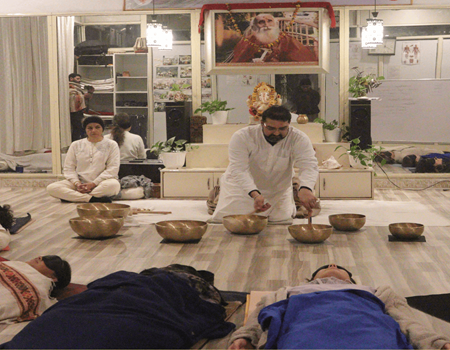
Yoga Nidra almost always requires a guide — a teacher in person, a recording, or an app. The guide's voice is the thread that keeps awareness engaged while the body and most of the mind fall into deep rest. Without the guide, most practitioners simply fall asleep. The voice is the architecture of the practice.
5. The Sankalpa — Intention Setting
Yoga Nidra includes a practice called Sankalpa — the planting of a short, heartfelt resolve into the subconscious mind at the moments when it is most receptive. There is no direct equivalent in most meditation traditions. The idea is that an intention received in the theta state bypasses the habitual filters of the conscious mind and takes root at a deeper level. Over time and repeated practice, the Sankalpa is said to gradually reshape patterns of thought, belief, and behavior.
6. The Relationship with Sleep
In traditional meditation, falling asleep means the practice has slipped away. The goal is to remain awake and aware regardless of how deeply relaxed the body becomes.
In Yoga Nidra, the boundary with sleep is deliberately approached and even occasionally crossed — especially in early practice. The goal is the threshold, not rigid wakefulness. If you drift into light sleep and return, that's fine. If you fall deeply asleep during your first few sessions, that might simply mean your body is catching up on rest it desperately needed. Over time, with practice, most people find they can rest at that exquisite edge — deeply still, deeply quiet, and yet somehow present.
7. Purpose and Long-Term Outcome
Meditation, practiced consistently, builds enduring mental qualities: sustained attention, emotional regulation, reduced reactivity, greater compassion and self-awareness. Its benefits are largely about how you show up in waking life — more focused, more patient, more present.
Yoga Nidra works differently. Its primary gift is deep rest and nervous system restoration. It's a reset. It's also a gateway to the subconscious — through the Sankalpa and the visualization stages, it works with layers of the mind that ordinary waking awareness can't easily reach. Think of meditation as building mental fitness over time, and Yoga Nidra as a profound recovery practice that restores the system so that all of life — including meditation — becomes easier.

The Science: What Research Actually Shows
Both practices have attracted serious scientific attention, and the findings are worth knowing.
Yoga Nidra has been studied in clinical settings with promising results. Research shows significant reductions in cortisol (the primary stress hormone), improvements in sleep quality, and measurable shifts in brainwave activity toward the theta range during practice. iRest — an evidence-based adaptation of Yoga Nidra developed by Dr. Richard Miller — has been studied with US military veterans experiencing PTSD and showed meaningful reductions in symptoms, leading to its endorsement by the US Army Surgeon General's office as a complementary approach to treatment.
The often-repeated claim that one hour of Yoga Nidra equals four hours of regular sleep is compelling but should be treated with nuance. What research does support is that the depth of physiological rest achieved during Yoga Nidra is comparable to deep sleep in certain measurable ways — but it isn't a replacement for full sleep cycles.
Meditation's scientific literature is even more extensive, spanning decades. Studies have found structural changes in the brains of long-term meditators, including increased gray matter density in regions associated with attention and emotional regulation, and decreased reactivity in the amygdala — the brain's threat-detection center. Even short-term mindfulness practice has been shown to reduce perceived stress, improve focus, and support immune function.
Both practices, in other words, have real and measurable effects. They simply work on different systems in different ways.
What They Share
Despite their differences, Yoga Nidra and meditation are more companion practices than competitors. Both activate the parasympathetic nervous system — the "rest and digest" counterpart to the stress response. Both cultivate a quality of inner witnessing — a capacity to observe experience rather than be entirely swept up in it. Both are accessible to beginners without prior experience, and both can be practiced with or without a spiritual framework depending on the individual's preferences.
And both reward consistency. A single session of either practice can provide noticeable relief. A sustained practice of either — or both — tends to compound in ways that reshape how you experience everyday life.
Which One Is Right for You?
Consider Yoga Nidra if: You're dealing with chronic stress, burnout, or exhaustion. You find it hard to sit still or keep your mind from racing during seated meditation. You have trouble sleeping or feel like no amount of rest actually restores you. You're drawn to the idea of working with your subconscious mind through the Sankalpa. Or you simply want to start somewhere accessible before building toward more active practice.
Consider meditation if: You want to build sustained attention and focus over time. You're drawn to a self-directed practice you can do without technology or a guide. You want to work specifically on emotional regulation or cognitive flexibility. Or you feel ready for the gentle challenge of training the mind rather than simply resting it.
The honest answer: you don't have to choose. Many practitioners do both — using Yoga Nidra as a restorative practice several times a week and meditation as a daily anchor. They work on different layers and in genuinely complementary ways.
How to Try Yoga Nidra for the First Time
You need very little: a mat or a bed, a pillow and blanket, a quiet room, and about 25 to 30 minutes. Lie down, get genuinely comfortable, and press play on a guided session. Insight Timer has dozens of free options. YouTube channels dedicated to Yoga Nidra offer everything from five-minute introductions to hour-long deep dives.
Don't try to control the experience. Don't worry if you drift. Don't judge yourself if you fall asleep the first few times. Just follow the voice, notice what arises, and let the practice do what it does. Most people find that even an imperfect session — one where the mind wandered constantly or sleep crept in — leaves them feeling noticeably more rested and settled afterward.
That's Yoga Nidra working. You don't have to do it perfectly for it to do its job.
The Bottom Line
Yoga Nidra and meditation are not the same practice, and understanding the difference matters — because each serves a different need. Meditation builds the mind's capacity for clarity and presence over time. Yoga Nidra restores the nervous system, accesses deeper layers of consciousness, and offers a form of rest that ordinary sleep doesn't always provide.
If you've tried meditation and found it too difficult, too frustrating, or too much effort for where you are right now — Yoga Nidra might be the door that was always available to you. And if you're already a meditator looking to deepen your practice and recovery, adding Yoga Nidra to your routine may be one of the most valuable things you can do.
Both paths point toward the same destination: a quieter mind, a more regulated nervous system, and a version of yourself that moves through the world with a little more ease.
The only thing left to do is lie down, close your eyes, and let the practice begin.
Start Your Yoga Journey
If you feel inspired to explore Ashtanga Yoga more deeply, you can join:
- 100 Hour Yoga Teacher Training
- 200 Hour Yoga Teacher Training
- 300 Hour Yoga Teacher Training
- 500 Hour Yoga Teacher Training
At Om Shanti Om Yoga Ashram in Rishikesh, you will experience yoga in its most authentic and traditional form.









0 Comments
No comments yet. Be the first to comment!