


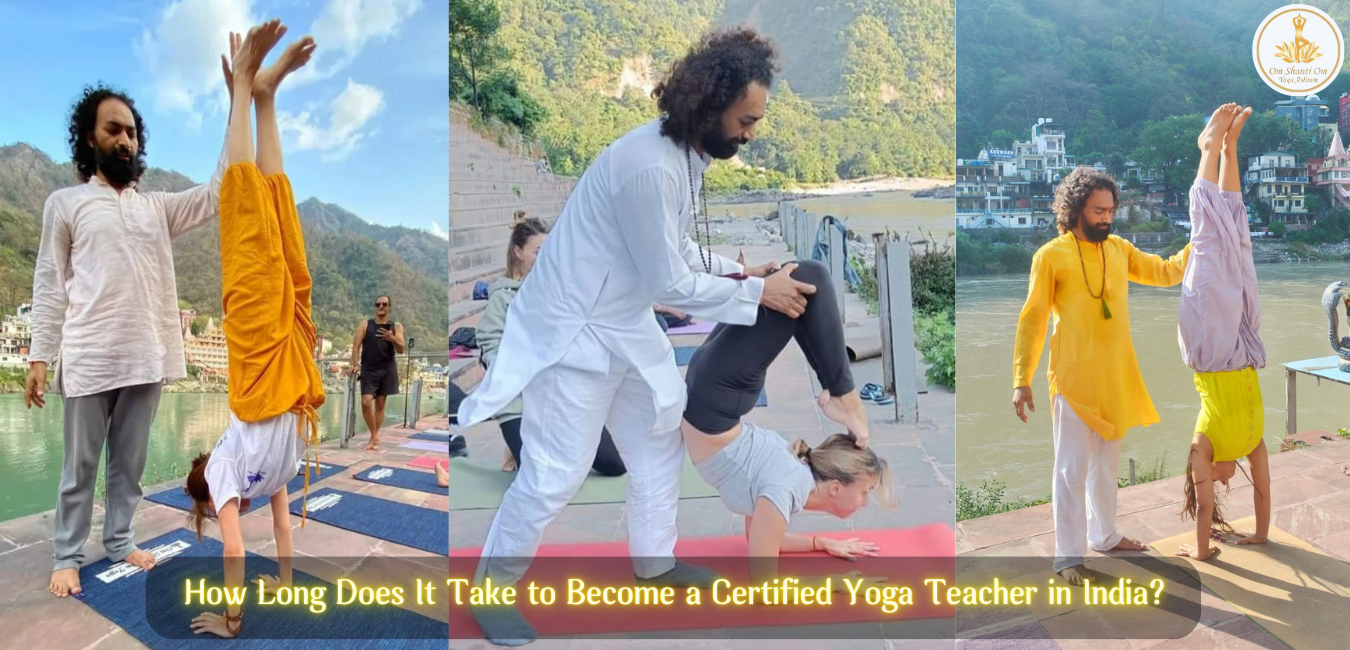
If you have ever stood in that moment of confusion, you are not alone. These three names come up constantly in the yoga world, and yet most beginners have never had someone sit down and explain what actually makes them different. They all happen on a mat. They all involve postures. They all have something to do with breathing. So what is going on?
The short answer is this: Hatha yoga is a slow, foundational practice where individual poses are held and explored with awareness. Ashtanga is a fixed, physically demanding sequence of postures that is practised the same way every single time. Vinyasa is a dynamic, breath-led flow where movement and breath are synchronised, and no two classes are ever quite the same.
But the longer answer — the one that actually helps you understand which style is right for you, or what you will be learning if you join a Yoga Teacher Training course — is worth spending some time with. Let us break it all down.

At a Glance: Hatha vs Ashtanga vs Vinyasa
|
Feature |
Hatha |
Ashtanga |
Vinyasa |
|
Pace |
Slow to moderate |
Fast and intense |
Moderate to fast |
|
Structure |
Flexible |
Fixed sequence |
Creative / varies |
|
Best For |
Beginners |
Athletic practitioners |
All levels |
|
Breath Focus |
General awareness |
Ujjayi pranayama |
Breath-movement sync |
|
Sweat Level |
Low to medium |
High |
Medium to high |
|
Class Length |
60–90 minutes |
60–120 minutes |
45–75 minutes |
|
Taught at OSO |
Yes |
Yes |
Yes |
The Common Root: Where All Three Styles Come From
Before we compare these styles, it helps to understand that they are not competing traditions — they are branches of the same tree.
All three trace their roots back to classical Indian yoga, which was first systematised in the Yoga Sutras of Patanjali roughly 2,000 years ago. Patanjali described yoga not as a physical exercise system but as an eight-limbed path toward self-realisation — a way of living that included ethical principles, physical postures, breath control, and meditation.
In the 20th century, a South Indian teacher named Tirumalai Krishnamacharya brought the physical practice of yoga to the modern world. He is often called the Father of Modern Yoga, and for good reason — almost every major style practised globally today can be traced back to his lineage. His students went on to develop both Ashtanga yoga and what we now call Vinyasa, while Hatha yoga continued as the foundational classical system that had always underpinned the tradition.
This is important to understand. When you practice any of these three styles at a traditional school in Rishikesh — like Om Shanti Om Yoga Ashram — you are not just exercising. You are touching a lineage that stretches back thousands of years, carried forward through teachers who received it directly from their own teachers. That depth is part of what makes learning yoga in India different from learning it anywhere else.
What is Hatha Yoga?
The word Hatha comes from two Sanskrit roots: Ha, meaning sun, and Tha, meaning moon. Together they represent the union of opposites — effort and ease, strength and softness, masculine and feminine energy. At its heart, Hatha yoga is about finding balance.
In practice, Hatha yoga is the most foundational of the three styles. It is characterised by a slower, more deliberate approach, in which each posture is held for several breaths before moving on. The emphasis is on alignment — understanding what a pose is actually doing to the body, how it opens certain muscles and engages others, and how your breath changes when you settle into it.
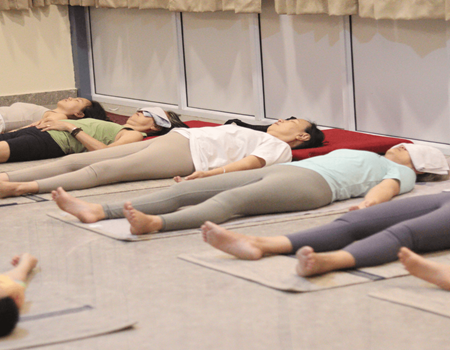
A typical Hatha class might begin with a few minutes of centring and breath awareness, move through a sequence of seated and standing postures, and end with Savasana (deep relaxation). The teacher will often pause on individual poses to offer detailed instructions and adjustments. There is no rush, and that is intentional.

Who Is Hatha Yoga Best For?
- Complete beginners who are new to yoga entirely
- People returning to movement after injury or illness
- Anyone seeking stress relief, better sleep, or improved flexibility
- Students who want to understand the mechanics of each posture before moving fast
- Older practitioners or those who prefer a gentler, more meditative experience
Key Postures in Hatha Yoga
Tadasana (Mountain Pose), Trikonasana (Triangle Pose), Bhujangasana (Cobra Pose), Balasana (Child's Pose), Viparita Karani (Legs-Up-the-Wall), and Sirsasana (Headstand) are all staples of a Hatha practice.
Common Misconception: Many people assume Hatha is easy yoga — the beginner's version before you graduate to something more serious. This is not true. Advanced Hatha practice involves deep, demanding postures that require both significant strength and genuine flexibility. It is foundational, but it is not simple.
What is Ashtanga Yoga?
The word Ashtanga literally means eight limbs in Sanskrit, a direct reference to Patanjali's eight-fold path. As a modern yoga system, Ashtanga was developed by Sri K. Pattabhi Jois — one of Krishnamacharya's most celebrated students — and codified at his institute in Mysore, India.
What makes Ashtanga fundamentally different from other styles is its structure. Ashtanga is not a sequence that a teacher creates fresh each week. It is a fixed, memorised series of postures that never changes. Every time you practice Ashtanga, you do the same sequence, in the same order, connected by the same transitions. That consistency is the point.
A traditional Ashtanga practice begins with five repetitions of Sun Salutation A, followed by five of Sun Salutation B, then moves through a standing sequence, a seated sequence, and a closing sequence. Throughout the entire practice, the student uses Ujjayi pranayama — a slow, audible breathing technique that creates internal heat — combined with Bandhas (muscular energy locks) and Drishti (specific gaze points for each posture).
The result is a deeply internal, physically demanding practice that generates significant body heat, promotes detoxification through sweat, and builds tremendous strength and focus over time.
The Series Structure of Ashtanga
- Primary Series (Yoga Chikitsa): The foundational series, focused on detoxification and physical alignment. This is where all students begin.
- Intermediate Series (Nadi Shodhana): Purification of the nervous system through deeper backbends and more complex postures.
- Advanced Series A, B, C, and D: These demand extraordinary strength, flexibility, and years of dedicated practice to access.
Who Is Ashtanga Yoga Best For?
- People who thrive on structure, discipline, and measurable progress
- Athletic or physically active practitioners who want a rigorous practice
- Students are serious about traditional yoga and want to study a classical system
- Those who find motivation in mastering a set sequence over time
Common Misconception: Ashtanga is not reserved for advanced yogis. The Primary Series is called Yoga Chikitsa — meaning yoga therapy — because it was designed as a healing, accessible practice. Beginners absolutely can and do practice Ashtanga. The difference is that it requires commitment and consistency.
What is Vinyasa Yoga?
Vinyasa is often described as the most modern of the three styles, and in some ways that is true. The word Vinyasa comes from the Sanskrit vi, meaning in a special way, and nyasa, meaning to place. Together, it means to place movement in a special, intentional way — specifically, in sync with the breath.
Vinyasa grew directly out of Ashtanga. It took the core principle of linking breath with movement and freed it from the fixed sequence. In a Vinyasa class, the teacher designs the flow — and no two classes are ever identical. One morning might open with a gentle standing sequence that builds slowly toward backbends. Another might launch straight into warrior flows and arm balances. The common thread is always the breath: every movement begins with either an inhale or an exhale, and the transition between poses flows naturally from one to the next.
This makes Vinyasa the most creative and versatile of the three styles. A skilled Vinyasa teacher can design a class that feels almost like choreography — a moving meditation where the boundaries between postures blur into one continuous, flowing experience.

What a Vinyasa Class Looks Like
- Opens with centring and breath awareness
- Builds through warming flows — often Sun Salutations as a foundation
- Progresses through a peak sequence designed by the teacher
- Cools down through seated postures and forward folds
- Ends in Savasana — always
Who Is Vinyasa Yoga Best For?
- People who enjoy variety and get bored with repetition
- Intermediate practitioners who want to explore creative movement
- Those who want a practice that combines cardiovascular benefit with flexibility
- Students looking for a bridge between a workout and a meditation
- Anyone who enjoys music, rhythm, and creative energy in their practice
Common Misconception: Vinyasa is not just fast yoga. The pace is entirely in the teacher's hands. A well-designed Vinyasa class can be slow, meditative, and deeply restorative. The defining characteristic is breath-movement synchronization — not speed.
The 5 Key Differences: Hatha, Ashtanga, and Vinyasa Side by Side
1. Structure
Hatha gives the teacher complete freedom to choose and sequence postures in any way they like. Ashtanga is entirely fixed — the sequence never changes, regardless of who is teaching or where in the world you practice. Vinyasa sits between the two: the teacher has creative freedom, but the breath-movement connection always provides the underlying structure.
2. Pace and Physical Intensity
Hatha is the slowest and most accessible. Poses are held long enough for you to really settle into them, feel what they are doing, and adjust your alignment without rushing. Ashtanga is the most physically demanding — the continuous sequence, the Ujjayi breath, and the Bandhas combine to create an intense internal heat. Vinyasa varies depending on the teacher, but typically sits somewhere between the two.
3. Approach to Breath
In Hatha, breath awareness is cultivated gently — you are encouraged to deepen your breath and notice how it changes in each posture. In Ashtanga, the Ujjayi breath is a technical requirement: it is the engine that drives the entire practice forward and the thing that keeps your mind internal. In Vinyasa, the breath is the choreographer — each movement is initiated by either an inhale or an exhale, and the flow only works when breath and movement are truly synchronised.
4. Best Use Case
Hatha is your foundation builder — the style that teaches you what the postures actually are and how to do them well. Ashtanga is your discipline builder — the style that teaches you consistency, mental fortitude, and the rewards of showing up to the same practice day after day. Vinyasa is your expression builder — the style that teaches you how to move fluidly, creatively, and with joy.
5. The Teacher's Role
In a Hatha class, the teacher is primarily a guide and a technician — pausing to explain alignment, offer adjustments, and ensure every student understands each posture. In Ashtanga, the teacher's role is more supervisory — students know the sequence and practice it independently while the teacher moves around the room offering hands-on assists. In Vinyasa, the teacher is also a choreographer and artist — designing a sequence that builds intelligently, flows beautifully, and serves the students in the room.

Which Style Should You Choose?
The honest answer is: try all three. But if you need a starting point, here is a simple guide.
Choose Hatha if you are brand new to yoga, if you are recovering from an injury, if you want to fully understand what each posture does before stringing them together, or if you prefer a slower, more meditative experience.
Choose Ashtanga if you love structure and want a measurable progression path, if you are physically active and want a rigorous practice, or if you are drawn to the idea of studying a classical, traditional system of yoga.
Choose Vinyasa if you like variety, enjoy movement that feels creative and expressive, want something that doubles as light cardiovascular exercise, or if you already have some yoga experience and want to explore flow.
Quick Self-Check: Ask yourself: Do you prefer a structured gym routine with a fixed programme? (Ashtanga.) A slow stretch class where you hold each position and breathe? (Hatha.) Or a flowing movement session where every class feels different? (Vinyasa.) Your gut answer tells you where to begin.
How All Three Are Taught at Om Shanti Om Yoga Ashram
One of the reasons Om Shanti Om Yoga Ashram's 200-hour Yoga Teacher Training is so highly regarded is that students do not graduate knowing only one style. The curriculum is built around all three — giving you a complete picture of modern yoga's most important traditions.
You will practice and study Hatha yoga as the foundational system, learning the classical postures with proper alignment and understanding their effects on the body and mind. You will move through Ashtanga Vinyasa and learn the Primary Series — experiencing the discipline, the Ujjayi breath, the Bandhas, and the meditative quality that comes from a fixed, repeatable sequence. And you will explore Vinyasa flow — understanding how to build creative, breath-led sequences that serve diverse groups of students.
By the time you complete the 200-hour TTC, you will be able to teach any of these styles with confidence. More importantly, you will understand how they relate to each other — why a student needs Hatha as a foundation, what Ashtanga develops that Hatha does not, and how Vinyasa gives practitioners a way to express everything they have learned in a single fluid practice.
All of this happens at the foot of the Himalayas, on the banks of the Ganga River, in an ashram that has been training yoga teachers since 1999. There are not many places in the world where you can say that.
_1779254239.jpg)
Final Thoughts
Hatha, Ashtanga, and Vinyasa are not rivals. They are not competing philosophies or different religions. They are three expressions of the same ancient practice — each one valuable, each one suited to a different person, a different moment, or a different phase of life.
Some people find Hatha and never need to go anywhere else. Others use it as a foundation before falling in love with the discipline of Ashtanga. Many discover Vinyasa and find that its creative freedom brings them back to the mat day after day in a way nothing else does. And some practitioners — particularly those who have trained deeply — move between all three, choosing their practice the way you might choose music: based on what the moment calls for.
The most important thing is not which style you choose first. It is that you start — and that when you start, you learn from teachers who understand these traditions not just as physical exercises but as complete systems for living.
Want to Learn All Three Styles in One Course?







0 Comments
No comments yet. Be the first to comment!