


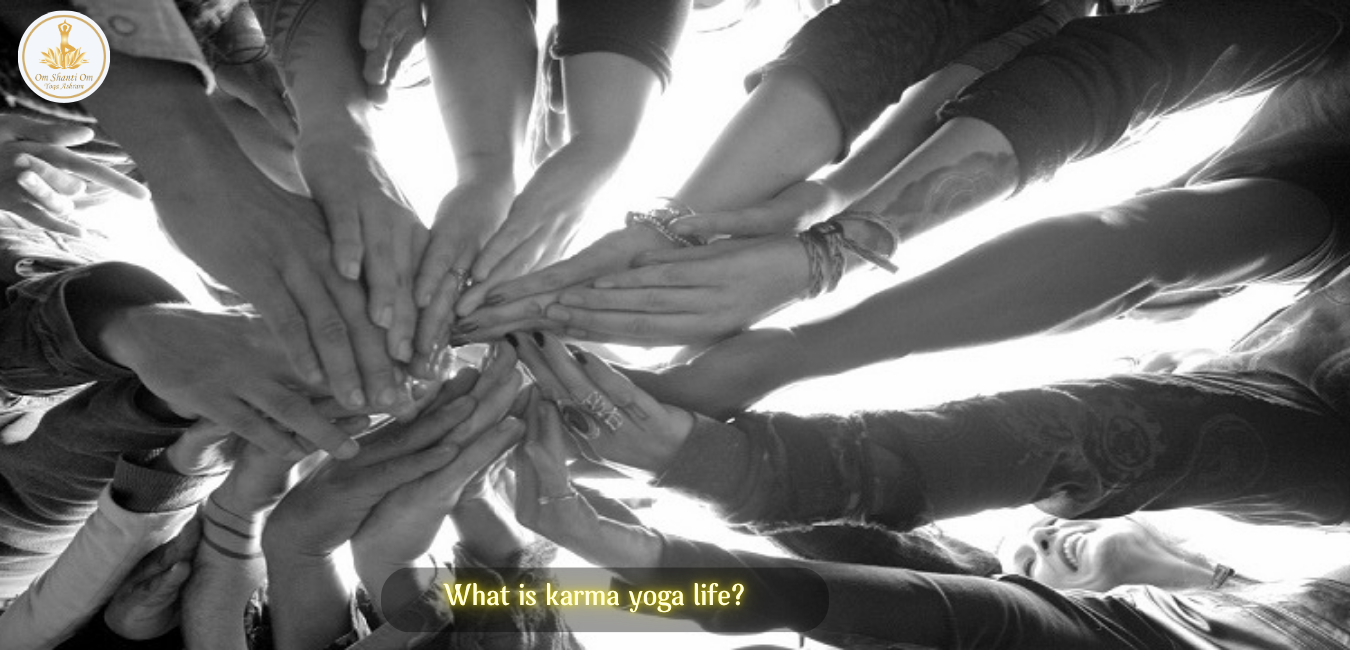
Karma Yoga is known as the Yoga of Action, yet it is far deeper than simply “doing work.” Literally, it can be understood as meditation in action—an inner state of awareness maintained while engaging fully with life. It is often described as eyes-open meditation, where mindfulness continues not only in silence but also in movement, work, and interaction.
Human beings are never truly inactive. Whether we are working, thinking, speaking, resting, or even sleeping, some form of action is always taking place. Even in sleep, the mind continues to dream and interact. Karma Yoga recognises this continuous activity and teaches us how to act in the right way, with awareness, balance, and inner freedom.
The essence of Karma Yoga lies not in avoiding action, but in transforming action into a spiritual practice.

The Right Way to Perform Action
Karma Yoga teaches that action should be performed with an inner attitude of meditative awareness. This means acting while remaining conscious of the mind, senses, and breath. The senses are guided by the mind, and the mind is guided by awareness.
Traditional meditation practices—performed with closed eyes—train the mind to become focused, calm, and observant. Karma Yoga takes these meditative skills and brings them into daily life. When we open our eyes and return to the world, the same state of awareness continues.
In this way, meditation does not end when we rise from the mat. It becomes a living practice, expressed through every task, responsibility, and interaction.
Karma Yoga as Meditation in Daily Work
When Karma Yoga is practised sincerely, work itself becomes meditation. Concentration on the task at hand naturally increases efficiency. The mind is no longer scattered, and energy is not wasted on distractions, worries, or emotional reactions.
As awareness expands, we begin to observe how actions unfold moment by moment. This observation keeps us on track and prevents impulsive behaviour. We become more responsive rather than reactive.
Through meditation and mindful action, we gain a broader perspective. We no longer see only fragments of a situation but understand the larger picture. This clarity allows us to make wiser decisions and act with greater intelligence.
In Karma Yoga, we are not lost in the action—we are witnessing the action.
The Power of the Witness Attitude
One of the most transformative aspects of Karma Yoga is developing the ability to observe without becoming emotionally entangled. We learn to witness thoughts, emotions, and external situations without identifying with them.
This witnessing attitude protects us from getting caught in drama—both our own and that of others. Instead of reacting emotionally, we remain centred and stable.
When emotions arise, we acknowledge them, but we do not allow them to control our actions. This inner distance creates freedom, peace, and emotional maturity.
Also Read: 200 Hour Yoga Teacher Training in Rishikesh, India
Seva: The Principle of Selfless Service
Another core principle of Karma Yoga is Seva, or selfless service. In Seva, actions are performed for the benefit of others, without personal gain or expectation.
When we work for the welfare of others, relationships naturally become more harmonious. There is less conflict because we are no longer driven by ego or personal agendas.
When expectations disappear, disappointment also disappears. Much of human suffering arises from unfulfilled expectations. Karma Yoga teaches us to act wholeheartedly while letting go of the demand for specific results.
This attitude frees us from stress and keeps the mind from sinking into lower emotional states.
Attachment and the Roots of Suffering
Attachment binds us to outcomes, possessions, recognition, power, pleasure, and control. These attachments create fear, insecurity, boredom, desire, and dissatisfaction.
Karma Yoga encourages non-attachment, not indifference. We still act with care, dedication, and excellence—but without clinging to the result.
By acting without craving rewards, we free ourselves from mental tension. Work becomes lighter, purer, and more joyful.
As the saying goes:
“Expect nothing, and you will never be disappointed.”

Non-Expectation as Inner Freedom
Non-expectation does not mean lack of effort. It means offering our best while remaining detached from success or failure.
When we stop demanding outcomes, the mind relaxes. Peace naturally arises because we are no longer measuring ourselves through external validation.
This attitude leads to deep inner contentment and balance.
The Challenge of Practising Karma Yoga
In the beginning, Karma Yoga can feel difficult. Combining efficiency, non-expectation, equanimity, egolessness, renunciation, and duty into a single action is not easy.
The true practice of Karma Yoga is to hold all these principles in one thought, one action, and one moment.
Once these qualities unite, action becomes effortless and pure. With time, this state becomes natural and spontaneous.
Karma Yoga as a Path to Mental Purification
As Karma Yoga deepens, the mind gradually becomes free from phobias, insecurities, and inner conflicts. Mental clutter dissolves, creating a stable foundation for higher spiritual practices.
A purified mind is essential for inner evolution. Karma Yoga prepares the practitioner for deeper meditation, self-inquiry, and realization.
Efficiency Through Awareness
When Karma Yoga is practiced as meditation in action, efficiency arises naturally. Concentration improves performance, observation maintains direction, and expanded awareness allows us to see situations clearly.
By remaining in the witness position, we are not distracted by emotional disturbances. The work flows smoothly, guided by awareness rather than impulse.
Work as Play, Not Compulsion
A beautiful teaching of Karma Yoga is:
“Try to make the job perfect—do it as a game, not as a compulsion.”
When work is approached playfully, joy replaces pressure. We act with enthusiasm, not fear. This attitude keeps the mind light and creative.
Non-Doership: Becoming an Instrument
Non-doership is the understanding that we are not the ultimate doer, but an instrument through which action happens. This realization dissolves ego and brings humility.
Many people struggle with this because the ego enjoys recognition and control. However, when non-doership is experienced, work flows effortlessly, guided by a higher intelligence.
The burden of “I must do everything” disappears.
Surrender to a Higher Power
The final step of Karma Yoga is surrender—offering all actions to a higher power. This can be understood in religious, spiritual, or universal terms.
Surrender becomes easier once ownership of action has already been renounced. When nothing is claimed, there is nothing to give.
Grace then begins to operate naturally.
Karma Yoga as the Ultimate Anti-Stress Practice
Karma Yoga, when lived fully, becomes the ultimate anti-stress mechanism. The mind remains peaceful, balanced, and free from unnecessary tension.
We recognize that we bring nothing into this world and take nothing with us. Only our actions—our karma—remain.
Through Karma Yoga, life itself becomes sacred. At its highest level, Karma Yoga merges with Bhakti Yoga, transforming action into devotion.
This union leads to pure contentment, inner freedom, and partnership with supreme consciousness.







0 Comments
No comments yet. Be the first to comment!