


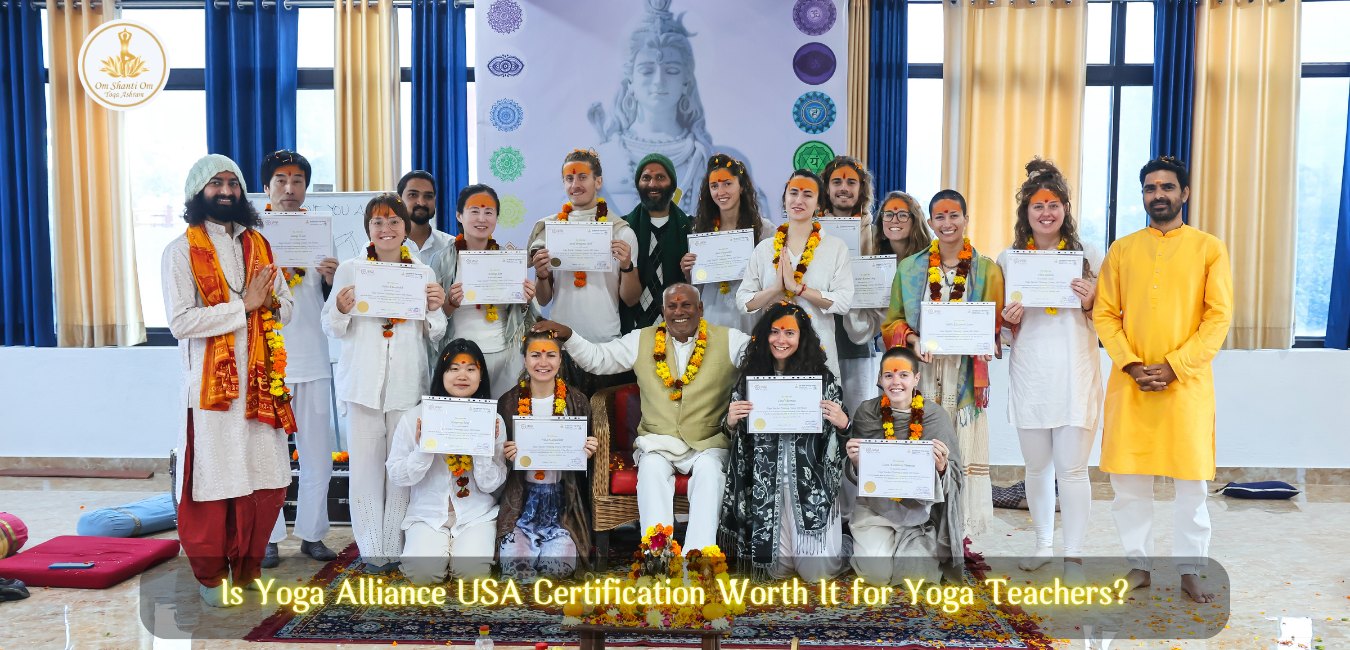
An honest, balanced look at what the credential actually gives you — and what it doesn't.
If you've just completed (or are about to complete) your yoga teacher training, you've probably run into the big question that almost every new teacher wrestles with: Do I need to register with Yoga Alliance?
You'll find passionate opinions on both sides. Some teachers swear it's the only way to be taken seriously. Others call it an overpriced stamp on a piece of paper. The truth, as is usually the case, sits somewhere in the middle — and the right answer depends almost entirely on your specific path as a teacher.
This post isn't going to tell you what to do. Instead, it's going to walk you through exactly what Yoga Alliance is, what registering actually gets you, where it falls short, and how to figure out whether it makes sense for you.

First, What Exactly Is Yoga Alliance?
A lot of people assume Yoga Alliance is some kind of official government body — a regulatory authority that licenses yoga teachers the way a state board licenses nurses or attorneys. It isn't.
Yoga Alliance is a private, non-profit membership organization founded in 1999. Its core function is to maintain a registry of yoga teachers and schools that meet its standards. Think of it less like a government license and more like a professional association — similar to joining a trade guild.
When you register with Yoga Alliance after completing a qualifying teacher training, you earn the title of Registered Yoga Teacher — commonly written as RYT-200 (if you completed a 200-hour training) or RYT-500 (if you completed 500 hours). There are also specialty designations like E-RYT (Experienced Registered Yoga Teacher, for those with significant teaching hours), RCYT (for children's yoga), and RPYT (for prenatal yoga).
To be eligible, your training must have been completed at a Registered Yoga School (RYS) — a school that Yoga Alliance has approved. After completing training, you pay an application fee and an annual membership fee (currently around $67/year for individual teachers) to maintain your registration.
That's the basic structure. Now let's talk about what it actually means for your career.
The Case For Getting Certified
Studios and gyms largely expect it
If you want to teach group classes at a gym, a yoga studio, a hotel wellness center, or a corporate yoga program, there's a good chance the employer will ask for your RYT credentials. It's become something of an industry default — a minimum baseline that signals you've completed a recognized, structured training.
This doesn't mean every studio requires it. Plenty of smaller, independently owned studios care more about your experience, your teaching style, and whether students love your classes. But at larger chains or more corporately-run wellness facilities, having your RYT on your resume removes a potential obstacle before you've even walked in the door.
It carries weight internationally
One underrated benefit of Yoga Alliance registration is its global recognition. If you're planning to teach yoga in Europe, Southeast Asia, Latin America, or Australia — whether permanently or on retreat — having an internationally recognized credential matters. Yoga Alliance is recognized in over 100 countries, and the RYT designation often serves as a common language between you and potential employers or partners who aren't familiar with your specific training school.
Access to professional liability insurance
This one is practical and easy to overlook: Yoga Alliance members get access to discounted professional liability insurance through partnered providers. For solo teachers running their own classes or private sessions, having liability coverage isn't optional — it's essential. The discounted rates available through the membership can make the annual fee worth it on insurance savings alone, depending on your situation.
The credential builds trust with new students
Think about the perspective of someone who has never taken yoga before and is browsing teachers online. They have no context for evaluating your training, your lineage, or your experience. An RYT designation gives them a recognizable shorthand for "this person has been trained to a recognized standard." It's a trust signal — especially useful when you're building a student base from scratch.
Continuing education and community
Yoga Alliance offers continuing education credits (CEUs), professional development workshops, and access to a global community of teachers. If you value structured ongoing learning and the sense of belonging to a professional community, these benefits have real appeal. The organization also provides resources like marketing tools, business guidance, and access to their online directory — which can drive organic traffic to your profile.
The Case Against Getting Certified
Yoga Alliance is self-regulated, not government-mandated
Here's something important to understand: in the United States, there is no legal requirement to hold any certification to teach yoga. Yoga Alliance doesn't have the power to prevent anyone from teaching — registered or not. This means the credential, while widely respected, is fundamentally voluntary and self-regulated.
The organization sets its own standards, evaluates its own schools, and maintains its own registry. There's no independent government oversight ensuring that a Yoga Alliance–registered school is actually delivering quality training. Two schools can both carry the RYS designation and produce teachers with wildly different skill levels.
The cost adds up
The annual membership fee is relatively modest, but when you factor in that you must have completed your training at a registered school (which can cost anywhere from $1,500 to $5,000 or more), the total investment is significant. If you completed a high-quality training at a non-registered school — perhaps one steeped in a specific lineage or tradition — you would need to find a separate pathway to register, which may not be straightforward.
For teachers who aren't actively looking for employment at studios or gyms, paying annual fees for a credential you rarely need to show can feel like an unnecessary overhead.
Registration doesn't guarantee training quality
This is one of the most important nuances to understand. The fact that a school is registered with Yoga Alliance tells you it met certain administrative and curriculum requirements at the time of registration. It does not tell you how good the teachers are, how immersive the training is, or how prepared you'll actually be to teach after completing it.
There are exceptional non-registered schools and mediocre registered ones. The credential is about meeting a standard, not exceeding it. As a student evaluating training programs, it's worth looking beyond the RYS badge and researching the school's reputation, graduates' experiences, and teaching philosophy directly.
Growing criticism from within the yoga community
It would be incomplete to talk about Yoga Alliance without acknowledging the real and growing critique from many yoga teachers and scholars. Critics argue that Yoga Alliance has contributed to the commodification of yoga — reducing a rich, ancient tradition to a checkbox and a fee. Some feel the organization benefits more from the fees it collects than from any meaningful impact it has on teaching quality.
In 2019 and 2020, several prominent teachers and schools publicly withdrew from Yoga Alliance citing ethical concerns, transparency issues, and a feeling that the organization had lost its way. These concerns haven't disappeared. For teachers who approach yoga as a deeply spiritual or cultural practice — rather than a fitness product — aligning with a commercial registry may feel incongruent with their values.

Who Benefits Most from Yoga Alliance Certification?
Putting aside the debate, let's get practical. Here are the situations where Yoga Alliance registration is likely to make the most sense:
You want to teach at gyms, fitness studios, or corporate wellness programs. These environments almost universally ask for RYT credentials. It's a box they need checked, and not having it will disqualify you from jobs you'd otherwise be great for.
You plan to teach internationally. The credential's global footprint makes it valuable when navigating hiring in countries where your specific training school is unknown.
You're new and building credibility from scratch. When you don't yet have testimonials, a full schedule, or a track record, the RYT designation gives potential students and employers a reason to give you a shot.
You want to start your own registered school someday. If building a teacher training program is in your long-term vision, you'll likely need to work toward E-RYT status and Yoga Alliance school registration — so starting now makes strategic sense.
Who Might Not Need It?
Experienced teachers with an established reputation. If you've been teaching for years and your students fill your classes by word of mouth, the credential adds little to what your track record already says about you.
Online yoga teachers building a digital audience. If your platform is YouTube, an app, or a subscription-based course, your subscribers don't care about your registration status. They care about your instruction quality, your personality, and how your teaching makes them feel.
Teachers in lineage-specific traditions. Iyengar, Ashtanga, Sivananda, Kundalini — these traditions have their own rigorous, deeply respected certification pathways that carry significant weight within their communities. Pursuing Yoga Alliance registration alongside these can feel redundant.
Community and non-commercial teachers. If you're teaching at a community center, a recovery program, a church group, or a nonprofit, the context doesn't demand a commercial credential. What matters there is showing up with knowledge, care, and consistency.
Alternatives Worth Considering
If Yoga Alliance doesn't feel right, there are several other routes to building legitimate, recognized credentials as a yoga teacher:
Lineage-based certifications are widely respected and often more rigorous. Iyengar certification, for example, involves years of assessment. Ashtanga certification from authorized teachers carries deep credibility within that community.
Specialty certifications — in areas like trauma-informed yoga, therapeutic yoga, adaptive yoga, or prenatal yoga — can differentiate you in specific markets and serve populations who genuinely need specialized care.
Building credibility organically through consistent teaching, student testimonials, continuing education with respected teachers, and community presence is underestimated. In many markets, what you've actually done speaks louder than any credential.

How to Decide: A Simple Framework
Before you commit to registering (or deciding not to), walk through these questions honestly:
Where do you want to teach, and who will hire you? Research a few job listings or studios in your area. What do they require? That tells you quickly whether registration is a gate you'll need to pass through.
Who is your target student? Studio regulars? Corporate clients? Online followers? Each audience has different expectations.
What's your financial reality? Between training costs and annual fees, calculate the total investment and weigh it against the opportunities it realistically opens up in your first year or two of teaching.
What matters to you about yoga? If your relationship with yoga is deeply rooted in tradition, lineage, or spirituality, the decision isn't just financial — it's also about alignment with your values.
The Bottom Line
Yoga Alliance certification is a useful tool. For many teachers, especially those entering the workforce at studios and gyms or teaching internationally, it's genuinely worth having. It reduces friction, signals credibility, and provides practical benefits like liability insurance access.
But it is not a golden ticket. It won't make you a better teacher. It won't guarantee you, students. And it's not the only path to a meaningful, successful career in yoga.
The most respected yoga teachers in the world built their reputations through years of dedicated practice, authentic relationships with students, continued learning, and a genuine commitment to the tradition. Some of them are registered with Yoga Alliance. Some of them aren't.
The real question isn't whether Yoga Alliance certification is worth it in the abstract. It's whether it's worth it for you — given where you are, where you want to go, and what you want your teaching life to look like.
Start there, and the answer will come more clearly than any blanket recommendation ever could.
Start Your Yoga Journey
If you feel inspired to explore Ashtanga Yoga more deeply, you can join:
- 100 Hour Yoga Teacher Training
- 200 Hour Yoga Teacher Training
- 300 Hour Yoga Teacher Training
- 500 Hour Yoga Teacher Training
At Om Shanti Om Yoga Ashram in Rishikesh, you will experience yoga in its most authentic and traditional form.












0 Comments
No comments yet. Be the first to comment!