


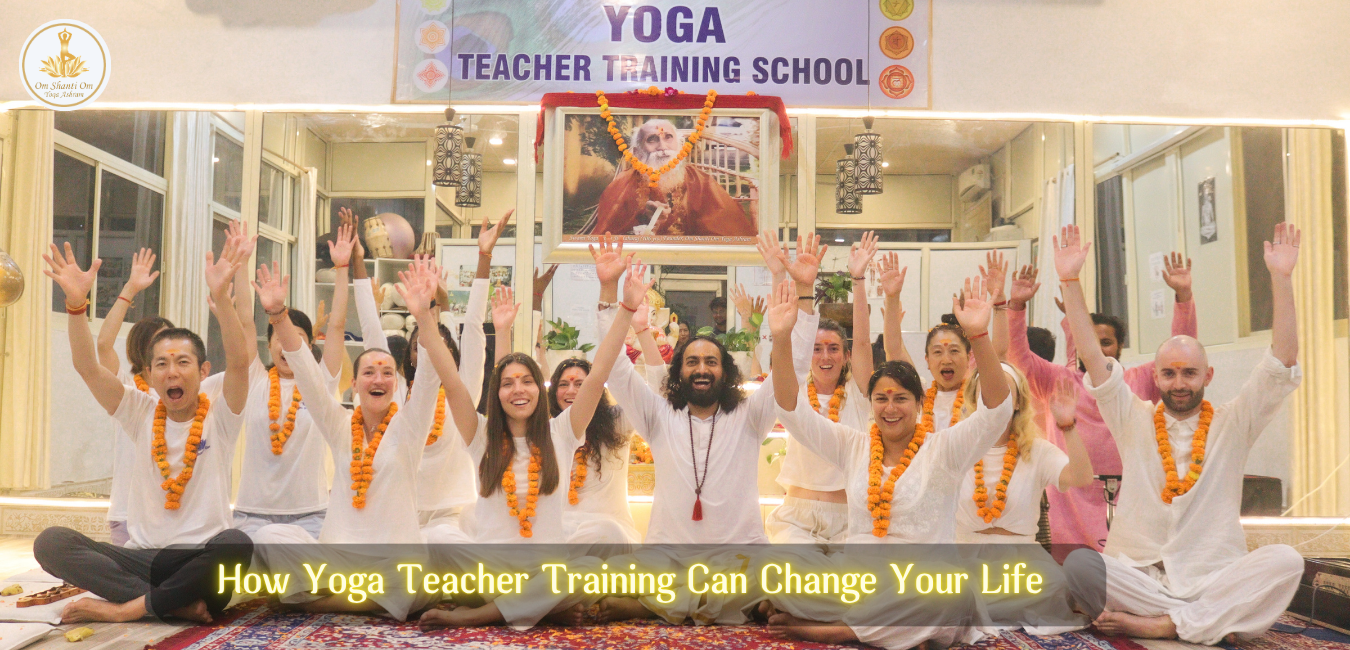
There's a version of you that exists on the other side of a Yoga Teacher Training. And if you've been circling the idea — saving the webpage, asking friends who've done it, telling yourself "maybe next year" — there's a good chance some part of you already knows that version is waiting.
Most people who sign up for a YTT tell themselves a practical story. They want to deepen their practice. They want a certification. They want to teach at their local studio or lead a few classes on the side. These are honest, reasonable motivations. But here is what almost every single YTT graduate will tell you when you ask them honestly about the experience: the certification was not the most important thing they came home with.
What they came home with was harder to put on a resume — and infinitely more valuable in real life.
This is the story of what Yoga Teacher Training actually does to a person. Not the syllabus version. The human version.
You Sign Up to Teach. You End Up Transforming.
Walk into any YTT program and you'll find a fascinating mix of people. Some are yoga teachers in the making. Some are seasoned practitioners who want to go deeper. Some are at a crossroads in their careers. Some are recovering from something — a loss, a burnout, a version of themselves they've outgrown. Many couldn't fully articulate why they signed up. They just felt pulled.
That pull is worth paying attention to.
The structure of a YTT is demanding by design. Over the course of twenty-five to thirty days, you're immersed in asana practice, anatomy, yoga philosophy, meditation, pranayama, and teaching methodology. The days are long, and the schedule is consistent. There isn't much room to hide from yourself — and that, it turns out, is exactly the point.
The outer curriculum teaches you how to sequence a class, cue alignment, and understand the body. The inner curriculum — the one nobody lists in the brochure — teaches you who you actually are when all the noise of your regular life falls away. For most people, that inner curriculum is the one that changes everything.

Your Relationship With Your Body Completely Changes
Most of us come to yoga with some version of a fitness mindset. We're there to stretch, to strengthen, to move well. These are perfectly fine reasons to practice. But YTT asks you to go somewhere much deeper than that.
During training, you study anatomy — not in an abstract, textbook way, but in a lived way. You learn what the psoas muscle actually does and why it holds stress. You understand how your hips are structured and why some poses feel impossible while others come naturally. You begin to map your own body from the inside out.
The result is a profound shift in how you inhabit yourself. Instead of pushing through discomfort, you learn to listen to it. Instead of using your body as a vehicle to perform, you begin to experience it as a home to live in. Body confidence — the quiet, unshakeable kind — starts to grow. Not because your body has changed shape, but because your relationship with it has changed entirely.
Many graduates describe this as one of the most lasting gifts of their training. Years later, they still move differently, rest differently, and treat themselves differently — because YTT taught them that their body deserves to be listened to, not just pushed.
You Learn to Breathe — Really Breathe
This one sounds almost too simple to be worth mentioning. You already know how to breathe, obviously. You've been doing it your whole life.
But here is something most people discover in their first week of pranayama practice: they have been breathing at about thirty percent of their actual capacity for most of their lives. Short, shallow, chest-bound breathing that keeps the nervous system in a low-grade state of alertness without ever fully releasing.
Pranayama — the formal practice of breath control in yoga — is transformative in a way that is both immediate and cumulative. In a single session, a practice like Nadi Shodhana (alternate nostril breathing) can shift you from anxious to calm in a matter of minutes. Over weeks of practice, the nervous system genuinely rewires. Stress responses become less automatic. Recovery from difficult emotions becomes faster. Clarity — the kind you usually only get after a long sleep or a walk in nature — becomes more accessible on demand.
Graduates consistently describe pranayama as the practical life skill they use most after completing their training. Not a sequence of poses, not a Sanskrit term — but the simple, radical power of a conscious breath.
Your Mind Becomes Quieter
The mind that arrives at YTT on day one is not the same mind that leaves thirty days later. This is almost universal.
Most of us are carrying an extraordinary amount of mental noise — the loop of to-do lists, the replay of past conversations, the low hum of anxiety about things we can't control. We've become so accustomed to this noise that we mistake it for normal. We don't even notice it anymore, the way you stop hearing traffic after you've lived near a road for long enough.
Meditation practice during YTT is incremental and consistent. You sit every day — sometimes twice a day. At first it's uncomfortable. The mind rebels. It generates thoughts with extraordinary creativity. But slowly, over days and then weeks, something begins to settle. Gaps appear between thoughts. A quality of quiet that you may not have experienced since childhood starts to show up.
The ancient yogic concept at work here is the movement from a rajasic mind — agitated, restless, reactive — to a sattvic one: clear, calm, and responsive. It doesn't mean you stop having difficult thoughts or challenging emotions. It means you stop being entirely at their mercy. There is a small but significant gap between stimulus and response — and in that gap, you have a choice.
Learning to live in that gap changes everything.

You Discover Yoga Philosophy — and It Changes How You See Everything
For many YTT students, the philosophy component is an unexpected revelation. They came for the poses and find themselves undone by a 2,000-year-old text.
The Yoga Sutras of Patanjali, the Bhagavad Gita, and the teachings on the Eight Limbs of yoga introduce a framework for living that is practical, profound, and surprisingly relevant to modern life. Concepts like ahimsa — non-harm, extended to how you speak to yourself as much as to others. Satya — truthfulness, including the uncomfortable kind. Santosha — contentment, the radical practice of being okay with what is, even while working toward something better. Aparigraha — non-attachment, releasing the grip on outcomes you cannot control.
These are not abstract philosophical ideas. They are tools. And when you begin to apply them — to your relationships, your work, your inner dialogue, your ambitions — they rearrange things.
Students who were unkind to themselves begin practicing ahimsa toward their own minds. People who had been dishonest with themselves about what they truly wanted start applying satya. Those who had been chasing something — approval, achievement, certainty — begin to loosen their grip through aparigraha. The philosophy works quietly and persistently, and its effects are rarely dramatic. They are subtle shifts that add up to a different way of moving through the world.
You Build Real Self-Discipline and Daily Rituals
The structure of a YTT day is rigorous. You rise before dawn. You practice before breakfast. You study through the morning and afternoon. You practice again in the evening. You are in bed before ten. There are no exceptions, no sleep-in days, no skipping the parts you find difficult.
For many students — especially those who have been living without much structure — this is initially difficult. And then it becomes something else entirely.
What the structure of YTT actually teaches is that discipline is not deprivation. It is devotion. The consistency of showing up every single day, even when you're tired, even when a pose frustrates you, even when a philosophy concept doesn't click — that consistency builds something in you that is deeply difficult to acquire any other way: trust in yourself.
By the end of a thirty-day training, most students have done hard things every single day. They have meditated when they didn't feel like it. They have held poses past the point of comfort. They have sat with confusion and let understanding arrive in its own time. That track record — lived in the body, not just recalled by the mind — becomes a new foundation. When hard things arrive in regular life, and they always do, graduates carry a different kind of confidence. They've already proved to themselves that they can do hard things.
Your Relationships Deepen
Something interesting happens when thirty people from different countries, backgrounds, and life stories spend thirty days practicing vulnerability together. They become genuinely close in a way that is rare in adult life.
YTT creates conditions for real intimacy — not romantic necessarily, but human. You practice together before you've had coffee. You sit across from someone in a partner breathing exercise and have to make eye contact for three full minutes. You share your fears about teaching in front of the group. You see people struggle and support them. You struggle and are supported in return. These are not small experiences.
The communication skills developed during YTT are equally significant. Learning to cue a yoga pose is a masterclass in clarity — you must be specific, warm, encouraging, and precise, all at the same time. These skills transfer directly. Graduates consistently report that they become better listeners, more patient communicators, and more present partners and friends.
Perhaps most importantly, YTT transforms the relationship you have with yourself. The daily practice of honest self-observation — watching your reactions, your resistances, your patterns without judgment — builds a quality of self-compassion that most people have spent years looking for elsewhere.
You Find a Community That Feels Like Home
One of the loneliest aspects of modern life is the difficulty of finding genuine community — people who share your values, who are interested in growth, who will actually show up for each other. The yoga world, at its best, offers exactly that.
The bonds formed during a YTT are forged under conditions that normally take years to replicate. Shared challenge, shared vulnerability, shared discovery — these accelerate intimacy in a way that ordinary socializing simply cannot. Students who arrive as strangers leave as something closer to family.
The global nature of YTT communities is also remarkable. Your cohort might include people from a dozen different countries, all of whom are now part of your personal and professional network. These connections have led to collaborations, retreat partnerships, job opportunities, and friendships that span decades and continents. It is a community that, once you're in it, tends to stay with you.
You Find a New Sense of Purpose
This is perhaps the most common — and most quietly powerful — outcome of YTT that people don't anticipate.
Many people who enroll in a Yoga Teacher Training are, whether they admit it or not, at some kind of crossroads. Something in their current life isn't fitting anymore. A career that once felt meaningful has gone hollow. A relationship or lifestyle that looked right from the outside doesn't feel right on the inside. A sense of restlessness or longing that they can't quite name.
YTT doesn't give you a roadmap. But it does something perhaps more valuable: it creates the conditions for clarity to arrive. The simplicity of the schedule, the removal of distraction, the daily practice of going inward — these things create enough quiet that the things which truly matter begin to surface.
Graduates have left their training and changed careers, ended relationships that had run their course, started businesses, moved countries, and made bold decisions they'd been postponing for years. Not because a teacher told them to. But because they finally heard themselves clearly enough to act.
Purpose, for most YTT graduates, turns out not to mean teaching yoga. It means living with intention. It means knowing what you value and building your daily life around those values rather than around expectations, obligations, and old stories about who you're supposed to be.

You Become a Teacher — Even If You Never Step Into a Studio
Here is the truth about the teaching certification you earn at the end of a YTT: it is one of the least significant things about the experience.
What you actually become — regardless of whether you ever lead a yoga class — is a person who has learned how to hold space. For a room full of students, yes. But also for a friend in crisis. For a difficult colleague. For yourself on a hard day. You have learned to be present without an agenda, to guide without controlling, to offer what is needed rather than what is easiest.
These qualities make you a better partner, a better parent, a better leader, a better human being. They ripple outward in ways that are impossible to fully trace. The student you teach might transform their life. The person you hold space for might go on to hold space for someone else. The calm you carry becomes contagious.
That is what a Yoga Teacher Training ultimately teaches. Not how to cue a Warrior pose or sequence a class. But how to be the kind of person whose presence makes things better — in a room, in a relationship, in the world.
The Invitation
If you are reading this and something in you is responding — if there is a yes somewhere underneath all the practical objections — pay attention to that.
The time is never perfect. The money is always a stretch. The fear of being the most inflexible person in the room is nearly universal. These are not reasons not to go. These are exactly the conditions under which transformation happens.
Yoga Teacher Training will meet you exactly where you are. It will ask more of you than you expected. It will give you more than you imagined. And it will return you to your life as someone who knows, in a way that is felt rather than simply believed, that you are capable of more than you thought.
That version of you is already waiting.
Start Your Yoga Journey
If you feel inspired to explore Ashtanga Yoga more deeply, you can join:
- 100 Hour Yoga Teacher Training
- 200 Hour Yoga Teacher Training
- 300 Hour Yoga Teacher Training
- 500 Hour Yoga Teacher Training
At Om Shanti Om Yoga Ashram in Rishikesh, you will experience yoga in its most authentic and traditional form.










0 Comments
No comments yet. Be the first to comment!