

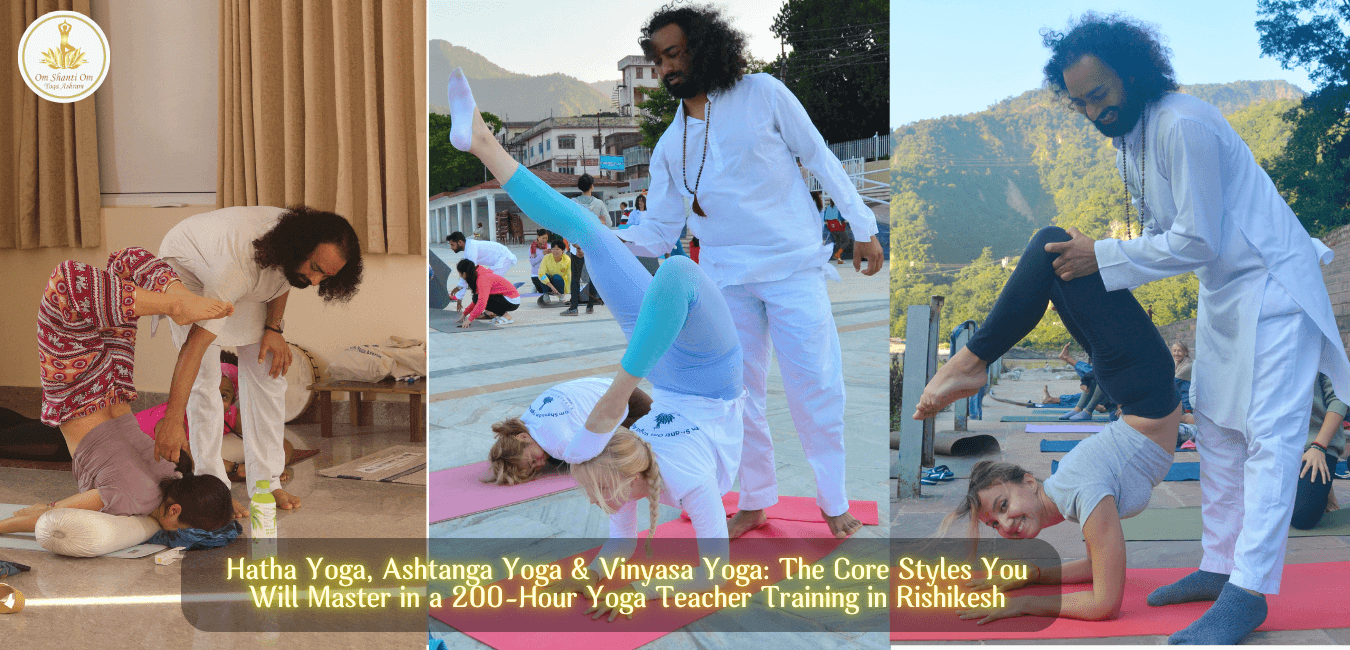
A 200-hour Yoga Teacher Training Course is more than just a certificate; it is the foundation of your entire yoga journey. Whether your goal is to become a professional Yoga teacher or deepen your personal Yoga practice, the training you choose shapes how confidently and creatively you will guide others. One of the biggest advantages of doing your Yoga Teacher Training in Rishikesh, the birthplace of yoga, is that most schools offer Multi-Style Yoga Teacher Training, rather than focusing on just one system.
This means you don’t graduate knowing only one sequence or one method. Instead, you learn the three pillars of modern yoga:
- Hatha Yoga — the root and foundation
- Ashtanga Vinyasa Yoga — the disciplined, structured system
- Vinyasa Flow Yoga — the creative, breath-led evolution
Mastering these three styles gives you versatility. You learn to teach beginners, advanced yoga practitioners, strong dynamic flows, and everything in between. Here we explore what you will learn in each style during your 200-hour Yoga TTC in Rishikesh, how each method supports your growth, and why this multi-style approach prepares you to teach with clarity, confidence, and purpose.
1. Hatha Yoga: The Root & Foundation of All Movement
‘Hatha’, in Sanskrit, means the union of ‘solar’ and ‘lunar’ energy and thus hatha yoga refers to a system of physical techniques. The origin of Hatha Yoga can be traced back to at least the 1st Century, as is evident from certain Hindu and Buddhist scripts. Contrary to the belief that Hatha yoga is merely a sophisticated physical exercise system, one must understand that it extends well beyond that. It integrates ideas of ethics, diet, cleansing, pranayama (breathing exercises), meditation and a system for the spiritual development of the yogi. Originally, Hatha Yoga has as many as 84,00,000 asanas mentioned in the classics of Yoga. The principal one is 84,000, but out of this, 8,400 are predominant. Among these, 84 are selected for special mention, while 32 are considered most important. However, only eight have been ranked as the most important and even among these, four are singled out for special mention and two of which are classed as outstanding. Finally, one is rated as superior to the other. This one is none BUT Lord Sankara himself- the originator of the system of Yoga, which is conversant with all the 84,00,000 asanas. However, either 108 or only 84 asanas are commonly in vogue.

What You Learn in Hatha During Your 200-Hour TTC
Alignment-Based Practice
Hatha Yoga is slower, steadier, and intentional. You do not simply move from posture to posture; you hold each asana long enough to understand:
- What muscles are working
- How the joints stack
- How the breath supports the pose
- How to modify the posture for different body types
- This is where you build the ability to see students’ bodies clearly, a crucial skill for any yoga teacher.
Strength Through Stillness
Hatha Yoga teaches the art of holding postures for 30–60 seconds. This builds:
- muscular endurance
- joint stability
- mental steadiness
- deeper body awareness
- mindful breathing
- Holding a Warrior pose for a full minute is not easy; it builds the inner discipline every yoga teacher needs.
- Understanding Classical Asanas
- You learn foundational poses such as:
- Tadasana (Mountain Pose)
- Trikonasana (Triangle Pose)
- Virabhadrasana Series (Warrior I, II, III)
- Paschimottanasana (Seated Forward Fold)
- Bhujangasana (Cobra Pose)
- Sarvangasana (Shoulder Stand)
- Sitting Postures / Meditative Postures
- Veerbadhrasana (Variation 1, 2)
- Twisting Postures
- Supta Udarakarshanasana
- Forward Bend Postures
- Yoga Mudhrasana
- Balancing Postures
- Eka Pada Pranamasana
- Relaxing Postures
- Makarasana
- Back Bend Postures
- Saral Dharunasana
- Each posture is studied in-depth, including adjustments, benefits, contraindications, and variations.
Pranayama & Cleansing Practices
A true Hatha Yoga curriculum includes:
- Kapalabhati
- Bhastrika
- Nadi Shodhana
- Sheetali & Sheetkari
- Anulom Vilom
- Plus foundational purification practices like Jala Neti. These methods help you understand the energetic system and prepare you for meditation.
Why Hatha Yoga Matters
Hatha builds the backbone of your Yoga TTC experience. Once you understand alignment, breath, and stability through Hatha Yoga, every other style becomes easier to learn and teach.

2. Ashtanga Vinyasa Yoga: Discipline, Structure & Inner Fire
Ashtanga Yoga is like a mirror; you practice the same sequence repeatedly, allowing you to observe your own progress and limitations with honesty. It is dynamic, powerful, and deeply transformative.
During your 200-hour Yoga Teacher Training Course, you study the Ashtanga Primary Series, also called Yoga Chikitsa, meaning “yoga therapy.” This system cleanses the body, strengthens the core, and purifies the nervous system.
The Tristhana Method: Breath, Bandhas & Drishti
Ashtanga Yoga has three pillars that make it unique:
a) Ujjayi breathing or “victorious breath: A yogic breathing technique that involves lightly constricting the back of the throat to create a soft, ocean-like sound on both the inhale and exhale. You learn how to maintain a steady, rhythmic, ocean-like breath that:
- warms the body
- helps with focus
- supports endurance
- guides movement
b) Bandha breathing: Core Energy Locks: A yogic breathing technique that uses muscular contractions to lock and redirect energy within the body, particularly by creating a vacuum in the abdomen and engaging the pelvic floor. You are taught to activate:
- Mula Bandha (root lock)
- Uddiyana Bandha (abdominal lock)
- Bandhas protect the spine, support transitions, and create lightness in jumps.
c) Drishti — Focused Gaze: “Drishti” is a Sanskrit word meaning “gaze” or “sight” that refers to several things, most commonly a yoga practice where practitioners focus their gaze on a specific point to improve concentration and balance. Every pose has a specific gaze point. This trains concentration and quiets mental distractions.
Led & Mysore-Style Ashtanga
During Yoga TTC, you learn Mysore-Style Ashtanga Yoga in two ways:
Led Classes:
The teacher counts each breath, guiding the entire group.
Mysore Style:
You practice at your own pace, under the silent supervision of the teacher. This method builds independence and deepens your connection with the sequence.
- Benefits of Ashtanga Training
- Strengthens the core
- Enhances stamina
- Builds mental discipline
- Develops rhythmic breath work
- Cultivates consistency
- Teaches precision in asana
Even if you don’t want to teach Ashtanga Yoga full-time, learning this Yoga style makes you a more focused and powerful yoga practitioner.

3. Vinyasa Yoga: Creativity, Flow & Intelligent Sequencing
If Hatha Yoga is the foundation and Ashtanga Yoga is the disciplined structure, then Vinyasa Yoga is the free-flowing river. It transforms breath and movement into a creative, intuitive expression.
Vinyasa Yoga is one of the most popular styles worldwide because it is dynamic, adaptable, and expressive. In your TTC, you learn how to design classes that are safe, intelligent, and enjoyable.
The Art of Sequencing
The heart of Vinyasa Yoga teaching is sequencing. You learn:
- How to plan a class
- How to warm up the right muscles
- How to build toward a peak pose
- How to cool down safely
- How to use counter poses
- How to structure a 60- or 90-minute class
- This training transforms you from a yoga practitioner into a yoga designer.
Creativity with Purpose
Vinyasa Yoga is not just about random movement. You explore how to:
- modify Sun Salutations
- create themed flows
- design strength-building routines
- guide deep stretches
- balance Yin Yoga-like slow movements with dynamic transitions
- You learn how to create a Yoga class that feels like a journey, not just a workout.
Teaching Skills You Gain
- Using voice and tone effectively
- Guiding clear transitions
- Offering hands-on or verbal adjustments
- Managing different levels in one class
- Creating a safe and intentional experience
- Vinyasa Yoga makes you a well-rounded teacher who can adapt to any environment — studios, retreats, online classes, or community sessions.
4. Beyond the Yoga Asanas: The Philosophy & Anatomy That Tie Everything Together
A 200-hour Yoga TTC is not only about physical practice. You also learn:
- Patanjali’s Yoga Sutras
- The Eight Limbs of Yoga
- Yamas & Niyamas
- Pranayama theory
- Chakras & Nadis
- Yoga ethics
- Functional anatomy
- Teaching methodology
These subjects help you understand why yoga works, not just how.
Why Rishikesh Is the Best Place to Learn These Three Styles
Rishikesh holds the title of “Yoga Capital of the World”, and it is because people here come to heighten their practice. This city is occupied with practitioners in all 12 months of the year, because of the serenity, there are many tourists which comes to this place. The yoga centre here is also providing accommodation facilities.
Rishikesh is known as the Yoga Capital of the World. Learning here gives you:
- traditional teaching
- disciplined practice
- a spiritual environment
- access to ancient yogic wisdom
- nature, rivers, and mountains for meditation
- authentic ashram settings
It is the perfect place to immerse yourself in the full depth of Hatha, Ashtanga, and Vinyasa yoga.
A Multi-Style Training Makes You a Complete Teacher
A 200-hour Yoga TTC that teaches Hatha Yoga, Ashtanga Yoga, and Vinyasa Yoga prepares you in a well-rounded way:
- Hatha Yoga builds your foundation
- Ashtanga Yoga strengthens your discipline
- Vinyasa Yoga develops your creativity
By learning all three, you gain the ability to teach beginners, intermediate practitioners, and mixed-level classes confidently. You learn structure, strength, flow, mindfulness, alignment, and philosophy in a balanced way.
A multi-style Yoga training makes you adaptable, versatile, and ready to grow as a practitioner and teacher.








0 Comments
No comments yet. Be the first to comment!