


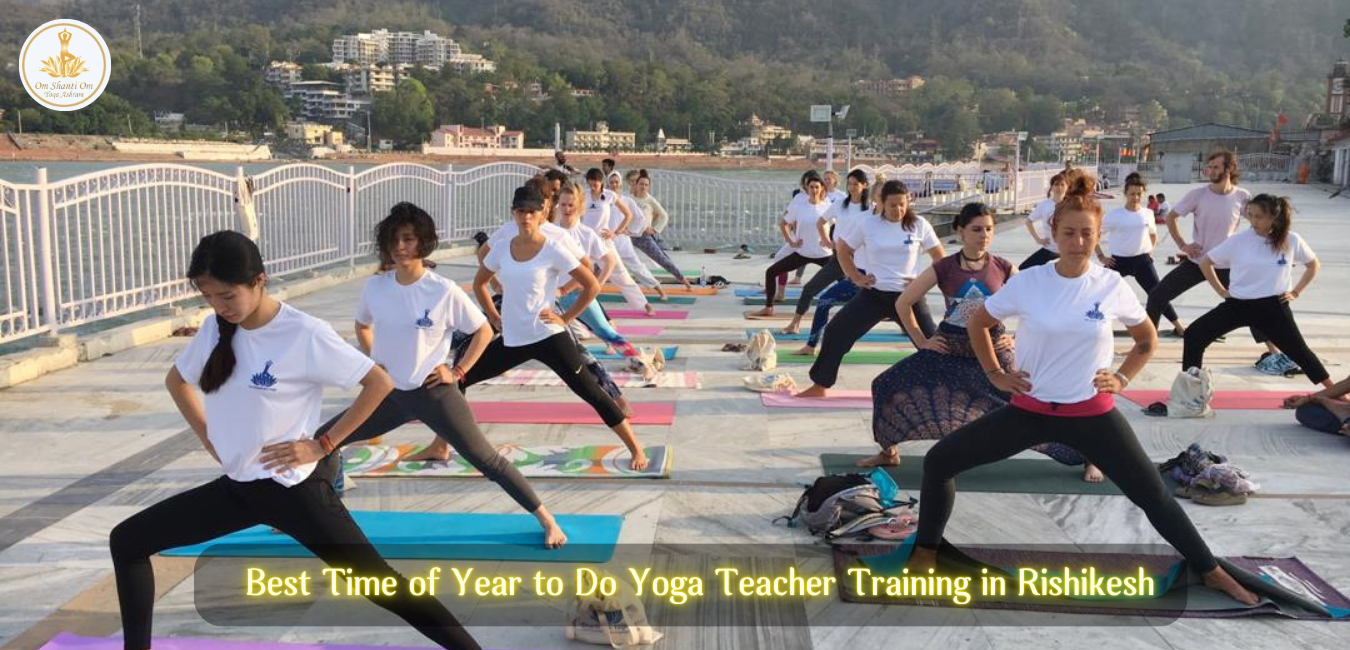
They spend weeks researching yoga schools, comparing curricula, reading reviews, and carefully choosing between a 200-hour and 300-hour programme. Then, when it comes to picking the actual month, they glance at their calendar, find a gap between work commitments, and book that.
Season as an afterthought.
What they don't realise — until they arrive — is that the time of year shapes their entire experience. The weather, the energy of the ashram, the size of the group, the local festivals happening around them, the price they pay, even the quality of their morning meditation on the banks of the Ganga — all of it shifts dramatically depending on when they show up.
At Om Shanti Om Yoga Ashram, we've been welcoming students from over 100 countries for more than 25 years. We run training programmes every single month. And over time, we've watched seasons turn ordinary students into transformed ones — and occasionally, we've watched students arrive in the wrong season for their temperament and spend the first week adjusting to something they hadn't anticipated.
This guide is written so you don't have to figure that out the hard way.
Rishikesh's Four Seasons at a Glance
Before we go deep, here's a quick reference:
| Season | Months | Temp Range | Crowds | Pricing | TTC Rating |
|---|---|---|---|---|---|
| Winter | Oct – Feb | 5–22°C | High | Higher | ⭐⭐⭐⭐⭐ |
| Spring / Pre-summer | Mar – May | 18–38°C | Moderate–High | Moderate | ⭐⭐⭐⭐ |
| Monsoon | Jun – Aug | 22–30°C | Low | Lowest | ⭐⭐⭐ |
| Post-monsoon / Autumn | Sep – Oct | 18–28°C | Low–Moderate | Moderate | ⭐⭐⭐⭐⭐ |
Now let's talk about what those numbers actually feel like on the ground.
Winter (October – February) — The Gold Standard
If you ask most long-term Rishikesh residents which months they'd recommend for a yoga teacher training, the majority will say October through February without much hesitation. There's a reason this window is considered the gold standard.
The weather is the first thing you notice. Crisp, clear mornings where the Himalayan peaks look close enough to touch. Cool air that makes your lungs feel sharp and awake. Temperatures range from about 5°C on the coldest January nights to a comfortable 22°C on sunny afternoons. It's the kind of climate that seems almost purpose-built for early rising, for long meditation sits, for walking the ghats of the Ganga as the mist lifts off the water.
For yoga practice specifically, cool weather is a significant advantage. You don't overheat during intensive asana sessions. Pranayama and breathwork, which are central to any quality TTC programme, feel more natural when the air is cool and clean. Meditation deepens more readily in stillness, and winter mornings in Rishikesh are extraordinarily still.
Beyond the weather, winter is when Rishikesh truly comes alive. The streets of Tapovan and Laxman Jhula fill with practitioners from around the world. The ashram community is at its most vibrant — evenings in the dining hall become genuine cultural exchanges, with students from Brazil, Germany, Japan, and Australia all sharing a table and a pot of chai. That community dimension is something many students say becomes as transformative as the yoga itself.
October and November are particularly sweet. The monsoon has just ended, the landscape is lush and green, the air has that freshly washed clarity, and the peak tourist rush hasn't quite arrived yet. It's arguably the best overall month combination in the entire year.
December and January, while wonderful, do come with one caveat: they can be genuinely cold, especially in the early mornings. Temperatures sometimes dip to 5–8°C before sunrise. For students arriving from tropical climates — Southeast Asia, parts of Africa, Central America — this can be a shock. Pack thermal layers, a good shawl, and warm socks. The cold doesn't last long once the sun rises, but those pre-dawn yoga sessions require some preparation.
February is another excellent choice. Temperatures begin to soften, the crowds are still present but beginning to ease, and the energy in Rishikesh is building toward March's International Yoga Festival.
Pricing note: Winter is peak season, and accommodation fills up quickly. If you're planning an October–February batch, book at least three to four months in advance. This is especially important if you want a private room or a specific batch date.
Best for: First-time visitors, students wanting the full spiritual atmosphere of Rishikesh, those undertaking longer 300-hour or 500-hour programmes, practitioners from warmer climates who enjoy cool weather.
Spring and Pre-Summer (March – May) — Warm, Vibrant, and Energetic
March in Rishikesh is electric.
In the first week of March, the International Yoga Festival takes place at Parmarth Niketan Ashram — one of the largest yoga gatherings in the world, drawing master teachers, healers, musicians, and practitioners from across the globe. If your TTC batch overlaps with this period, you're not just getting a teacher training. You're arriving into a city that is, for those few days, the yoga capital of the entire planet.
The weather in March is nearly perfect: warm enough to shed the winter layers, cool enough that you're never uncomfortable. Temperatures sit between 18°C and 25°C — ideal for outdoor yoga sessions, sunrise walks to the Ganga, and evening meditations under a clear sky. The Himalayas are often still snow-capped and sharply visible, making March one of the most photogenic months in Rishikesh.
April is a transition. Temperatures begin climbing — reaching 28–32°C by mid-month and sometimes touching 38°C in May. The early mornings and evenings remain beautiful and manageable, but the middle of the day becomes genuinely hot. Thankfully, a well-designed TTC schedule accounts for this: at Om Shanti Om, the most intensive physical sessions happen in the cooler morning hours, leaving afternoons for philosophy classes, anatomy, and self-study — all conducted comfortably indoors.
As April progresses into May, the casual tourist footfall drops significantly. The pilgrimage season to higher Himalayan temples begins, and Rishikesh takes on a more local, quieter character. For students who want the energy of spring without the peak-season crowds, a late April or May batch can be surprisingly good — you get attentive teachers, smaller group dynamics, and accommodation that's often more available and more affordable.
One thing to be aware of: if you're heat-sensitive, May in Rishikesh is demanding. The afternoon heat is real, and it can leave you feeling drained on days when you're already giving a great deal to your training. If this is a concern, March or early April are far more comfortable.
Best for: Students who thrive in warmth, those wanting to catch the International Yoga Festival, practitioners from cold climates who find winter temperatures too extreme, and budget-conscious students targeting April–May.
Monsoon (June – August) — Lush, Intense, and Surprisingly Rewarding
Let's be honest about the monsoon first.
It rains. A lot. Heavy, sustained, sometimes dramatic rainfall arrives with the monsoon in June and stays through August. The humidity climbs to 70–85%. The Ganga swells to an impressive, powerful volume. Some outdoor excursions get cancelled. Some days you'll step outside and wonder if you made the right call.
And then the clouds part, and you'll see the Himalayan foothills draped in a green so deep and saturated it looks almost surreal. Waterfalls appear on hillsides that were bare in winter. The air smells of rain and earth and something ancient. The ashram, quieter than it's ever been, feels like a secret place.
The monsoon is not for everyone. But for the right person, it might be the most profound season of all.
Here's what makes it work: the monsoon naturally turns you inward. When you can't walk to the ghats, when the rain is falling steadily outside, when the world has slowed down and quieted — you practice more deeply. Meditation becomes less something you do because it's on the schedule and more something you actually settle into. Philosophy discussions go longer. Students read more. The introspective dimension of yoga teacher training, which is sometimes glossed over in the busier seasons when there are rivers to swim in and temples to visit, comes fully to the foreground.
The ashram is quieter during monsoon than at any other time of year. Group sizes are smaller. Teachers have more time for individual attention. If you've ever felt slightly lost in a large group setting, monsoon season is when you get the most personalised experience.
Pricing is also at its lowest. Accommodation rates are more flexible, and some schools offer early-bird discounts on monsoon batches that make this the most affordable window of the year for a residential TTC.
Practical tip: Pack a quality waterproof bag for your books and electronics, a good rain jacket, and sandals that dry quickly. Accept in advance that some excursions will be replaced with indoor alternatives, and let that be part of the adventure rather than a disappointment.
Health note: The transition into and out of monsoon can bring mild digestive adjustments for some international students. Eat your meals at the ashram rather than experimenting with street food during these months, and carry probiotics if your stomach is sensitive.
Best for: Experienced practitioners, introverts, budget-focused students, those drawn to deep solitary practice, and anyone curious about Rishikesh's more contemplative, rain-soaked character.
Post-Monsoon and Autumn (September – October) — The Hidden Gem
This is the window most travellers overlook, and it's genuinely one of the best-kept secrets in Rishikesh.
By mid-September, the rains begin to ease. The air holds onto the freshness that the monsoon brought, but the relentless rainfall is largely done. Temperatures settle into a deeply comfortable 18–28°C range. And Rishikesh — having been quiet for three months — begins to wake up again, slowly and gently, before the full winter rush arrives.
October in particular is stunning. The mountains are washed clean by months of rain and look impossibly sharp against a deep blue sky. The Ganga is full and majestic — more powerful and beautiful than at any other point in the year. Everything is green. The light in the evenings has that particular quality of autumn light that feels golden and unhurried.
This is also festival season in India. Navratri — nine nights of devotional music, dance, and prayer — often falls in October. Diwali, the festival of lights, follows shortly after. Doing a yoga teacher training during Navratri or Diwali is genuinely unlike anything else. The ashram participates in the celebrations. The streets of Rishikesh are lit up. The energy is joyful and devotional at the same time — a perfect complement to the inward work of a TTC.
Crowds are building but haven't yet reached the peak-season intensity. This creates what we'd call the ideal balance: enough community energy to make evenings feel alive, but not so many people that you lose the feeling of being in a sacred, quiet place. Accommodation is still reasonably priced and relatively easy to book.
Students who chose this window — particularly October — consistently report that the combination of weather, natural beauty, manageable crowds, and festival atmosphere made it feel like the most perfectly timed version of the Rishikesh experience.
Best for: Anyone who wants a bit of everything — ideal weather, natural beauty at its peak, vibrant cultural experiences, and a community that's present but not overwhelming.
How to Choose Based on Your Personal Profile
If you still feel uncertain, use this simple guide:
You're a first-timer who wants the "full Rishikesh" experience → October, November, or February. Peak season delivers everything — the atmosphere, the community, the clear mountain views, the spiritual energy of a city fully alive.
You're on a tight budget → June or July monsoon batches. Accommodation is at its most affordable, and the quality of the teaching doesn't change with the season.
You're introverted and want deep, quiet practice → Monsoon season. Smaller groups, more one-on-one teacher time, and a natural invitation to go inward.
You love warmth and don't mind the heat → March or early April. The International Yoga Festival in early March is a remarkable experience for any yoga student.
You're heat-sensitive → October through January. Avoid May if high temperatures drain you.
You're doing a 300-hour or 500-hour programme → Winter is your window. The longer your commitment, the more important stable, comfortable weather becomes.
You want the best balance of everything → October. It's the closest thing to a universally ideal month that Rishikesh offers.
Practical Planning Tips for Every Season
Booking timeline: For peak-season batches (October–February), book three to four months ahead to secure your preferred accommodation and batch date. For monsoon batches, four to six weeks is usually sufficient.
Visa: India's tourist e-visa is processed online and typically takes three to five business days. Apply at least two weeks before travel, regardless of season. Ensure your passport has at least six months of validity remaining.
Packing by season:
- Winter: thermal base layers, a warm fleece or jacket, a wool shawl for evening meditation, warm socks
- Spring/Summer: light cotton or linen clothing, a sun hat, sunscreen for outdoor sessions
- Monsoon: waterproof bag, quick-dry sandals, rain jacket, a small umbrella, and a sense of humour about the rain
Getting to Om Shanti Om: Jolly Grant Airport in Dehradun is the closest airport, approximately 35 km from the ashram. We arrange complimentary pickup from Jolly Grant for all enrolled students — just share your arrival details when you book. Haridwar Railway Station is about 25 km away and is also well-connected to Delhi.
Health and adjustment: Your first few days in Rishikesh may involve adjusting to a new altitude (about 372 metres above sea level), a new time zone, a new diet, and an early-morning schedule. Give yourself grace for the first three to four days. The early wake-up time — usually 5:30 AM — catches most students off guard regardless of season. It becomes completely natural by the end of the first week.
Final Thoughts
There isn't a universally "best" month to do your yoga teacher training in Rishikesh. There's only the best month for you — for your budget, your temperament, your relationship with heat and cold, and what kind of experience you're hoping to have.
What we can say, after 25 years and more than 25,000 students, is this: every season in Rishikesh has given students something they didn't expect. Winter has given solitude-seekers the warmest communities they've ever been part of. Monsoon has given social butterflies the quiet they desperately needed. October has given people who thought they wanted an easy holiday the deepest inner transformation of their lives.
The Himalayas don't really care which month you arrive. They'll offer you something profound regardless.
If we had to recommend one window for someone with no other constraints, we'd say October or November. The weather is near-perfect, the landscape is at its most beautiful, the community is building, and the festivals make the cultural dimension of a Rishikesh TTC feel especially rich.
Start Your Yoga Journey
If you feel inspired to explore Ashtanga Yoga more deeply, you can join:
- 100 Hour Yoga Teacher Training
- 200 Hour Yoga Teacher Training
- 300 Hour Yoga Teacher Training
- 500 Hour Yoga Teacher Training
At Om Shanti Om Yoga Ashram in Rishikesh, you will experience yoga in its most authentic and traditional form.










0 Comments
No comments yet. Be the first to comment!