


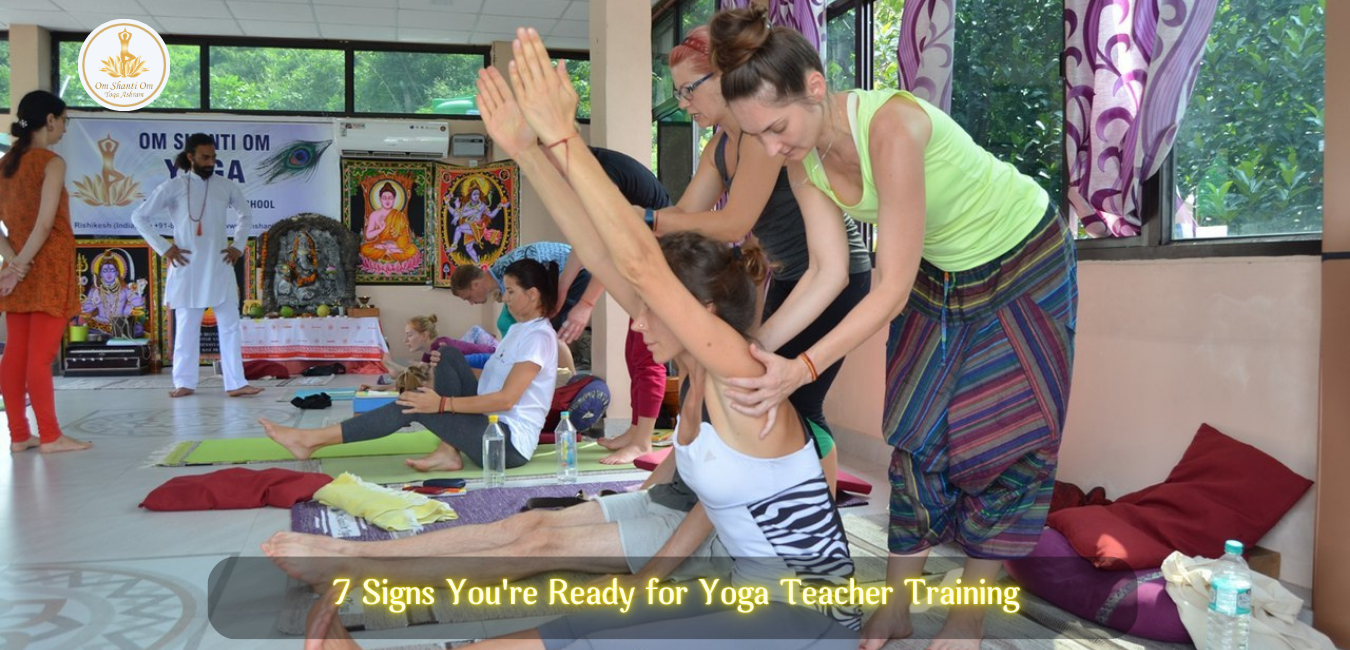
At some point in a yoga practitioner's life, a quiet thought appears. Maybe it surfaces after a particularly moving class. Maybe it comes during a long Savasana, or in the car ride home when you're still carrying the stillness of the practice with you.
Could I do this? Could I teach?
And then, almost immediately, the second-guessing begins.
I'm not advanced enough. I don't know enough philosophy. My Warrior II probably isn't even right. Real yoga teachers have been doing this for decades. Who am I to think I'm ready?
Here's the thing about readiness: most people who are genuinely ready for yoga teacher training don't feel ready. They feel curious, a little scared, and unsure of whether the timing is right. That uncertainty isn't a sign to wait — it's often a sign that something meaningful is calling you forward.
This blog isn't a checklist to pass or fail. It's a set of honest signals to reflect on — the kind that come from within, not from how many years you've been practising or how flexible your hamstrings are. Read through them with an open mind and see what resonates.
Sign #1: You Practice Yoga Consistently — Not Just Occasionally
There's a difference between loving yoga and having a yoga practice. Lots of people love yoga. They go when they can, enjoy it every time, and feel better for it. That's genuinely wonderful. But a yoga practice is something slightly different — it's a commitment that shows up even when it's inconvenient, even when you're tired, even when life gets busy.
If you've moved from "I go to yoga sometimes" to "yoga is a non-negotiable part of my week," that shift matters.
Consistency doesn't mean perfection. It doesn't mean practising every single day without exception. But it does mean that yoga has become woven into the rhythm of your life in a meaningful way — three to five times a week over a sustained period of months, not just during a phase when you had extra time.
Why does this matter for teacher training? Because a 200-hour YTT is intensive. You'll be doing yoga every day, studying late into the evening, and processing new information constantly. If your body and mind aren't already conditioned to showing up regularly, the early weeks of training can feel like a shock to the system. Consistency before training is less about proving your dedication and more about building the physical and mental stamina the training requires.
If yoga is already a steady presence in your life — something you return to without being told to — that's sign number one.
Sign #2: You're Curious About the "Why" Behind the Poses
There's a recognisable moment in a yoga practitioner's journey when the poses stop being the point.
Maybe a teacher mentioned the vagus nerve during a twist, and you spent the rest of class thinking about it. Maybe you heard a reference to the Yoga Sutras and found yourself Googling them on your phone before you'd even rolled up your mat. Maybe you started noticing how different breathing patterns change the way you feel in your body — and you wanted to understand why.
This shift — from doing yoga to understanding yoga — is one of the clearest signs of readiness for teacher training.
A 200-hour program covers far more than asana. It goes into anatomy, physiology, the nervous system, ancient philosophy, the history of the practice, meditation, pranayama, and the ethics of teaching. If you're only interested in the physical postures, you're likely to find large portions of the curriculum dry or frustrating. But if you've already found yourself reading about these things on your own, without anyone telling you to — that intellectual curiosity is exactly what training will reward.
Readiness for YTT isn't just physical. It's the mind leaning in.
Sign #3: You Feel a Pull to Share Yoga With Others
You don't have to want to be a full-time yoga teacher to be ready for teacher training. Many people who complete a 200-hour program never intend to teach professionally — they come for the depth of study, the personal transformation, or the community. And that's completely valid.
But there's a particular sign worth paying attention to: the feeling that yoga is something worth sharing.
Maybe you've found yourself suggesting yoga to a stressed friend and wishing you could actually guide them through it. Maybe you've caught yourself mentally cueing a classmate whose alignment you noticed. Maybe after particularly powerful classes, your first instinct is to tell someone, you need to experience this.
That impulse — the desire to pass something on, to create an experience for someone else the way a teacher once created it for you — is a meaningful signal. It doesn't have to be a crystal-clear vision of teaching packed classes in a studio. It can be quieter than that. A sense that what you've found on the mat is too good to keep to yourself.
If you feel that pull, however faint, it's worth listening to.
Sign #4: Yoga Has Moved You Through Something Real
This one is harder to quantify, but it might be the most important sign of all.
Has yoga carried you through something? A period of anxiety or depression. The grief of a loss. A health challenge, a relationship ending, a career upheaval. The slow, difficult work of learning to be at home in your own body after years of not being. A reconnection with yourself after a long time feeling disconnected.
If yoga has been more than exercise for you — if it has genuinely been a practice of healing, growth, or transformation — then you understand something about it that can't be taught from a textbook. You understand it from the inside.
That understanding becomes the foundation of authentic teaching. Students don't just need to be instructed in alignment. They need to feel that their teacher knows, on some level, what it is to need yoga. Not to be perfect at yoga — to need it.
The teachers who leave the deepest impressions are rarely the ones who are the most technically advanced. They're the ones who seem to genuinely get it. Who practices what they teach. Whose presence in a room communicates something beyond the words they use.
That kind of depth comes from lived experience. If you have it, it's a sign.
Sign #5: You're Ready to Be a Student Again
This one surprises people — especially practitioners who have been doing yoga for a long time.
Teacher training, whatever your current level of experience, will require you to set aside what you think you know and be genuinely teachable. That means accepting corrections without defensiveness. It means sitting without understanding something. It means being vulnerable in front of your cohort — teaching a pose you're not sure about, asking a question that feels basic, having your assumptions gently challenged.
In Zen Buddhism, there's a concept called shoshin — beginner's mind. The idea is that an open, eager, unprejudiced mind is capable of receiving far more than one that is already full of fixed conclusions. It's the reason beginners sometimes learn faster than experts: they're not working against their own certainty.
Teacher training asks every participant, regardless of experience level, to cultivate that quality. To approach the material as if you don't already know. To be curious rather than confident. To receive feedback as a gift rather than a criticism.
If you can honestly say that you're ready to be a student — to be humbled, stretched intellectually, and shaped by the process — that's a powerful sign of readiness. It requires a particular kind of maturity, and not everyone arrives there at the same time.
Sign #6: Your Life Can Realistically Support the Commitment
Passion is essential. But passion alone won't get you through a 200-hour teacher training. The logistics have to work too — and being honest with yourself about this before you enrol is a form of self-respect.
Time. A part-time YTT might run across six months of weekends. An intensive might require four weeks of full days. Either way, this is a significant chunk of your life dedicated to the program. Are you in a season where that's genuinely possible, or are you overcommitted in ways that would make training feel like one more pressure?
Finances. Programs typically range from $1,500 to $5,000 or more, depending on format, location, and prestige. That's a real investment. Going into training while stressed about money affects your ability to be present. Have you budgeted for this — or at least explored payment plans and financial options?
Energy. Emotional and mental bandwidth matter as much as physical stamina. If you're in a period of significant personal upheaval — navigating a difficult relationship, a major health issue, a high-stress career moment — adding an intensive training on top of that may serve you less well than it would in a calmer season.
Support. The people in your life will be affected by your commitment to training. Does your partner, family, or employer understand and support what you're taking on? Having people in your corner makes a measurable difference.
None of this is meant to talk you out of it. It's meant to help you choose a moment when you can actually show up fully — because the investment, in every sense, deserves that.
Sign #7: You Feel the Fear — And Want to Do It Anyway
Let's be honest: almost everyone who shows up to the first day of a 200-hour yoga teacher training is at least a little scared.
Scared of not being good enough. Scared of looking foolish in front of strangers. Scared of being exposed as someone who doesn't actually know what they're doing. Scared that they made a mistake signing up. Scared of what the training might ask of them — not just physically, but emotionally and personally.
That fear? It's almost universal. And it's not a sign that you're not ready. In fact, the complete absence of fear might be more worth questioning — it can sometimes signal that you're not taking the full weight of the commitment seriously.
There's a useful distinction between two kinds of fear. The first is protective fear — the kind that warns you away from something genuinely wrong for you, something unsafe or misaligned with your values. The second is growth fear — the kind that shows up precisely because something matters deeply, because the stakes are real. After all, you actually care about the outcome.
The nervousness most people feel about teacher training is growth fear. It's the feeling that lives right at the edge of your comfort zone, on the boundary between who you are now and who you're becoming.
Courage isn't the absence of that feeling. It's choosing to move forward while it's still present.
If you feel the fear and find yourself wanting to do it anyway — that's not a warning sign. That's one of the clearest signs there is.
A Bonus Note: Signs You Might Want to Wait
In the spirit of honesty, it's worth acknowledging that sometimes the timing genuinely isn't right — and recognising that is wisdom, not failure.
You might want to give it more time if:
- You're burned out or in crisis. A training will deepen whatever you bring into it. If you're depleted, it can deplete you further rather than restore you. Take care of yourself first.
- Your motivation is primarily external. If you're signing up because someone else thinks you should, or because it seems like a good thing to put on a resume, that motivation tends to fade fast when the work gets hard. The most sustaining motivation is internal — a genuine pull toward the practice and the growth.
- You haven't developed any personal relationship with yoga yet. If you've been to a handful of classes and found them interesting but haven't yet built a real practice, give yourself a few more months on the mat first. The training will mean far more once you have some lived experience to bring to it.
There's no shame in any of these. Timing matters. The right training at the wrong time is still the wrong time.
So — Are You Ready?
Look back at the seven signs. You don't need to check every single one perfectly. But if the majority of them resonated — if you found yourself nodding, or felt a little flutter of recognition in your chest — that's information worth sitting with.
No one ever feels one hundred per cent ready for something that genuinely matters. If you waited for complete certainty, you'd wait forever. The teachers who eventually stand at the front of a room and change someone's life — sometimes without knowing it — weren't the ones who had everything figured out. They were the ones who decided to begin.
If something in you is stirring, pay attention to it. Research programs. Attend open days. Talk to teachers you respect. Let the idea breathe.
The mat will meet you where you are. It always does.
Start Your Yoga Journey
If you feel inspired to explore Ashtanga Yoga more deeply, you can join:
- 100 Hour Yoga Teacher Training
- 200 Hour Yoga Teacher Training
- 300 Hour Yoga Teacher Training
- 500 Hour Yoga Teacher Training
At Om Shanti Om Yoga Ashram in Rishikesh, you will experience yoga in its most authentic and traditional form.












0 Comments
No comments yet. Be the first to comment!